
One Voice, One Arena, One Moment Frozen in Time: When Roy Orbison Sang the National Anthem His Own Way
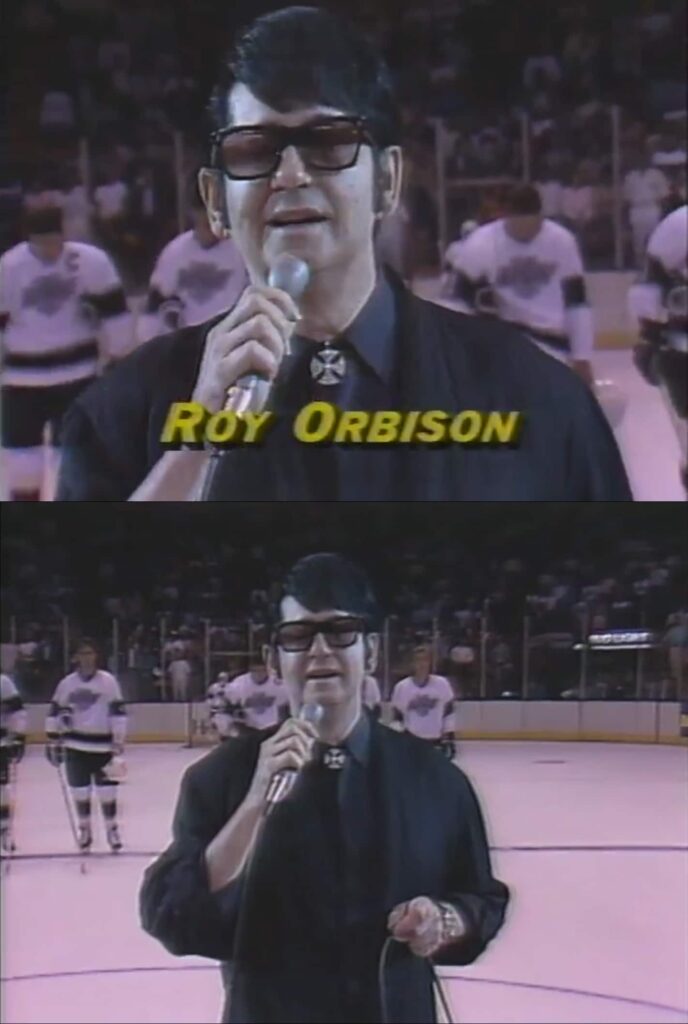
On October 6, 1988, before the opening game of the Los Angeles Kings season in Los Angeles, Roy Orbison stepped onto the ice to perform “The Star-Spangled Banner.” What could have been a routine ceremonial appearance quickly became something far more memorable.
From the opening line, it was unmistakably Orbison. The same soaring control that had defined classics like “Crying” and “Only the Lonely” was now being applied to The Star-Spangled Banner. Yet he approached the anthem without theatrical excess. There were no dramatic pauses or showman gestures. Instead, he relied on tone, phrasing, and emotional gravity.
The arena atmosphere plays an important role in the performance’s impact. Hockey arenas are not traditionally places of stillness. But as Orbison sang, the noise seemed to recede. Players stood motionless along the blue lines, the audience attentive rather than restless. His voice filled the space not with force, but with presence.
What makes this rendition particularly striking is its vulnerability. Orbison does not attempt to overpower the anthem. He humanizes it. The famous lines arrive with a sense of reflection rather than triumphalism, giving the performance an unusual emotional texture. The melody feels less ceremonial and more personal, almost as if he is rediscovering the words while singing them.
By late 1988, Orbison was experiencing a remarkable career resurgence. His involvement with The Traveling Wilburys and renewed public interest had reintroduced him to a new generation. Yet there was also an unspoken poignancy to this moment. Just weeks later, he would pass away unexpectedly in December of that same year.
Looking back now, the performance carries an emotional weight no audience in the arena could have fully understood at the time. It captures Orbison in one of his final public appearances, still commanding attention through nothing more than the sound of his voice.
And perhaps that is why this rendition endures. Because beyond the anthem itself, it preserves something increasingly rare: a moment when dignity, humility, and pure vocal expression came together in front of thousands of people, and for a brief minute and a half, the entire arena simply listened.