
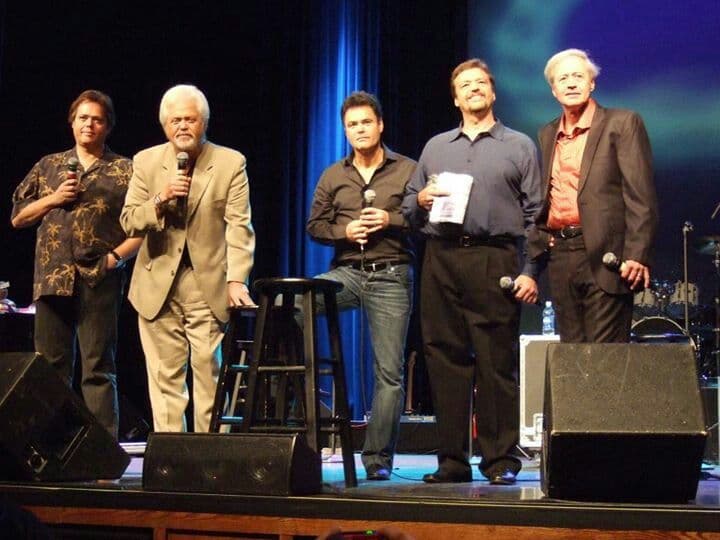
A Reunion Performance That Carried the Weight of Brotherhood, Memory, and Time
When The Osmonds stood together once again to perform “He Ain’t Heavy, He’s My Brother” during the 50th Anniversary Reunion Concert, it felt less like a concert moment and more like a lifetime unfolding in front of the audience. Some songs entertain for a few minutes. Others seem to gather decades of love, struggle, family loyalty, and shared history into a single performance. This was one of those moments.
Originally written by Bobby Scott and Bob Russell, “He Ain’t Heavy, He’s My Brother” first became a major international hit for The Hollies in 1969, reaching No. 3 on the UK Singles Chart and later becoming one of the defining ballads of its era. Over the decades, many artists recorded it, but when The Osmonds chose the song for their reunion celebration, it gained an entirely different emotional dimension. It no longer sounded like simply a song about compassion or brotherhood in the abstract. It sounded deeply personal.
By the time of the reunion concert, audiences already knew the long and complicated journey of the Osmond family. From the clean-cut phenomenon of the early 1970s—with screaming fans, gold records, and television fame—to the financial hardships, health battles, and changing music industry that followed, The Osmonds had experienced nearly every possible rise and fall together. That history quietly echoed behind every line they sang.
And perhaps that is why the performance resonated so strongly.
The title itself—“He Ain’t Heavy, He’s My Brother”—has always carried a simple but profound message: true love does not measure burdens. But hearing it sung by brothers who had literally spent a lifetime carrying one another through fame, exhaustion, expectations, disappointments, and personal trials gave the lyrics extraordinary authenticity. There was no need for dramatic staging or elaborate production. The emotional truth was already there.
What made the performance especially moving was the visible passage of time. Audiences who once watched the Osmonds as energetic young stars in matching outfits now saw older men standing together with decades written across their faces and voices. Yet instead of weakening the song, age deepened it. The slight wear in the vocals, the gentleness in their expressions, the calm sincerity in their delivery—all of it transformed the performance into something reflective and human.
For many longtime listeners, the reunion concert awakened memories far beyond music itself. The Osmonds were not simply another pop group from the 1970s. They represented family-centered entertainment during an era when television variety shows still gathered households together in the evening. Songs by The Osmonds often carried optimism, warmth, and emotional accessibility that connected naturally with audiences around the world. In retrospect, their enduring appeal was never only about chart success or teen-idol popularity. It was about emotional familiarity.
That is partly why this reunion performance struck such a powerful chord.
Unlike some anniversary concerts that feel overly polished or nostalgic in a commercial sense, this performance carried emotional honesty. There was an unspoken understanding that the audience was not only revisiting songs—they were revisiting pieces of their own lives. Music from youth has a unique ability to preserve emotions long after specific moments fade. A song heard decades later can suddenly reopen entire chapters of memory: old friendships, family gatherings, first loves, quiet evenings, difficult years survived.
In this context, “He Ain’t Heavy, He’s My Brother” became more than a cover song. It became a statement about endurance.
The story behind the song itself adds another layer of meaning. Lyricist Bob Russell was seriously ill while working on the words, and many have interpreted the song as reflecting compassion, sacrifice, and human connection in the face of suffering. Those themes aligned naturally with the Osmonds’ own story. Few groups remained together emotionally for as long as they did despite the pressures of fame. The performance subtly honored not only brotherhood within the family, but also loyalty between performers and audiences who had stayed connected across generations.
Musically, the arrangement during the reunion leaned into restraint rather than grandeur. That choice mattered. Instead of trying to modernize the song or overpower it with production, the performance allowed the lyrics and emotional weight to remain central. The harmonies—always one of the Osmonds’ greatest strengths—still carried warmth and familiarity, even softened by time.