
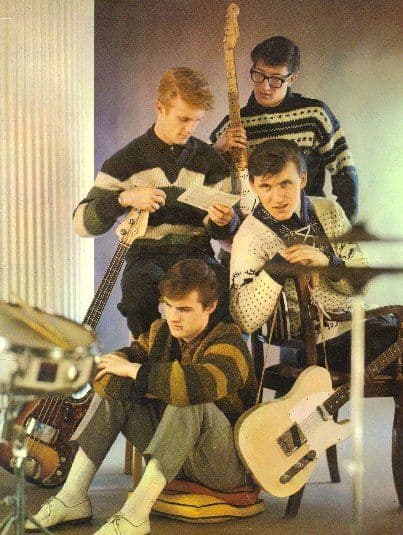
A Guitar Instrumental That Rode Across the World Like a Dusty Western Dream
Long before music videos, digital effects, or stadium-sized rock spectacles, one instrumental recording managed to paint entire landscapes inside the listener’s imagination. “Apache” by The Shadows was not just a hit record — it became a mood, a memory, and for many listeners, the sound of a changing era where British popular music was beginning to find its own confident voice.
Released in 1960, “Apache” quickly climbed to No. 1 on the UK Singles Chart, where it remained for five consecutive weeks. In many ways, it announced the arrival of The Shadows as far more than simply the backing group for Cliff Richard. They suddenly stood on their own, carrying a sound so atmospheric and distinctive that it felt almost cinematic. Across Europe and beyond, the record became a sensation, influencing generations of guitar players who would later define rock music itself.
What made “Apache” so unforgettable was its ability to tell a story without a single lyric. From the opening notes played by Hank Marvin, the listener is transported into a vast emotional landscape — lonely deserts, galloping horses, distant horizons, and the bittersweet romance of old Western films. The melody was haunting yet gentle, adventurous yet strangely melancholic. It carried the spirit of frontier mythology, but beneath the surface there was also a deep sense of longing and solitude.
The story behind the song is just as fascinating as the recording itself. The piece was originally written by English songwriter Jerry Lordan, who reportedly became inspired after watching the 1954 Western film Apache, starring Burt Lancaster. Lordan imagined music that could capture the dignity and tragedy often associated with Native American imagery in classic cinema. Before The Shadows recorded it, the song had actually been offered to guitarist Bert Weedon, whose version failed to gain major attention.
Everything changed once The Shadows touched it.
Producer Norrie Paramor helped shape the clean, spacious recording style, but the emotional heart of the track came from Hank Marvin’s now-legendary guitar tone. Using a Fender Stratocaster, Marvin created a sound that felt revolutionary in Britain at the time — echoing, smooth, melodic, and emotionally expressive without becoming flashy. It was one of the earliest moments where the electric guitar truly became the “voice” of a song rather than merely part of the rhythm section.
For countless young musicians in the early 1960s, hearing “Apache” was a life-changing experience. Many future artists — including members of The Beatles, Pink Floyd, and later generations of rock guitarists — spoke about the enormous influence of The Shadows. In Britain especially, before the rise of the Merseybeat explosion, The Shadows represented sophistication, precision, and modernity. Their matching suits, synchronized stage movements, and polished musicianship created an image that felt elegant yet accessible.
But perhaps the enduring power of “Apache” lies not in its technical brilliance, but in its emotional ambiguity. Instrumentals often leave room for listeners to project their own memories onto the music, and this song became exactly that kind of companion. For some, it recalls childhood living rooms with the radio softly glowing in the corner. For others, it evokes dance halls, first romances, long drives, or evenings when the future still felt wide open and mysterious.
There is also something deeply nostalgic about the era from which it emerged. The early 1960s stood at the threshold between innocence and transformation. Popular music was beginning to evolve rapidly, but songs like “Apache” still carried traces of the gentler post-war world — melodic craftsmanship, patience, atmosphere, and emotional restraint. Unlike many later guitar showcases, this recording never demanded attention through speed or aggression. Instead, it invited listeners inward.
Over the decades, “Apache” has lived many different lives. It became a foundational influence in surf rock, instrumental pop, and even early hip-hop culture. Remarkably, the drum break from the 1973 version recorded by The Incredible Bongo Band would later become one of the most sampled rhythms in hip-hop history. Yet even with all those reinterpretations, many listeners still return to the original Shadows recording because of its quiet emotional purity.
Listening to “Apache” today feels a little like opening an old photograph album. The sound is elegant, restrained, and unmistakably human. There are no digital tricks hiding inside it — only melody, atmosphere, and musicians who understood that sometimes the spaces between notes can speak louder than words themselves.
And perhaps that is why the song has never truly faded away.
Because some melodies do not belong to a single decade. They travel through time like distant echoes, carrying pieces of memory with them. And somewhere inside those shimmering guitar notes of The Shadows’ “Apache,” there is still the sound of open roads, fading sunsets, and a world many people remember with great affection.