
When a Country Traditionalist Took on One of Rock & Roll’s Most Untouchable Classics
SINGING A ROY ORBISON CLASSIC IS RISKY. SINGING “OH, PRETTY WOMAN” MIGHT BE THE BIGGEST RISK OF ALL.
There are hit songs, and then there are songs so closely connected to a single artist that they almost become impossible to separate from the voice that created them. “Oh, Pretty Woman” belongs in that rare category. More than sixty years after its release, the opening words still instantly summon the image of Roy Orbison, one of the most distinctive voices ever to emerge from American music.
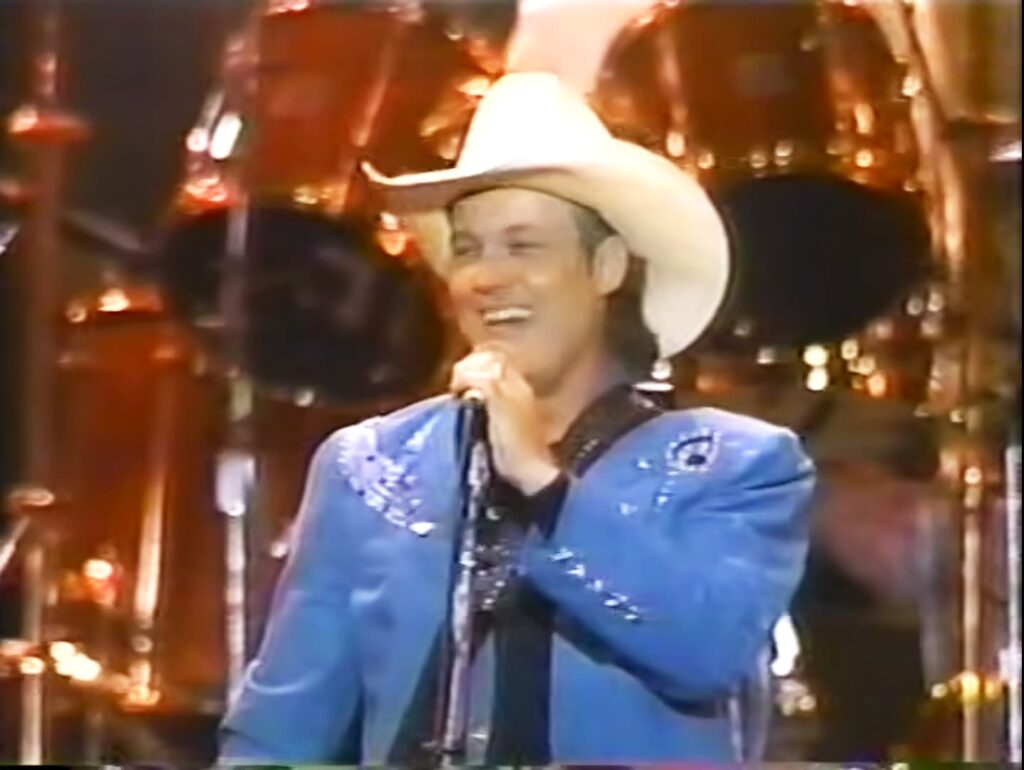
That is precisely what makes Ricky Van Shelton’s performance so fascinating.
Rather than choosing a safer standard or a familiar country favorite, Shelton stepped into territory many singers would have avoided altogether. Taking on “Oh, Pretty Woman” meant entering the shadow of a legend whose influence stretched far beyond rock and roll. It was a challenge that carried enormous expectations before a single note had even been sung.
What makes the performance memorable is that Shelton never attempts to imitate Orbison.
That would have been the easy mistake.
Instead, he approaches the song as a country artist. Where Orbison’s original recording was dramatic, soaring, and almost operatic in its emotional intensity, Shelton brings a warmer Nashville sensibility. His voice leans toward storytelling rather than theatrical grandeur. The result is not a copy of a classic recording but a reinterpretation that reveals different shades within a song many listeners thought they already knew by heart.
In Shelton’s hands, “Oh, Pretty Woman” feels surprisingly at home in the world of traditional country music.
That transformation says something important about the song itself.
Although remembered for its unforgettable guitar riff and rock and roll energy, the heart of the lyric is remarkably simple. It tells the story of a lonely man who believes his chance has passed him by, only to discover, in the final moments, that hope is still walking toward him. Beneath the swagger and excitement lies a timeless emotional truth. That is one reason the song continues to resonate generation after generation.
For many listeners, the performance also feels like a tribute.
Artists from Shelton’s generation grew up during the years when Orbison’s recordings dominated radio. Long before Shelton became one of country music’s biggest stars, Orbison had already established himself as a towering influence whose songs crossed musical boundaries. While often celebrated as a rock and roll pioneer, Orbison’s storytelling instincts, emotional vulnerability, and powerful vocal phrasing left a lasting imprint on countless country performers as well.
Listening to Shelton sing the song, it becomes clear that Roy Orbison remains the invisible presence throughout the performance. He never appears on stage, yet his influence can be felt in every verse.
The timing of the performance adds another layer of significance. During the late 1980s and early 1990s, Ricky Van Shelton stood among the most successful voices in country music. With a string of chart-topping hits and a reputation for honest, heartfelt performances, he represented a style of country that valued authenticity over spectacle. His greatest strength was never flashy showmanship. It was his ability to make listeners believe every word he sang.
That quality serves this song beautifully.
Looking back today, the performance captures a moment when country music and rock and roll still openly celebrated their shared roots. It recalls an era when artists proudly honored the musicians who came before them and when great songs were expected to live beyond a single generation.
Perhaps that is the most enduring lesson of this performance.
The real story is not whether Shelton could sing “Oh, Pretty Woman” as well as Orbison. No artist could truly replace the original.
The story is that a gifted country singer respected the song enough to make it his own while never forgetting where it came from.
For a few unforgettable minutes, two musical worlds met in the same melody. One belonged to Roy Orbison, the man who created the classic. The other belonged to Ricky Van Shelton, the country star who carried it somewhere new.
And somewhere between those two voices, the song found another life.