
She Wasn’t a Superstar Yet. Two Years Before “Nick of Time” Changed Everything, Bonnie Raitt Sang a Song So Quietly Heartbreaking That It Still Lingers Nearly Four Decades Later.
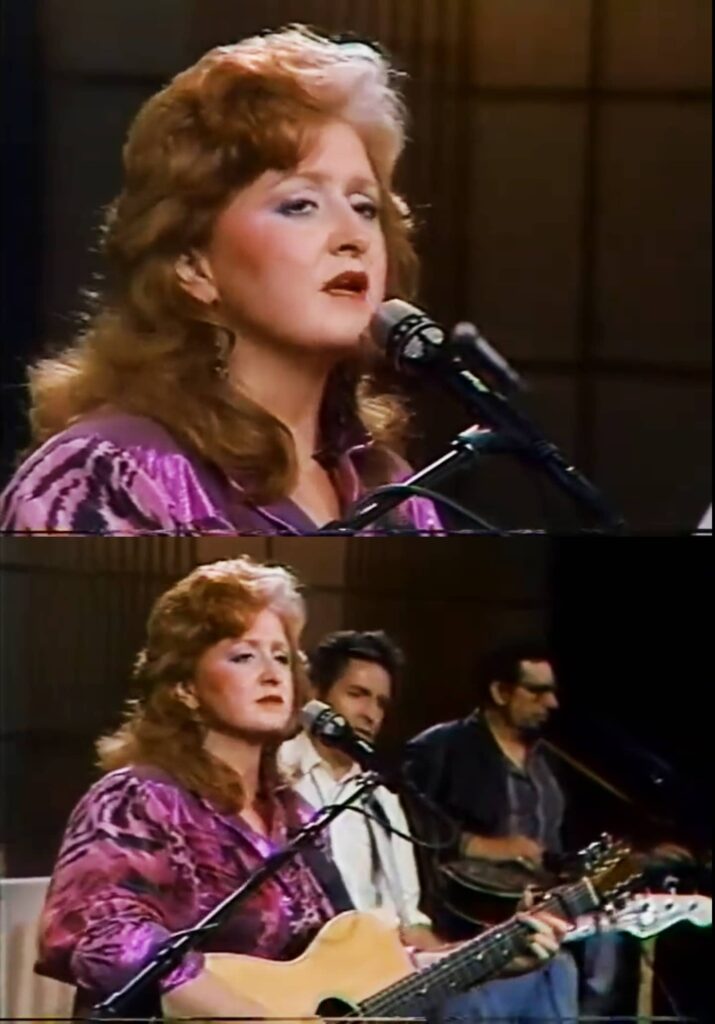
On February 27, 1987, Bonnie Raitt appeared on The Arlo Guthrie Show in Austin, Texas, and delivered a performance that now feels like a remarkable snapshot of a career standing on the edge of transformation.
The song was “Louise.”
Written by the highly respected but commercially overlooked songwriter Paul Siebel, it has long been regarded by fellow musicians as one of the finest compositions in the folk-country tradition. While Siebel never became a household name, artists such as Emmylou Harris, Linda Ronstadt, and Bonnie Raitt continued returning to his songs year after year.
That alone says something extraordinary about the quality of his writing.
Many songwriters have successful careers.
Only a handful create songs that other great artists never stop singing.
“Louise” is one of those songs.
What makes the song so devastating is its restraint. There is no dramatic tragedy. No shocking twist. No grand emotional outburst. Instead, Siebel paints a portrait of a woman whose dreams have slowly faded with time. Louise becomes less a specific person than a symbol of loneliness, lost youth, and the quiet disappointments that life sometimes leaves behind.
That subtle sadness is precisely what gives the song its lasting power.
The pain arrives gradually.
And stays long after the music ends.
Watching Bonnie perform it in 1987 adds another layer of meaning. At that point, she was already deeply respected by musicians and critics, but the massive commercial breakthrough of Nick of Time was still two years away. The Grammy Awards, the platinum records, and the widespread recognition that would redefine her career had not yet arrived.
Looking back now, the performance feels almost like a glimpse into the calm before a storm.
The talent was already there.
The voice was already unmistakable.
The world simply had not fully caught up yet.
Accompanied by David Bromberg on dobro and Johnny Lee Schell, Raitt performs with remarkable simplicity. No one on stage tries to dominate the spotlight. Every instrument serves the song. Every note supports the story.
It is a perfect example of the Americana tradition at its finest, where musicians understand that the song itself is always the most important person in the room.
What makes Bonnie’s interpretation particularly memorable is her empathy.
She does not sing “Louise” as though she is narrating someone else’s story. She sings as if she has known Louise for years.
Her voice, already carrying that distinctive blend of warmth, weariness, and compassion, gives the character a human presence that feels startlingly real. By the end of the performance, listeners often forget they are hearing a fictional character at all.
They begin to imagine Louise as someone they once knew.
Or perhaps someone they still remember.
There is also something deeply nostalgic about the setting itself. This was public television in the 1980s. No giant video screens. No elaborate lighting rigs. No carefully choreographed production designed for social media clips.
Just a singer.
A few acoustic instruments.
And a song.
Yet nearly forty years later, people continue seeking out this performance.
That endurance speaks to a larger truth about music. Technology changes. Trends come and go. Entire genres rise and fall.
But a great song performed with honesty never really disappears.
Perhaps that is why “Louise” continues to fascinate listeners decades after it was written. It reminds us that life’s deepest sorrows are not always dramatic. Sometimes they arrive quietly, carried by passing years and unfulfilled hopes.
And in Bonnie Raitt’s hands, those quiet sorrows become impossible to forget.
Long before the Grammy Awards and the commercial triumphs, she already possessed the gift that would define her career: the ability to make a listener believe every word.
For a song like “Louise,” there may be no greater gift than that.