
One Year Before Hurricane Katrina, Fats Domino Sat at a Piano in New Orleans and Gave the City Back Its Own Sound
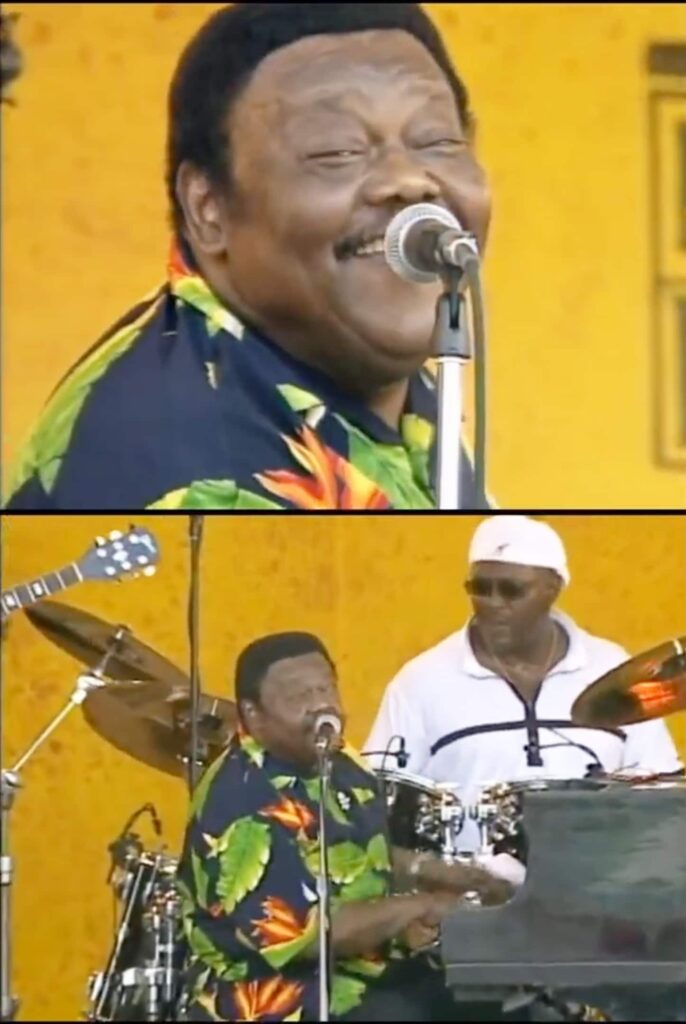
In the spring of 2004, Fats Domino took the stage at the New Orleans Jazz & Heritage Festival and performed “My Girl Josephine.” On paper, it was just another festival appearance by a beloved music legend. Looking back today, it feels like something much larger.
It feels like a homecoming.
At 76 years old, Domino was no longer the young rhythm and blues sensation who had helped transform American popular music in the 1950s. He was already a living monument to an era that had reshaped the cultural landscape. Yet as he sat behind the piano in his hometown of New Orleans, there was nothing grand or theatrical about the performance.
He simply smiled.
He played.
He sang.
And the crowd loved every second of it.
What makes this performance especially fascinating is that “My Girl Josephine” was not one of Domino’s biggest crossover hits. It never achieved the iconic status of “Blueberry Hill” or “Ain’t That a Shame.” Yet in many ways, it may have been the perfect song for this occasion.
The tune was closely associated with Dave Bartholomew, Domino’s longtime collaborator and one of the architects of the New Orleans rhythm and blues sound. Together, the two men helped create a style that blended boogie-woogie piano, rolling rhythms, and the unmistakable spirit of Louisiana street culture.
Listening to “My Girl Josephine” at Jazz Fest, it becomes clear that this was more than a song.
It was New Orleans itself.
The relaxed groove, the joyful piano, and the effortless swing all carried the musical DNA of the city that gave birth to so much of America’s popular music. Domino was not merely performing for his hometown. He was performing the soundtrack of its identity.
That is what made the scene so powerful.
Many performers rely on spectacle to command an audience. Fats Domino never needed to. By 2004, he had nothing left to prove. He did not race across the stage. He did not chase applause. He simply sat at the piano and allowed decades of history to speak through the music.
The audience understood exactly who they were watching.
This was one of the pioneers of rock and roll, a man whose records had sold millions during the 1950s and whose influence stretched across generations of musicians. While names like Elvis Presley, Chuck Berry, and Little Richard often dominate discussions about the birth of rock music, many historians argue that Domino’s contribution has never received the full recognition it deserves.
His influence was enormous.
His personality was humble.
The combination made him one of the most beloved figures in American music.
What gives the performance an even deeper emotional resonance today is what happened next.
The concert took place in 2004.
Just one year later, Hurricane Katrina would devastate New Orleans and forever alter the city. In the chaotic days following the disaster, reports circulated that Fats Domino was missing. Fans across America feared the worst. Fortunately, he was eventually found safe, but the episode reminded the world how closely his story was intertwined with that of New Orleans itself.
Seen through that lens, the 2004 performance becomes something almost cinematic.
The city is still intact.
The festival grounds are alive with celebration.
The legendary musician is still comfortably seated behind his piano.
No one in the crowd knows how much is about to change.
Today, the footage stands as more than a concert recording. It captures one of the final years when both Fats Domino and the New Orleans he had spent a lifetime representing remained largely untouched by the events that would soon redefine them.
That is why this performance endures.
Not because of the song alone.
But because it preserves a fleeting moment when a rock and roll pioneer returned home, sat down at a piano, and reminded an entire city of the music it had given to the world.