
Two Years Before the World Said Goodbye, John Prine Was Still Making People Laugh With a Song About a Snowman
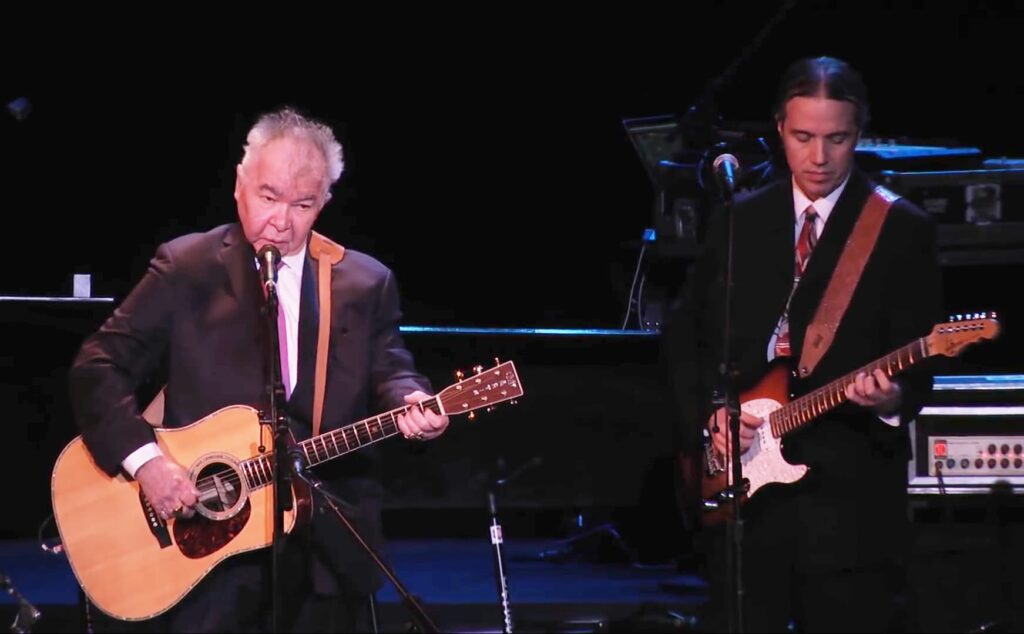
On January 20, 2018, John Prine walked onto the stage carrying the same qualities that had defined him for nearly half a century: humility, curiosity, wit, and an uncanny ability to find wisdom in places where nobody else thought to look.
That evening, he chose to perform “Humidity Built the Snowman,” a delightfully eccentric song from his 1995 album Lost Dogs and Mixed Blessings.
Even the title sounds like a joke.
A snowman built by humidity?
It is exactly the sort of idea that only John Prine could turn into a memorable song.
And perhaps that is why this performance feels even more meaningful today.
By 2018, Prine was already a living legend. He had survived cancer twice. The illnesses and treatments had permanently altered the smooth voice that first captivated audiences in the early 1970s. The youthful sound was gone, replaced by a weathered voice that carried every mile, every hardship, and every triumph of a remarkable life.
Yet what remained untouched was the spirit behind the voice.
Many artists become increasingly serious as they grow older. Their songs turn toward legacy, reflection, and the weight of passing years.
Prine certainly understood those themes.
But he never allowed wisdom to crowd out wonder.
Instead, at seventy-one years old, he sat before an audience and sang about a snowman.
That choice reveals something essential about who he was.
Throughout his career, John Prine possessed a rare gift for finding profound truths inside seemingly ordinary or absurd ideas. He could write about old people sitting on a park bench, a mailman, a forgotten veteran, or a bowl of soup and somehow uncover emotions that felt universal.
“Humidity Built the Snowman” belongs to that tradition.
On the surface, it is playful and whimsical. Beneath the humor lies a familiar Prine theme: the fragile, temporary nature of life itself. Like a snowman destined to melt, everything eventually changes. Yet Prine never treats that reality with despair. Instead, he approaches it with a smile, a shrug, and a gentle appreciation for the beauty that exists while it lasts.
That outlook is part of what made him one of America’s most beloved songwriters.
Watching the performance today adds another layer of emotion.
The audience gathered that January night could not have known what lay ahead. They could not know that just over two years later, the music world would lose John Prine in 2020. They could not know they were witnessing one of the final chapters of a career that had influenced generations of songwriters and storytellers.
To them, it was simply another evening with John.
Another song.
Another laugh.
Another story.
Looking back now, those ordinary moments feel extraordinary.
The performance captures Prine in a state that longtime admirers will immediately recognize. He is relaxed. He is funny. He is completely at ease. There is no attempt to present himself as an icon or a monument. Despite decades of acclaim, he remains the same curious observer who once worked as a mailman in Chicago and wrote songs because he saw poetry in everyday life.
The greatest surprise may be that a song with such a ridiculous title carries so much emotional weight.
That was always Prine’s magic.
He could sneak profound ideas past listeners disguised as jokes.
He could make people laugh before quietly breaking their hearts.
And he could remind them that life’s deepest truths often arrive wearing the clothes of a punchline.
The most moving detail of all is not the stage, the album, or even the song itself.
It is the realization that two years before the world lost him, John Prine was still doing exactly what he had always done: making audiences smile, think, and marvel at life’s strange little mysteries.
In an increasingly serious world, he remained wonderfully, stubbornly playful.
And that may be the most beautiful part of his legacy.
A man who endured illness, fame, loss, and time itself never stopped believing that wisdom and laughter belonged together.