
He Could Have Sung One Of His Hits. Instead, Dwight Yoakam Chose A Song That Honored Every Parent Who Sacrificed For Their Children
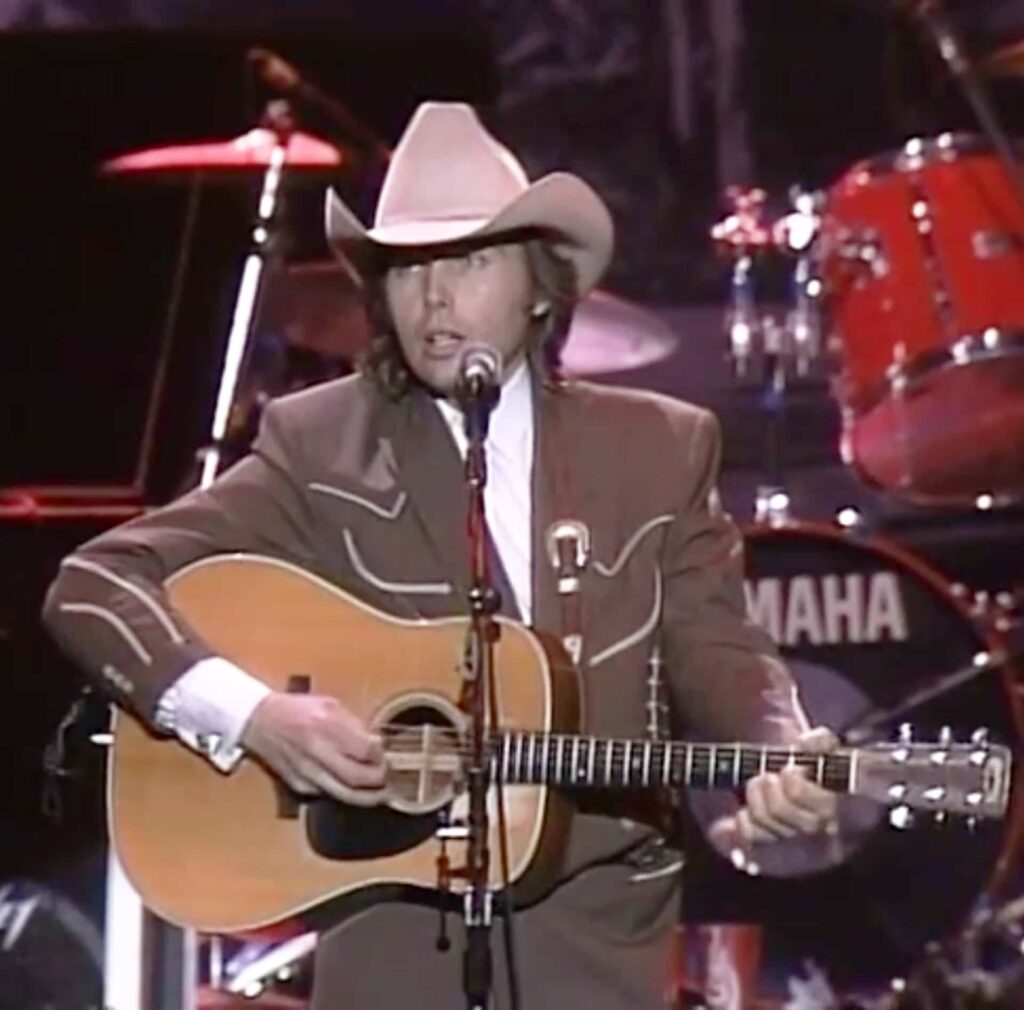
On April 7, 1990, Dwight Yoakam stepped onto the stage at Farm Aid in Indianapolis surrounded by some of the biggest names in American music. At the time, he was already one of country music’s hottest stars, with a string of hit records and a growing reputation as the artist who had helped bring traditional honky-tonk back into the mainstream.
He could have opened with one of his own chart-topping songs.
Instead, he chose “Hungry Eyes.”
Before beginning, Yoakam told the crowd that rather than doing the talking himself, he would let a Merle Haggard song speak for him. It was a simple introduction, but it revealed exactly why the performance remains so memorable more than three decades later.
Written and recorded by Merle Haggard in 1969, “Hungry Eyes” is one of the most deeply personal songs in country music history. Inspired by Haggard’s own childhood, it tells the story of a poor family living in a California labor camp during the years following the Great Depression. Through the eyes of a son, the song remembers a father who worked tirelessly and a mother whose quiet sacrifices left an unforgettable mark on her children.
At Farm Aid, the song carried even greater significance.
The annual concert, founded by Willie Nelson, Neil Young, and John Mellencamp, was created to support struggling family farmers across America. Many in the audience either came from farming communities or understood firsthand the challenges of making a living from the land. Against that backdrop, the lyrics of “Hungry Eyes” felt less like a history lesson and more like a reflection of countless real lives.
Yoakam approached the song with remarkable restraint.
There were no flashy stage moves. No attempts to modernize the arrangement. No effort to make the performance about himself. Instead, he stood before the crowd and allowed Haggard’s words to take center stage. His unmistakable Kentucky-infused voice carried the story with both respect and conviction, capturing the dignity and heartbreak woven into every verse.
What makes the song so powerful is that it never portrays its characters as victims. The father works. The mother endures. The children watch and remember. The family’s struggles are presented not with self-pity but with quiet resilience. That honesty has allowed the song to resonate across generations.
Listening to Yoakam sing it in 1990 also highlights the deep connection between the two artists. Throughout his career, Yoakam often acknowledged the influence of Merle Haggard and the Bakersfield Sound. In many ways, he became one of the most successful torchbearers for the style of country music Haggard helped define. Performing “Hungry Eyes” at Farm Aid felt like both a tribute and a statement of gratitude.
Today, the footage remains striking because of its simplicity. In an era increasingly driven by spectacle, the performance reminds us that a great song needs very little decoration. A powerful story, a heartfelt voice, and an audience willing to listen are often enough.
As Yoakam reached the song’s final lines, the message lingered long after the music faded. Behind every generation’s achievements are mothers and fathers whose sacrifices often go unnoticed. They worked longer hours, carried heavier burdens, and gave up dreams of their own so their children could have a better future.
That truth was as meaningful in Merle Haggard’s childhood labor camp as it was at Farm Aid in 1990.
And it remains just as powerful today.
Sometimes the most unforgettable performances are not the loudest ones. Sometimes they are the ones that remind us where we came from, who helped us get there, and why we should never forget the faces behind those hungry eyes.
 Oldies Songs