
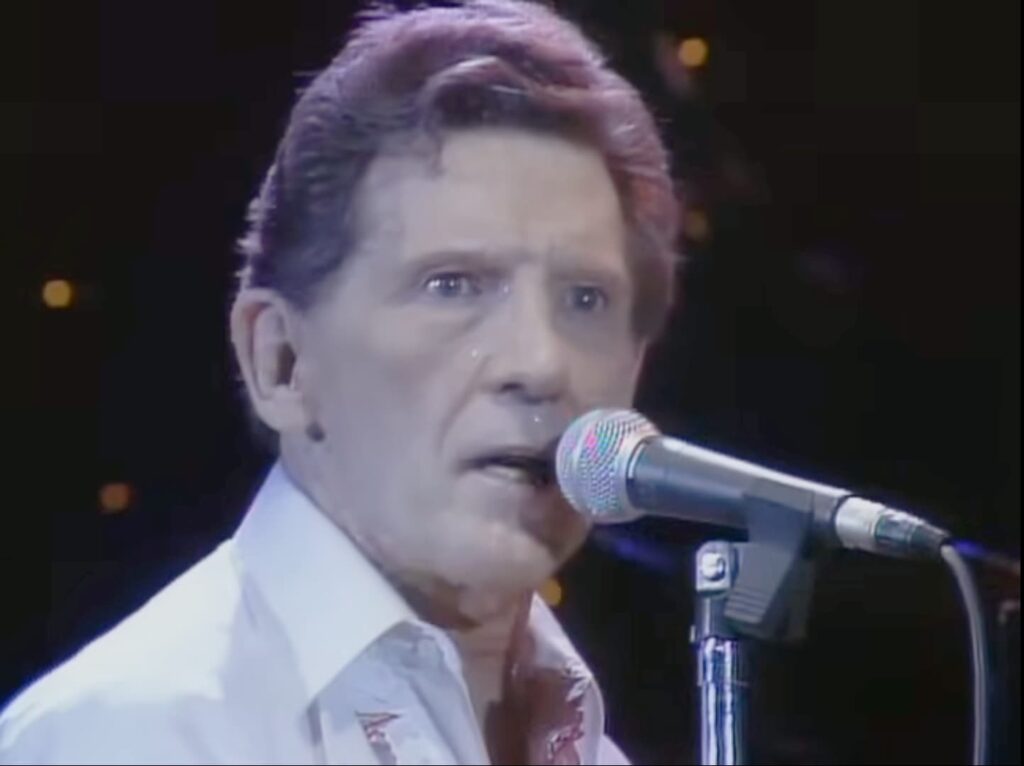
More Than a Song, “Wild One” Was Jerry Lee Lewis’ Lifetime Declaration That He Never Stopped Being “The Killer.”
There are moments when a song becomes more than part of a concert. It becomes a statement of identity. During “Jerry Lee Lewis and Friends,” Jerry Lee Lewis did not return to the piano with one of his biggest hits like “Great Balls of Fire” or “Whole Lotta Shakin’ Goin’ On.” Instead, he chose “Wild One,” a title that seemed to summarize the man the world had known for more than half a century. It was as if he were telling the audience, with a knowing smile, “I’m still the same wild soul I’ve always been.”
That choice carried special meaning. The event was not an ordinary concert but a celebration of Jerry Lee Lewis’ extraordinary legacy. Surrounded by fellow musicians who had been inspired by his groundbreaking career, every appearance by the rock and roll pioneer felt like the arrival of the evening’s central figure. The audience was not simply waiting for another song. They were waiting to witness the man whose fearless piano playing had forever changed American music.
By the time he performed “Wild One,” Jerry Lee Lewis was well into his seventies. Many artists at that stage of life naturally lean toward reflective ballads and nostalgic favorites. Lewis chose a different path. The song surged with confidence and swagger, proving that age had never diminished the rebellious spirit that made him famous. Rather than trying to convince anyone he was still young, he demonstrated something far more convincing. Authentic personality does not grow old.
For decades, audiences had known him by one unforgettable nickname, “The Killer.” It was never about violence. It described the astonishing way he could dominate a stage with explosive piano rhythms, relentless energy, and a voice that demanded attention from the very first note. During this performance, the fire was still unmistakable. He no longer needed the shocking antics that defined his youth. There was no climbing across the piano or setting the stage ablaze. Simply sitting behind the keyboard was enough to command the room.
That quiet confidence revealed the difference between a star and a legend. Young performers often strive to capture attention. Legends no longer need to. Jerry Lee Lewis understood that every note carried decades of history, every smile recalled thousands of unforgettable performances, and every strike of the piano keys reminded listeners why he remained one of rock and roll’s true architects.
Perhaps that is why “Wild One” feels almost autobiographical. The lyrics seem perfectly suited to the man himself. Throughout his remarkable career, Jerry Lee Lewis refused to follow expectations. He challenged convention, embraced controversy, and lived according to his own uncompromising rules. The song never sounds like he is describing another character. It feels as though he is introducing himself once again.
One of the performance’s greatest strengths is its refusal to become sentimental. Tribute concerts often focus on farewell emotions and memories of what once was. Jerry Lee Lewis and Friends felt different whenever he took the stage. The atmosphere remained vibrant and alive. Rather than asking audiences to remember him, Lewis reminded them that his spirit had never left. The years had changed his appearance, but not the unmistakable force of his musical personality.
Watching Jerry Lee Lewis perform “Wild One” also highlighted a remarkable contrast. Time had weathered his face and slowed his movements, yet his timing, vocal phrasing, and unmistakable piano touch still echoed the fearless young musician who stunned audiences in the 1950s. The performance became a powerful reminder that genuine artistry survives long after youthful energy begins to fade.
In the end, “Wild One” was more than another song in the setlist. It became a concise portrait of Jerry Lee Lewis himself: rebellious, independent, unpredictable, and utterly authentic. As one of the last surviving pioneers of rock and roll sat before the piano, audiences were witnessing far more than a performance. They were seeing a lifetime of music, passion, and individuality distilled into a few unforgettable minutes.