
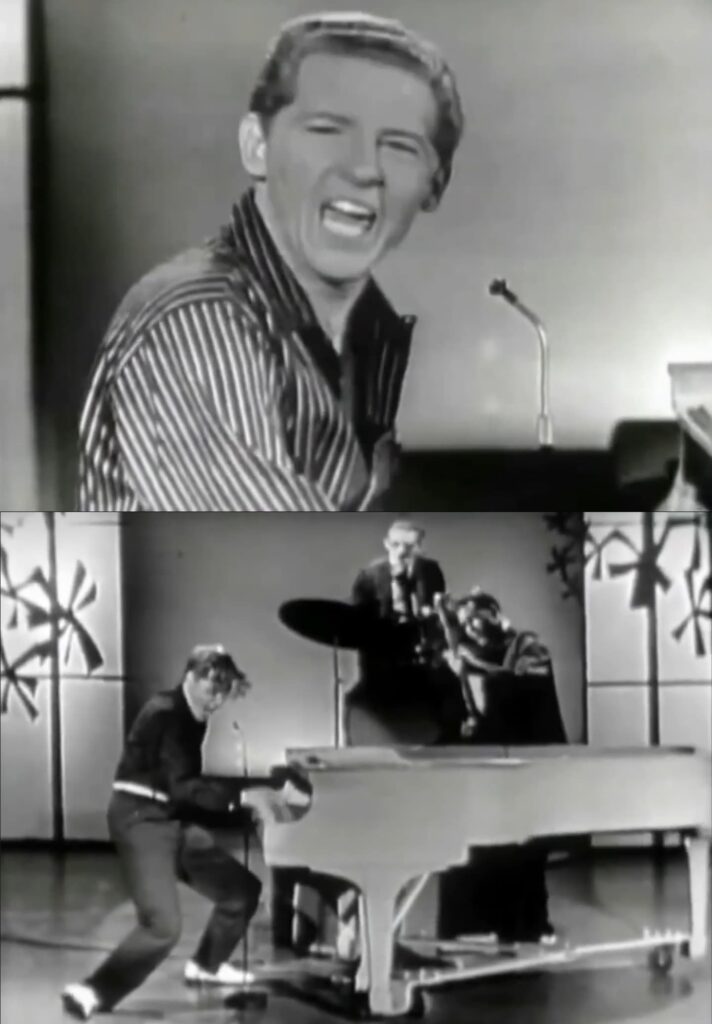
The Night Jerry Lee Lewis Turned Television Into Pure Rock And Roll Chaos With Nothing But A Piano And Wild Energy
On August 11, 1957, viewers watching The Steve Allen Show witnessed something that felt almost dangerous for its time.
A young pianist from Louisiana sat behind the keys with restless energy burning in his eyes. Within moments, Jerry Lee Lewis launched into “Whole Lotta Shakin’ Goin’ On,” and American television suddenly looked nothing like the polished entertainment audiences had grown accustomed to during the 1950s.
This was not smooth crooning. This was not carefully controlled pop music.
This was rock and roll exploding in real time.
From the very first pounding piano notes, Lewis attacked the song with astonishing intensity. His hands flew wildly across the keyboard while his body twisted and bounced with nervous electricity. Every movement looked spontaneous, almost out of control, as though the music itself had completely taken hold of him.
At the center of it all was that unmistakable voice. Half shout, half laughter, half Southern sermon.
Released earlier in 1957, “Whole Lotta Shakin’ Goin’ On” had already become one of the defining records of the rock and roll revolution. Originally recorded years earlier by rhythm and blues singer Big Maybelle, the song found immortality when Jerry Lee Lewis transformed it into something louder, faster, and far more explosive at Sun Records in Memphis.
Producer Sam Phillips, who had also helped launch the careers of Elvis Presley, Johnny Cash, and Carl Perkins, immediately understood Lewis possessed something different. While Elvis brought charisma and mystery, Jerry Lee Lewis brought chaos.
And television audiences could feel it.
Watching the Steve Allen Show performance today still feels startling because Lewis refused to behave like entertainers of his era were expected to behave. Most television performers in the 1950s stood relatively still, smiling politely through carefully rehearsed routines. Jerry Lee Lewis looked as though he might set the entire stage on fire before the song ended.
His pounding piano became the heartbeat of the performance. Unlike many rock singers who relied heavily on backing bands, Lewis turned the piano itself into a weapon. He slammed the keys, drove the rhythm forward relentlessly, and attacked every note with raw physical force.
The audience reaction revealed just how unusual he seemed at the time. Some viewers were thrilled. Others looked stunned. Adults often viewed early rock and roll with suspicion, fearing its rebellious energy and emotional freedom. Lewis embodied those fears completely.
Yet younger audiences recognized something liberating inside the chaos.
What made the performance especially remarkable was its sense of unpredictability. Even now, decades later, it feels like anything could happen at any second. Lewis never performed as though he were simply reproducing a hit song. He performed like a man consumed by the music itself.
That wild intensity would eventually make Jerry Lee Lewis one of the most controversial and unforgettable figures in American music history. Nicknamed “The Killer,” he spent decades building a career defined by brilliance, scandal, su
But in 1957, all of that future still lay ahead.
What audiences saw on The Steve Allen Show was simply a young man changing popular music through force of personality alone.
Watching the clip now feels like opening a time capsule from the exact moment rock and roll stopped asking permission to exist. The sound was louder. The emotion was rawer. The performance carried danger and excitement that television rarely allowed before.
And at the center of the storm sat Jerry Lee Lewis, hammering the piano keys as though the future of rock music depended on it.