
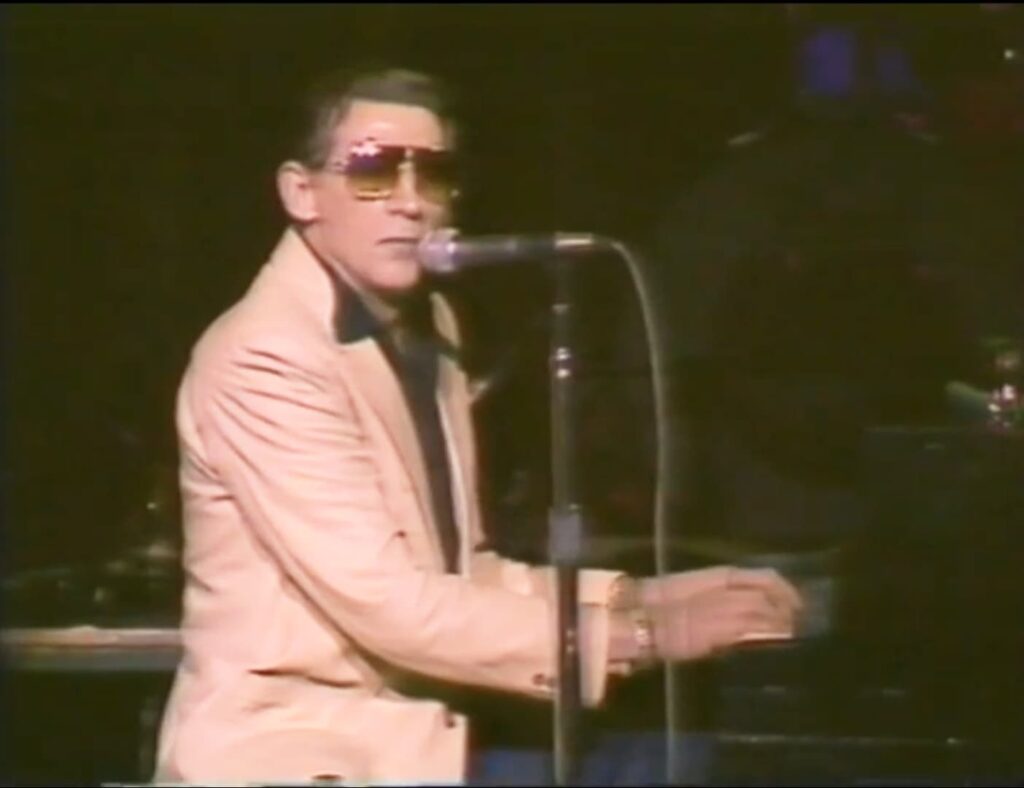
In London, Jerry Lee Lewis Sang “Would You Take Another Chance On Me” Like a Man Trying to Outrun His Own Past
For a few fragile minutes in 1983, the wild architect of rock ’n’ roll stopped fighting the world and quietly asked for forgiveness.
By the time Jerry Lee Lewis walked onto the London stage in 1983, his legend was already larger than life. Audiences knew him as “The Killer,” the piano-smashing rebel who scandalized America, survived personal chaos, and somehow continued performing with the same dangerous electricity that made him famous in the 1950s.
But during his haunting performance of “Would You Take Another Chance On Me,” another version of Jerry Lee emerged entirely.
Not the swaggering rocker.
Not the headline-making outlaw.
Just a tired Southern man sitting at a piano, sounding as though he truly needed the answer to the question he was singing.
The performance begins almost casually, with Lewis joking and talking directly to the audience in his familiar loose style. Then suddenly the atmosphere changes. As his hands settle onto the piano keys and the melody begins unfolding, the room grows noticeably quieter.
“If I promise you I might straighten up…”
From the very first lines, the song feels painfully personal.
Originally released in 1971 during Lewis’s successful country music resurgence, “Would You Take Another Chance On Me” was already a confession disguised as a love song. But in London, more than a decade later, it sounded even heavier. By then, Jerry Lee carried years of public scandals, failed relationships, career collapses, and personal battles inside his voice.
And the audience could hear every ounce of it.
Unlike his explosive rock performances, there is remarkable restraint here. Lewis does not attack the piano. He caresses the melody softly, allowing the lyrics to breathe. His voice, roughened by age and hard living, cracks gently around certain phrases, especially when he sings about mistakes, forgiveness, and the hope of changing.
At around the one-minute mark, when he admits, “The good Lord knows I done you wrong,” the performance begins moving beyond entertainment entirely. It becomes confession.
That was always the hidden power inside Jerry Lee Lewis as a performer.
For all his chaos, he understood emotional truth instinctively. He knew how to sound dangerous, but he also knew how to sound broken. And sometimes the second quality was even more powerful than the first.
The intimacy of the London venue amplified every emotional detail. There were no elaborate production tricks separating the audience from the man onstage. Listeners could hear the weariness in his breathing, the pleading edge in his phrasing, even the hesitation between lines.
When Lewis repeated, “Would you take another chance on me?” it no longer sounded directed toward one lover alone. The question seemed larger than that. It felt aimed at everyone: the audience, God, his past, perhaps even himself.
That emotional ambiguity made the performance unforgettable.
Throughout his career, Lewis often appeared trapped between rebellion and redemption. Raised in strict Pentecostal surroundings in Louisiana, he spent decades wrestling publicly with guilt, faith, desire, and self-destruction. Those tensions fueled both his greatest music and his deepest personal struggles.
In this performance, all of it surfaces quietly beneath the song.
By the final verses, his delivery grows even more fragile. There is almost a trembling sincerity underneath the humor and swagger he tries to maintain between phrases. Then, just as the emotional intensity threatens to overwhelm the room completely, Lewis breaks the tension with a quick casual remark, retreating once again behind the familiar persona of “The Killer.”
But the audience had already seen behind the curtain.
For a few unforgettable minutes in London, Jerry Lee Lewis was not simply performing a country ballad. He was standing in front of strangers, carrying decades of regret, and asking one of the oldest human questions imaginable:
Can a person truly be forgiven for the life they have lived?