
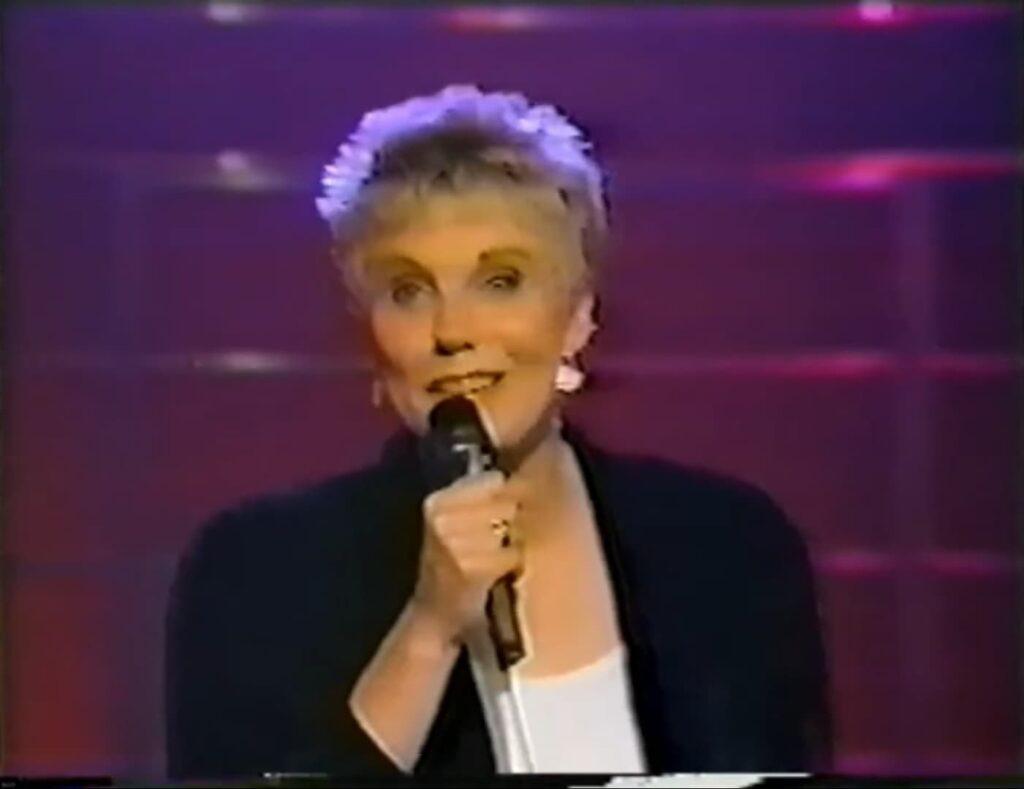
A Subtle Flame of Elegance Where Nostalgia Meets Quiet Seduction
In the early 1990s, as part of the promotional campaign for her album “Croonin’”, Anne Murray stepped onto the stage of a televised special and delivered a performance that surprised even her most devoted listeners. With “Fever”, a song immortalized in 1950s popular culture and famously associated with Peggy Lee, Murray revealed a different shade of her artistry, one that leaned into intimacy, restraint, and a quiet, confident allure. The album itself was a carefully curated collection of classic standards from the 1950s, allowing her to revisit the musical language of an earlier era while reinterpreting it through her own unmistakable voice.
By the time “Croonin’” was released, Anne Murray had already spent decades building a reputation rooted in warmth, sincerity, and emotional clarity. She was widely known for her country-pop ballads, songs that spoke gently but directly to the heart. Yet in this performance of “Fever”, she steps into a more understated and sophisticated space. There is no attempt to overpower the song. Instead, she lets it unfold slowly, almost like a conversation shared in low light.
What makes this rendition particularly compelling is the control. Anne Murray does not chase the sultry intensity that earlier versions of “Fever” often emphasized. Rather, she softens it. Her delivery is measured, her phrasing deliberate, creating a sense of closeness that feels personal rather than performative. For older listeners, this approach carries a certain familiarity. It recalls a time when music relied less on spectacle and more on nuance, when a single vocal inflection could carry more meaning than an entire arrangement.
The setting of the Croonin’ TV special adds to that atmosphere. It is polished, yet never distant. The arrangement remains faithful to the song’s original spirit, with its subtle rhythm and minimal instrumentation, allowing the voice to remain at the center. And in that space, Murray’s interpretation begins to reveal its quiet strength. She is not imitating the past. She is acknowledging it, respecting it, and then gently making it her own.
There is also something deeply nostalgic about hearing Anne Murray inhabit this kind of repertoire. For many who grew up with her music, this performance feels like a bridge between eras. The familiar voice remains, but the emotional color shifts, offering a new perspective on both the artist and the song.
Looking back, this live rendition of “Fever” stands as a reminder of Anne Murray’s versatility. It shows that beneath the calm, reassuring presence that defined her career, there was always a subtle sophistication waiting to emerge. And in this moment, she allows it to glow, not brightly, but steadily, like a quiet flame that lingers long after the music fades.