
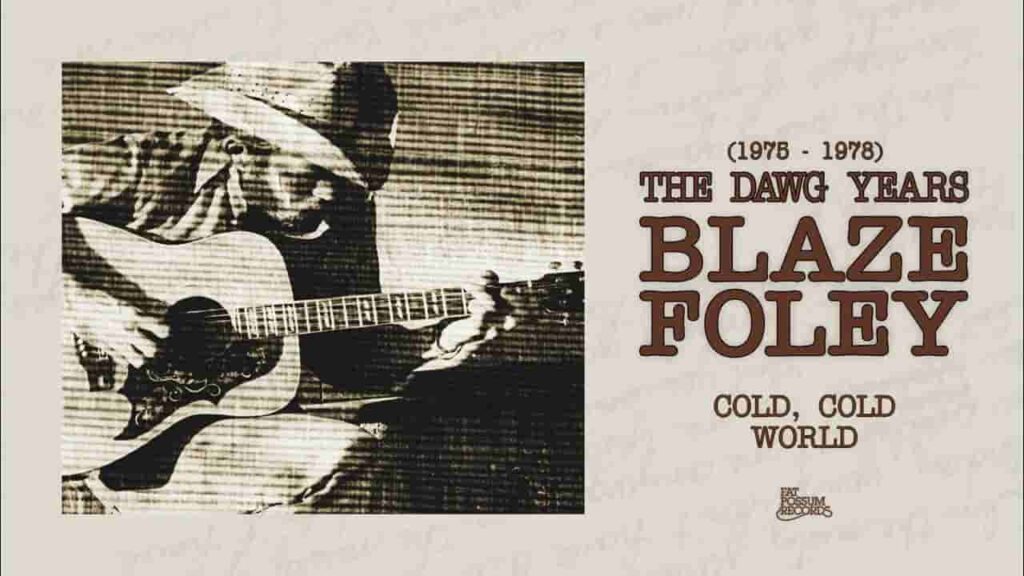
A Quiet Testament to Human Fragility and Dignity in the Face of Defeat
Cold, Cold World stands as one of the most enduring and emotionally unguarded statements in the catalog of Blaze Foley, a songwriter whose life and music existed far from the comforts of commercial success. Recorded between 1979 and 1980 with his backing group The Beaver Valley Boys, the song later gave its name to the posthumous album Cold, Cold World, released in 1989 by Lost Art Records, the same year Foley’s legacy began to reach listeners beyond the small circles that once knew him personally. Neither the song nor the album ever entered the Billboard charts, and that absence is not an oversight but rather a reflection of Foley’s place in American music history: revered, influential, and profoundly overlooked during his lifetime.
At the time of its recording, Blaze Foley was deeply embedded in the Texas outlaw folk and country scene, sharing stages and friendships with figures like Townes Van Zandt and Guy Clark. Yet unlike some of his peers, Foley never found stability in the recording industry. His music was too raw, too unvarnished, and too honest to be easily packaged. Cold, Cold World emerged from this reality. It was not written to court radio play or label approval. It was written as a confession, almost as a reckoning, delivered in Foley’s unmistakable low baritone, often described as “spooky” for its ghostlike calm and emotional restraint.
Musically, the song is sparse and restrained. The arrangement leans toward folk-country minimalism, allowing the lyric to carry the full weight of the experience. There is no dramatic crescendo, no lyrical resolution. Instead, the song unfolds with quiet inevitability, mirroring the emotional exhaustion at its core. Foley’s voice never pleads for sympathy. It simply states the truth as he understood it. Lines such as “I’ve tried for a long time but I think I can’t win” and “I’d do it all better if I could do it again” are delivered without bitterness, as if resignation has replaced anger.
The story behind Cold, Cold World cannot be separated from Foley’s own life. He lived on the margins, often homeless, surviving on sporadic gigs and the generosity of friends. Violence and instability followed him, culminating in his tragic death in 1989 when he was fatally shot by the son of a close friend. When the album Cold, Cold World was released later that year, it arrived not as a comeback or revival, but as a quiet memorial. For many listeners, it felt less like a new record and more like a voice reaching back from silence.
The meaning of Cold, Cold World lies in its refusal to offer comfort through illusion. The song does not suggest that perseverance guarantees reward, nor does it promise redemption. Instead, it acknowledges the reality that effort and goodness do not always shield a person from hardship. Yet there is dignity in that acknowledgment. Foley does not curse the world. He observes it. The coldness he describes is not cruelty alone, but indifference, the kind that wears a person down slowly over time.
In later years, the song gained renewed attention through tributes, cover versions, and its inclusion in films and documentaries about Foley’s life. Each rediscovery reinforced the same truth: Cold, Cold World speaks most powerfully to those who have lived long enough to understand disappointment, regret, and endurance. It resonates not because it dramatizes suffering, but because it normalizes it.
Today, Blaze Foley is recognized as a songwriter’s songwriter, and Cold, Cold World remains his most personal signature. It is a song that does not demand attention, yet once heard, it lingers. Like many of the finest works in American roots music, its power lies in understatement. It stands as a reminder that some voices are not meant to conquer the world, only to tell the truth about it, quietly, before fading into memory.
 Oldies Songs