
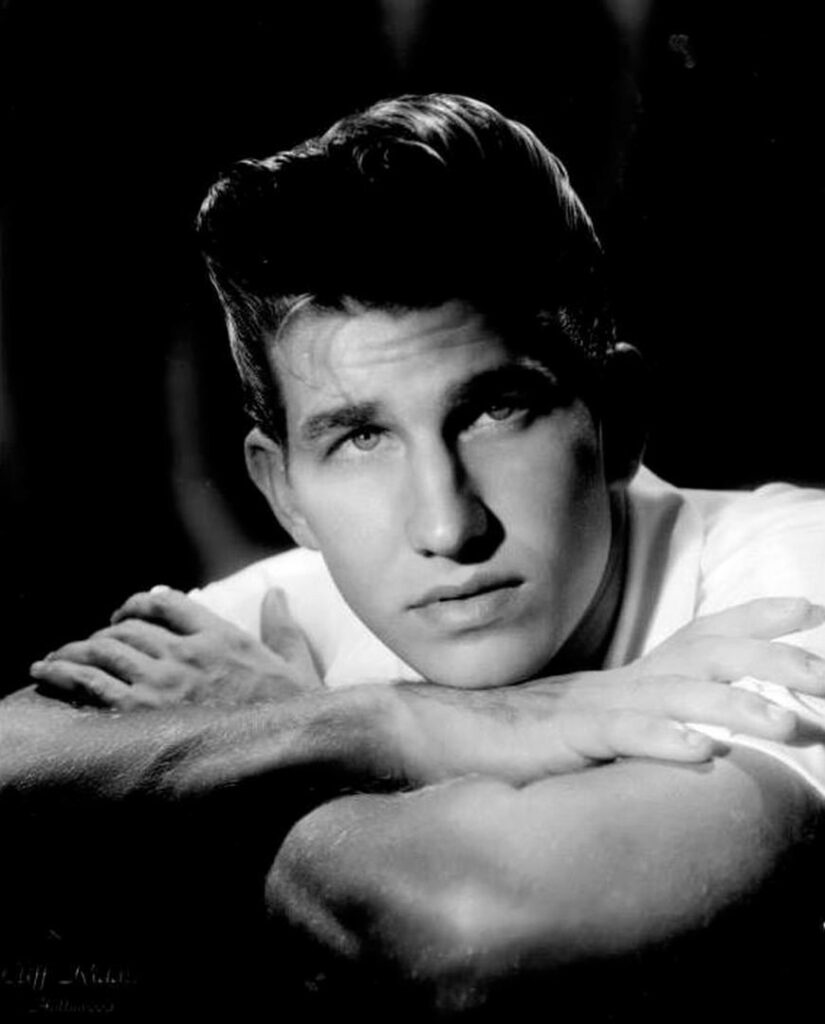
A youthful dream set beneath moonlight—where innocence, longing, and early rock romance quietly bloom
When “Under the Moon of Love” by Curtis Lee first reached listeners in 1961, it carried with it the unmistakable glow of early rock and roll’s tender side—a softer, more romantic counterpoint to the rebellious energy that defined the era. Produced by the legendary Phil Spector, the song climbed to No. 46 on the Billboard Hot 100 in the United States, a modest chart position perhaps, but one that belies the lasting charm and emotional resonance it would come to hold over time.
There is something unmistakably sincere about Curtis Lee’s delivery—his voice, slightly unpolished yet full of youthful hope, feels like it belongs to a moment just before the world became more complicated. Backed by Spector’s early experimentation with what would later evolve into his famed “Wall of Sound,” the arrangement is simple but evocative: gentle rhythms, doo-wop harmonies, and a melody that lingers like a memory you didn’t realize you still carried.
The story behind “Under the Moon of Love” is rooted in the innocence of young romance—those quiet, fleeting moments shared away from the noise of everyday life. The song paints a picture of two lovers meeting under the soft glow of the moon, a setting that has long symbolized intimacy, secrecy, and emotional vulnerability. Yet what makes this particular track stand out is not its originality of theme, but rather its honesty. There is no grand drama here, no heartbreak or betrayal—just a simple, almost fragile happiness.
Curtis Lee himself was a relatively short-lived figure in the broader landscape of early 1960s pop. Despite scoring a bigger hit with “Pretty Little Angel Eyes”—which reached the Top 10—his career never quite achieved the enduring fame of some of his contemporaries. Still, in songs like this, one hears the unmistakable imprint of a young artist trying to capture something pure before it slips away. That sense of transience, whether intentional or not, gives “Under the Moon of Love” an added layer of poignancy.
Interestingly, the song found a second life decades later when it was covered by Showaddywaddy in 1976, where it soared to No. 1 on the UK Singles Chart. That revival speaks volumes about the song’s universal appeal—it transcends generations, continuing to evoke that same feeling of nostalgic warmth, even as the world around it changes.
At its heart, “Under the Moon of Love” is less about a specific story and more about a feeling—one that many recognize but rarely put into words. It captures that delicate space between youth and adulthood, where emotions are still uncomplicated, and love feels both new and eternal at the same time. The moon, in this sense, becomes more than just a backdrop; it is a silent witness to moments that are as fleeting as they are unforgettable.
Listening to the song now, one might find themselves transported—not necessarily to a specific place, but to a version of themselves that once believed in small, perfect moments like these. And perhaps that is its greatest achievement. Not the chart position, nor the production, but the quiet ability to remind us of something we may have long since forgotten: that sometimes, the simplest memories are the ones that stay with us the longest.