
A Gentle Return to Childhood Joy Wrapped in Holiday Harmony
When Winter Wonderland found its way into the voices of David Cassidy and Shirley Jones, it was more than just another seasonal recording—it became a quietly cherished moment where family, nostalgia, and music intertwined. Released during the height of the early 1970s pop television era, their rendition appeared on A Partridge Family Christmas Card (1971), an album by The Partridge Family that reached No. 1 on the Billboard Christmas Albums Chart. While “Winter Wonderland” itself was not issued as a standalone charting single from this album, its presence contributed significantly to the record’s enduring seasonal success.
To understand the weight of this version, one must first look back at the origins of Winter Wonderland, written in 1934 by Felix Bernard and Richard B. Smith. The song was born not from festive cheer alone, but from a deeply personal place—Smith, battling illness, penned lyrics that imagined the snowy scenes he could no longer freely experience. That contrast—between longing and joy—has always lingered beneath the song’s surface, no matter how brightly it is performed.
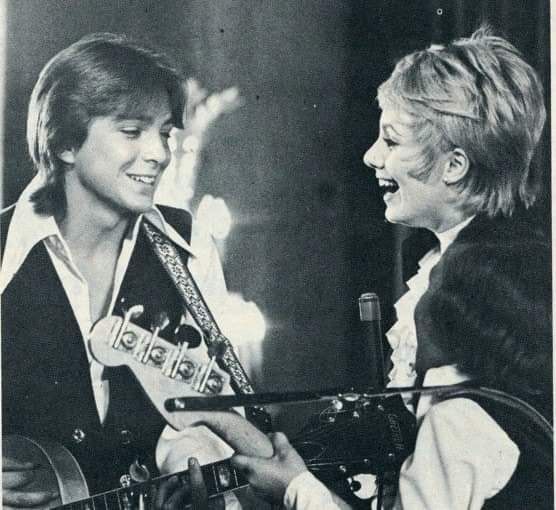
In the hands of David Cassidy and Shirley Jones, that duality takes on a new dimension. Here was a real-life mother and son, portraying a fictional musical family on television, yet bringing an authenticity that could not be scripted. Cassidy, at the peak of his teen idol fame, brings a youthful warmth—his voice light, inviting, and effortlessly melodic. Jones, with her seasoned, comforting tone, provides a grounding presence. Together, they don’t simply sing the song—they inhabit it, as if walking side by side through those imagined snowy fields.
What makes this version particularly poignant is its context. By 1971, The Partridge Family had become a cultural fixture, offering audiences a sense of unity and gentle escapism during a time of social change. Their Christmas album, and this track in particular, felt like an invitation—to step away from the noise of the world and return, even briefly, to something simpler. The arrangement reflects this intention: soft orchestration, subtle choral backing, and a tempo that never rushes, allowing each phrase to linger just long enough to stir memory.
Unlike some grander, more theatrical renditions of Winter Wonderland, this performance avoids excess. There are no overpowering crescendos or dramatic flourishes. Instead, it leans into intimacy. One can almost picture a living room softly lit by holiday lights, a record player turning slowly, and voices that feel close enough to reach out and touch.
The meaning of the song itself—often perceived as purely festive—gains depth through this interpretation. Lines about walking in a winter landscape or building a snowman take on a metaphorical quality: they speak to companionship, to shared imagination, to the quiet comfort of being with someone who understands your world. In the case of Cassidy and Jones, that connection is not merely artistic—it is deeply personal.
Over the decades, Winter Wonderland has been recorded by countless artists, from Bing Crosby to Frank Sinatra, each bringing their own interpretation. Yet there is something uniquely enduring about this version. Perhaps it is the sincerity. Perhaps it is the subtle blending of fiction and reality. Or perhaps it is simply the way their voices seem to carry not just melody, but memory itself.
Listening now, years removed from its original release, one might find that this recording does not merely evoke winter—it evokes a time, a feeling, a version of the world that seems gentler in hindsight. It reminds us that music, at its best, does not just entertain—it preserves moments we might otherwise lose.
And if you haven’t taken the time to revisit this quietly beautiful rendition, then you may be overlooking one of the most heartfelt interpretations ever committed to record—a small, glowing fragment of a musical past that still knows how to warm the present.