
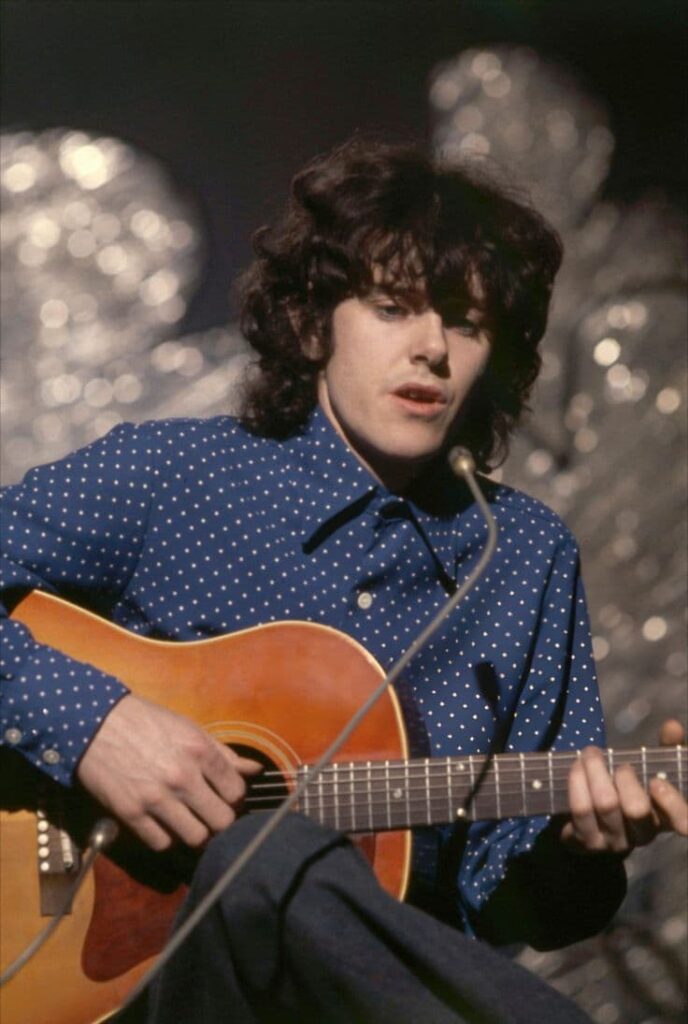
A hypnotic journey into mysticism and sound — a song that captured the late 1960s’ restless spirit and turned it into something timeless, eerie, and unforgettable.
When “Hurdy Gurdy Man” by Donovan first emerged in the summer of 1968, it did not simply arrive—it drifted in, like a strange, perfumed wind from another world. Released as a single ahead of the album Hurdy Gurdy Man, the track quickly climbed the charts, reaching No. 5 on the Billboard Hot 100 in the United States and No. 4 in the UK Singles Chart. These were not just respectable numbers; they marked a decisive turning point in Donovan’s career, signaling his transformation from a gentle folk troubadour into something far more enigmatic and sonically adventurous.
By 1968, the musical landscape was shifting beneath everyone’s feet. Psychedelia had taken root, and artists were searching for new ways to express the ineffable. Donovan, already known for his soft, Dylan-esque beginnings, stepped boldly into this new terrain. “Hurdy Gurdy Man” became his declaration of independence from the past—a song that fused Eastern mysticism, hypnotic rhythm, and electric intensity into a sound that felt both ancient and startlingly modern.
The story behind the song is as fascinating as the record itself. Donovan reportedly began writing it during a time of spiritual exploration in India, a journey shared by many musicians of that era. There are long-standing accounts—often retold with a sense of myth—that he originally offered the song to Jimi Hendrix, who ultimately encouraged Donovan to record it himself. While the full truth may be blurred by time, what remains undeniable is the spirit of collaboration and cross-pollination that defined that moment in music history.
Even more intriguing is the lineup of musicians who may have contributed to the recording. Though never fully confirmed, it is widely believed that members of Led Zeppelin—including Jimmy Page and John Paul Jones—played on the track. Whether legend or fact, this association only deepens the song’s mystique, tying it to the very roots of hard rock’s emergence.
From the very first note, the song establishes its haunting atmosphere. The droning guitar riff, heavy and circular, mimics the ancient instrument referenced in the title—the hurdy-gurdy itself, known for its continuous, almost trance-like sound. Donovan’s voice enters not as a narrator, but as a guide, leading the listener through imagery that feels both symbolic and elusive. The lyrics speak of a mysterious figure—“the hurdy-gurdy man”—who seems to embody enlightenment, creativity, and perhaps even a kind of divine messenger.
There is a quiet profundity in the song’s meaning. At its heart, “Hurdy Gurdy Man” reflects a yearning for transcendence—a desire to break free from the ordinary and touch something infinite. In an age marked by upheaval and searching, this message resonated deeply. Yet, even today, the song retains its power, precisely because it refuses to explain itself fully. It invites reflection rather than providing answers.
Listening now, decades later, one cannot help but feel a certain stillness settle in. The world has changed immeasurably, but that hypnotic rhythm, that shimmering sense of mystery—it remains untouched. For many, the song is not just a piece of music, but a doorway back to a time when discovery felt boundless and the horizon seemed just a little bit wider.
And perhaps that is the enduring gift of Donovan’s work here. He did not simply capture a moment—he created an atmosphere that continues to linger, like a half-remembered dream. In “Hurdy Gurdy Man”, we hear not just a song, but an echo of a generation reaching beyond itself, searching for meaning in sound, in silence, and in everything in between.