
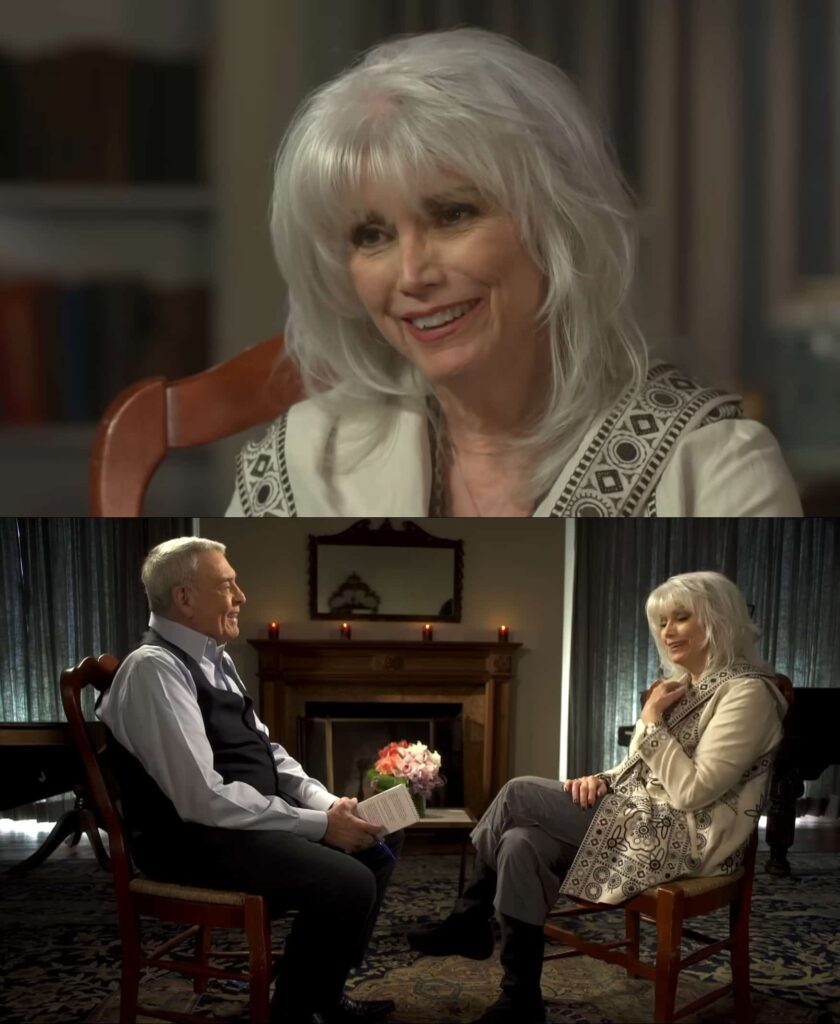
Emmylou Harris Spoke About Love, Loss, Faith, And Music With The Wisdom Of Someone Who Had Truly Lived
There are interviews that simply promote a career, and then there are conversations that slowly reveal the soul behind the music. When Emmylou Harris sat down with Dan Rather, the result became something far more meaningful than a standard television interview. It felt like listening to an old friend reflect honestly on life, heartbreak, spirituality, family, and the winding road that ultimately led her toward becoming one of the most respected voices in American music history.
One of the most unforgettable moments came when Dan Rather gently asked about marriage. Emmylou’s parents had remained together for fifty years, building the kind of loving partnership many people of her generation grew up admiring. Yet Emmylou quietly admitted that lasting marriage was never truly her own path.
With a soft laugh and remarkable honesty, she described herself as “an excellent ex-wife.”
The line carried humor, but also wisdom. There was no bitterness in her voice. No regret. She spoke warmly about the men she had married, calling them wonderful people, while acknowledging that long-term intimacy simply may not fit every person’s emotional makeup. For older listeners especially, the moment resonated deeply because it challenged the old belief that every life must follow the same traditional blueprint in order to be meaningful.
What made Emmylou’s reflections so moving was her refusal to judge herself harshly. Instead, she spoke with compassion about human complexity. She questioned society’s obsession with defining what is “normal,” joking that “normal” sounded more like a washing machine setting than a meaningful life standard. Beneath the humor was a deeply thoughtful observation: people often spend too much time trying to fit expectations rather than understanding who they truly are.
That openness has always been part of what makes Emmylou Harris such a compelling artist. Her singing has never sounded manufactured. It sounds lived-in. Weathered by experience. Tender but resilient.
The conversation then drifted into memories of her childhood and parents, revealing where much of that emotional depth originated. Emmylou described growing up in a home filled with respect, honesty, and quiet affection. Her parents rarely fought. They treated one another with dignity every day. She admitted she once assumed all families were like hers until college opened her eyes to the pain many others carried.
Those memories seemed to explain why kindness and emotional truth became central themes throughout her music.
Religion also entered the discussion, though not in a rigid or preachy way. Emmylou explained that while she had drifted somewhat from organized church life, she still deeply believed in spiritual authenticity. She spoke beautifully about gospel music, describing how even nonbelievers can feel overwhelmed by its emotional truth because the people who created those songs sang from somewhere profoundly real.
It was one of the interview’s most powerful moments.
You could hear how much she values sincerity in art. To Emmylou, great music is not about perfection or performance. It is about emotional honesty. That philosophy perhaps explains why her voice has remained so beloved across generations. When she sings, listeners believe her.
The interview also offered remarkable insight into her early musical journey. She spoke candidly about hating formal music lessons as a child despite being naturally gifted. Piano practice felt like punishment. Marching band made her miserable. Yet everything changed after she discovered folk music and bought a thirty-dollar guitar from a pawn shop with her grandfather.
Suddenly, music became personal.
She fell in love with artists like Joan Baez, Judy Collins, Bob Dylan, and Buffy Sainte-Marie. Using only a few chords, she began teaching herself songs late at night while listening to college radio. Looking back, there is something touching about how accidental her musical awakening seemed. She never imagined she could actually make a living doing it.
Then came the life-changing arrival of Gram Parsons.
Her memories of meeting Parsons remain among the most historically important stories in country-rock history. At the time, Emmylou was still finding herself artistically. Parsons immediately recognized something special in her voice and invited her to Los Angeles to sing on his solo work. She accepted almost casually, expecting little more than a small paycheck and an adventure.
Instead, it changed her life forever.
Through singing harmony beside Gram Parsons, Emmylou discovered country music on a much deeper emotional level. She spoke passionately about hearing the heartbreak of George Jones, the haunting harmonies of The Louvin Brothers, and the poetic realism buried inside traditional country songs. She described harmony singing almost like a spiritual experience, saying it was through those harmonies that she finally discovered her own authentic voice.
Then the interview reached perhaps its most emotional point when she reflected on Parsons’ sudden death in 1973. Emmylou admitted the shock devastated her because it was the first time she had lost someone truly close from her own generation. That grief eventually inspired her haunting composition “Boulder to Birmingham,” one of the most heartbreaking tributes ever written in American roots music.
Watching this interview today feels profoundly different in an age dominated by noise, speed, and performance. Emmylou Harris speaks slowly. Thoughtfully. She leaves space for uncertainty, for questions without answers, for contradictions within human lives.