
A Tiny Music Shop Became A Concert Hall When Steve Earle Turned One Song Into Pure Storytelling Magic
Some performances are unforgettable precisely because they happen without warning.
No giant crowd. No arena lights. No carefully rehearsed spectacle.
Just Steve Earle, a rare mandolin, and a small room suddenly filled with the kind of music that reminds people why songs matter in the first place.
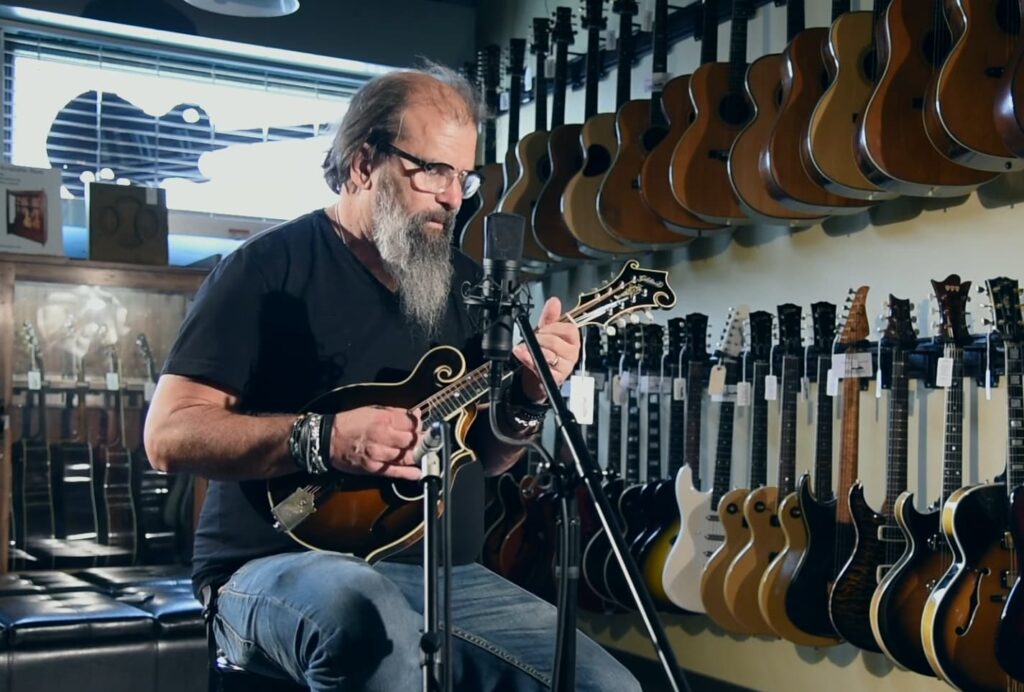
When Earle casually walked into the instrument shop and picked up a beautiful 2003 Gilchrist Model 5 mandolin, nobody expected the quiet moment to transform into an intimate performance of “Galway Girl” that felt almost suspended outside of time. Yet within seconds, the atmosphere changed completely.
The opening rhythm arrived with that instantly recognizable Celtic pulse, driven by Earle’s rough-edged voice and the bright ringing tone of the mandolin. Without a full band behind him, the song became even more alive somehow. Every stomp of his foot against the floorboards echoed through the tiny shop like an old pub session late at night somewhere along the Irish coast.
Originally released on the 2000 album Transcendental Blues, “Galway Girl” became one of Steve Earle’s most beloved songs, blending Irish folk influences with his trademark American storytelling style. Over the years, the song developed a life far beyond radio play, becoming a favorite in bars, festivals, and live acoustic gatherings around the world.
But hearing it performed this way stripped everything back to its emotional core.
There was something deeply human about watching Earle stand among hanging instruments and shelves of wood and strings, singing not like a celebrity putting on a show, but like a wandering songwriter sharing a tune with whoever happened to be nearby. The intimacy of the setting revealed details often hidden on larger stages. The slight gravel in his voice. The rhythmic breathing between lines. The way his playing locked naturally into the pulse of the song.
And then there was the mandolin itself.
The Gilchrist Model 5 carried a sharp, crystalline tone that cut through the room beautifully. Every note sparkled with warmth and clarity, balancing perfectly against the rugged texture of Earle’s vocals. It did not sound polished in a studio sense. It sounded alive.
That rawness has always been central to Steve Earle’s music.
Throughout his career, Earle built his reputation not on perfection, but on honesty. Songs like “Copperhead Road,” “The Galway Girl,” and “Someday” resonated because they carried real scars, real wanderlust, and real emotional weight. Even after decades in music, he still performs with the intensity of someone who believes every lyric should mean something.
Watching this shop performance today feels strangely comforting in an era dominated by overproduction and digital polish. There are no visual effects, no elaborate sound systems, no distance between artist and listener. Just wood, strings, rhythm, and storytelling.
For many longtime music lovers, moments like this awaken memories of another time. Small local music stores. Informal jam sessions. Musicians gathering simply because they loved songs more than spectacle. Before concerts became massive productions, this was how music often lived, close enough to feel personal.
And perhaps that is why this performance resonates so deeply.
Inside that tiny instrument shop, Steve Earle reminded everyone listening that great songs do not require a stadium to feel enormous. Sometimes all it takes is one voice, one instrument, and a melody strong enough to stop a room full of strangers in their tracks.