
A Quiet Folk Tragedy Wrapped in Harmony — “Darcy Farrow” as a Timeless Echo of Love, Loss, and the American West
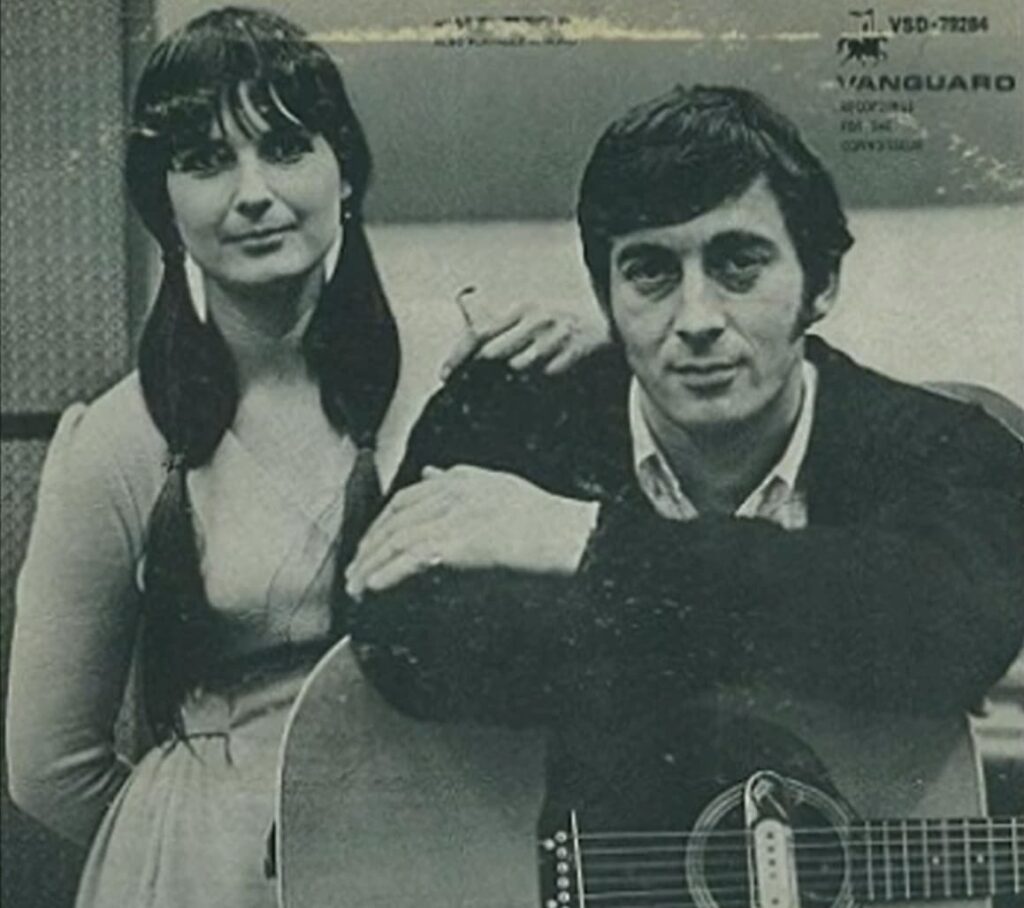
In “Darcy Farrow”, Ian & Sylvia turn a simple folk narrative into something far more enduring—a haunting ballad where innocence, landscape, and tragedy meet under an unspoken sky. It is a song that does not merely tell a story; it lingers like a memory you cannot quite place, yet somehow never forget.
Released on their 1964 album “Northern Journey”, “Darcy Farrow” was never a mainstream charting single in the pop sense. It did not climb Billboard rankings or dominate radio countdowns of its time. Instead, its impact unfolded in a quieter, more enduring way—within the folk revival circles of the 1960s, where songs were judged not by commercial position, but by emotional truth and longevity. Over time, it became one of the duo’s most respected interpretations and later a widely covered folk standard, passed along like oral history among musicians who understood its delicate weight.
The song itself was written by Steve Gillette and Tom Campbell, rooted in the evocative storytelling tradition of American folk music. Inspired by the atmosphere and mythos of rural Nevada life, “Darcy Farrow” feels like a portrait drawn from the edge of memory—where fact and folklore blur until they become inseparable. It tells of a young woman named Darcy, raised in a rugged Western landscape, where love is both tender and fragile, and where fate often arrives without warning or mercy.
At its core, the narrative is heartbreakingly simple. Darcy falls in love with a man who promises her a future as wide as the valley she comes from. But the West, in its vastness and unpredictability, becomes both backdrop and silent antagonist. A riding accident—swift, almost careless in its finality—ends her life prematurely, leaving behind a lover, a brother, and a community shaped by grief that has nowhere to go but inward. There is no dramatic resolution, no moral lesson announced. Only the quiet aftermath of loss.
What makes Ian & Sylvia’s interpretation so enduring is not embellishment, but restraint. Their harmonies—gentle, intertwined, and almost fragile—carry the emotional burden of the lyrics without ever overwhelming them. In their version, Darcy does not feel like a fictional character; she feels like someone once known, someone whose absence is still noticed in the way a chair remains slightly out of place in a room long after someone has left.
Listening today, one can sense how the song belongs to a different tempo of storytelling. It is not designed for immediacy or spectacle. Instead, it unfolds slowly, like dust settling after a long ride home. The guitars are unhurried, the vocal delivery steady but mournful, as if the singers themselves are careful not to disturb the silence the story leaves behind.
There is also something deeply nostalgic about how “Darcy Farrow” reflects the broader spirit of early 1960s folk music—a time when songs were often vessels for shared memory rather than individual fame. It stands alongside other narrative folk works of its era that sought to preserve human experiences in their most unvarnished form, resisting the polished sheen of mainstream pop production.
Today, the song continues to resonate not because it demands attention, but because it quietly earns it. It reminds listeners that some stories do not age into irrelevance; instead, they deepen, like old wood darkening with time. “Darcy Farrow” is one of those rare folk ballads where beauty and sorrow are indistinguishable, and where the past never fully leaves—it simply learns to sing in harmony with the present.