
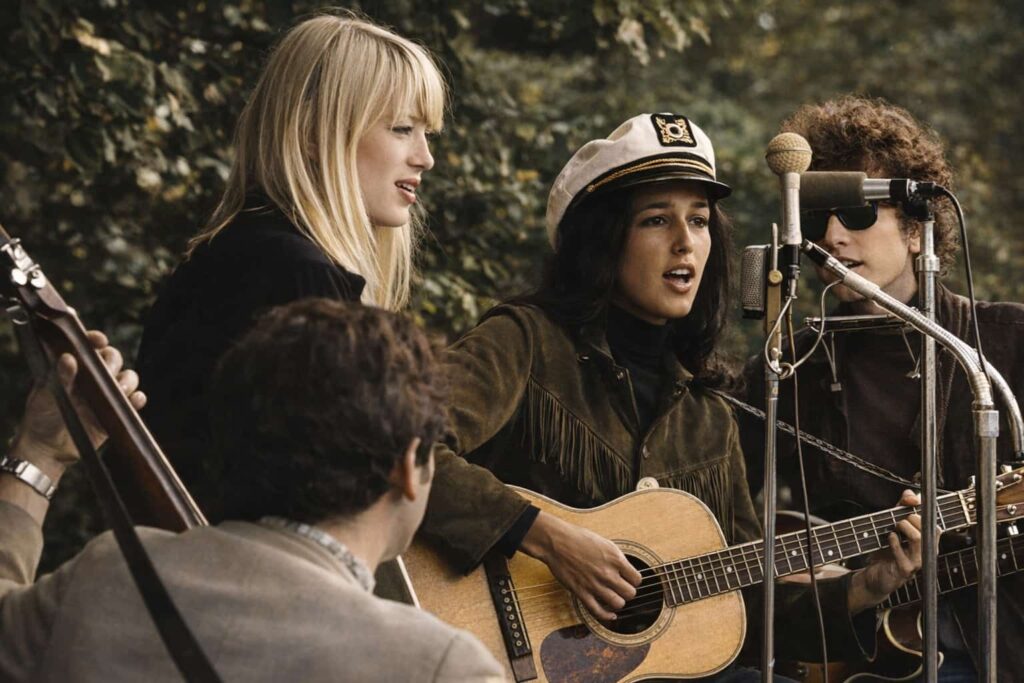
A Timeless Meeting of Voices: When Joan Baez and Mary Travers Brought Folk’s Conscience to the Newport Stage
In the summer of 1964, at the height of America’s folk revival, the stage of the Newport Folk Festival became a sacred gathering ground for voices that carried both beauty and conviction. Among the most quietly powerful moments was the meeting of two remarkable women: Joan Baez and Mary Travers, representing the beloved trio Peter, Paul and Mary. Though not tied to a single charting release or commercial single, this performance remains one of those rare musical encounters that transcended rankings and instead etched itself into memory and history.
By 1964, both artists stood at the very peak of their influence. Joan Baez, often called the “Queen of Folk,” had already scored major success with albums like Joan Baez, Vol. 2, which reached No. 13 on the Billboard 200. Meanwhile, Peter, Paul and Mary had achieved extraordinary commercial and critical acclaim. Their 1962 self-titled debut album, Peter, Paul and Mary, climbed to No. 1 on the Billboard 200 and remained there for weeks, driven by hits like If I Had a Hammer and Puff, the Magic Dragon. Just a year before Newport 1964, their rendition of Blowin’ in the Wind, written by Bob Dylan, had reached No. 2 on the Billboard Hot 100, becoming an anthem of a generation searching for answers.
It is within this cultural and musical context that the Newport performance must be understood. This was not merely a duet or a shared stage—it was a convergence of ideals. Both Baez and Travers were deeply involved in the civil rights movement, and their music often carried messages of justice, peace, and human dignity. At Newport, those ideals were not spoken loudly, but they resonated in every harmony, every glance exchanged between performers, and every attentive silence from the audience.
The beauty of this moment lies in its simplicity. There was no elaborate production, no attempt to impress with spectacle. Instead, what we witness is the purity of two voices—distinct yet complementary. Joan Baez’s crystal-clear soprano, often described as almost otherworldly, intertwined with Mary Travers’s warmer, steadier tone. Together, they created a sound that felt both intimate and expansive, like a quiet conversation that somehow reached thousands.
Behind this performance is also a subtle narrative of mutual respect. Though often associated with different circles within the folk community, Baez and Peter, Paul and Mary shared a deep admiration for the same songwriting tradition—one that valued storytelling over showmanship. They were interpreters of songs that belonged to the people, songs passed down, reshaped, and given new life in changing times. Their meeting at Newport symbolized a unity within the folk movement, even as it stood on the brink of transformation—just a year before Bob Dylan’s controversial electric set at the same festival in 1965.
The meaning of this performance, therefore, extends far beyond the notes sung that day. It represents a moment when music served as both refuge and rallying cry. In a world filled with uncertainty, these artists reminded listeners of something enduring: that a song, sung honestly, could still carry truth.
Listening back now, decades later, one cannot help but feel a quiet ache of nostalgia. There is a sense of something pure, something unguarded, that defined that era. The voices of Joan Baez and Mary Travers do not simply recall a time gone by—they invite us to remember what music once dared to be: not just entertainment, but a reflection of conscience, compassion, and hope.
And perhaps that is why this moment at Newport 1964 continues to linger. Not because it topped the charts or broke records, but because it spoke softly—and yet, somehow, said everything.