
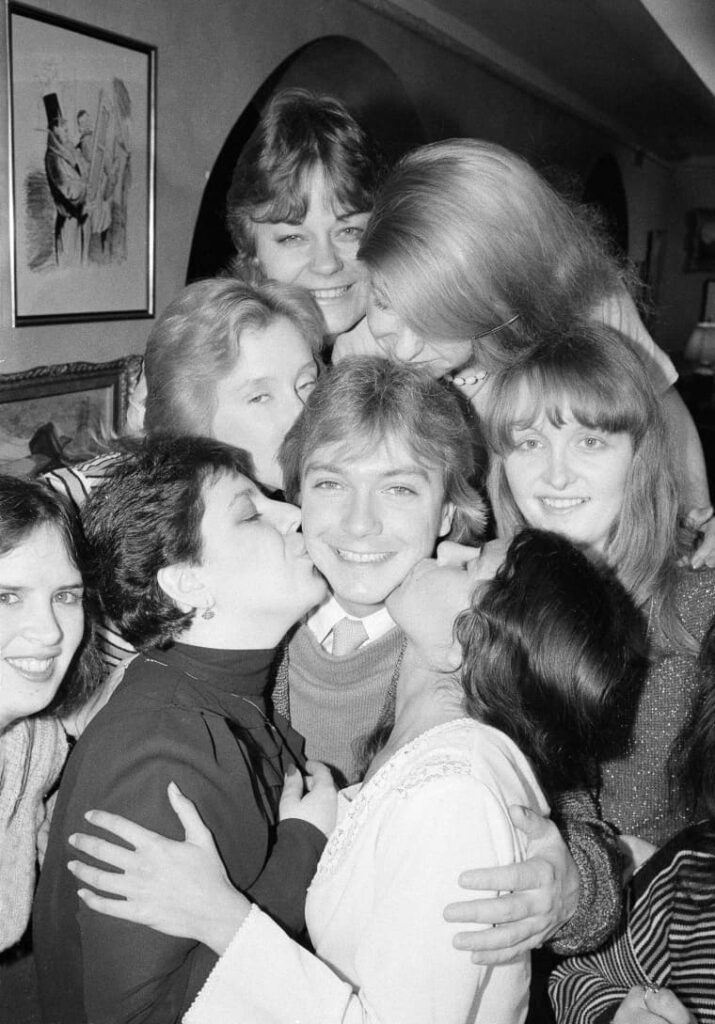
A fleeting moment of youthful longing, where hope, romance, and vulnerability meet under the soft glow of a promised night
Few voices in early 1970s pop carried the same bittersweet charm as David Cassidy, and among his lesser-discussed yet emotionally resonant recordings, “This Could Be The Night” stands as a gentle reminder of a time when anticipation itself was enough to stir the heart. Released during the height of Cassidy’s fame—when his image as both teen idol and serious vocalist was delicately balanced—the song did not achieve the towering chart success of hits like “Cherish” or “How Can I Be Sure,” but it nonetheless found a quiet place in the broader landscape of early ‘70s pop.
The track appeared on the album Rock Me Baby (1972), a record that marked a subtle turning point in Cassidy’s career. While not as commercially dominant as his earlier releases tied to The Partridge Family, the album showcased a maturing artist trying to step beyond the confines of television fame. Although “This Could Be The Night” was not released as a major standalone single in key markets like the U.S. or U.K., and therefore did not secure a notable position on the Billboard Hot 100, it remains a cherished album track among dedicated listeners and collectors of Cassidy’s work.
What makes this song linger is not chart performance, but atmosphere. From the very first notes, there is a softness—an almost hesitant tenderness—that defines the recording. Cassidy’s voice, often associated with youthful brightness, takes on a more introspective tone here. He sings not with certainty, but with possibility. The phrase “this could be the night” is not a declaration—it is a hope, fragile and unspoken, like standing at the threshold of something life-changing without knowing if one should step forward.
Behind the song lies a broader story of transition. By 1972, Cassidy was beginning to feel the pressures of fame and the limitations imposed by his teen idol status. He had already expressed, in interviews of the time, a desire to be taken seriously as a musician. Songs like this—gentler, more reflective, less overtly commercial—hint at that internal struggle. There is a sense that Cassidy was reaching for something more personal, even if the machinery around him still demanded polished pop perfection.
Lyrically, the song captures a universal human moment: the quiet anticipation before a confession, a meeting, or a turning point. It speaks to that delicate space where imagination fills in the gaps left by uncertainty. The night becomes symbolic—not just of romance, but of possibility itself. In this way, the song transcends its era. It is not bound to teenage love alone; it resonates with anyone who has ever paused before a moment that might change everything.
Musically, the arrangement is understated, allowing Cassidy’s vocal to carry the emotional weight. There is a gentle swell in the instrumentation—strings that seem to breathe rather than dominate, a rhythm section that moves like a heartbeat rather than a driving force. It reflects a production style common in early ‘70s pop, where emotion was often conveyed through restraint rather than excess.
Looking back now, “This Could Be The Night” feels like a quiet conversation from another time. It does not demand attention the way chart-topping hits do. Instead, it invites the listener to lean in, to remember what it felt like to hope without certainty, to stand on the edge of something undefined yet deeply meaningful.
In the broader context of David Cassidy’s career, the song may not be the one most often remembered. Yet perhaps that is precisely why it endures. It belongs to those who seek more than nostalgia—those who listen closely, who understand that sometimes the most powerful songs are not the loudest, but the ones that whisper truths we have carried with us all along.