
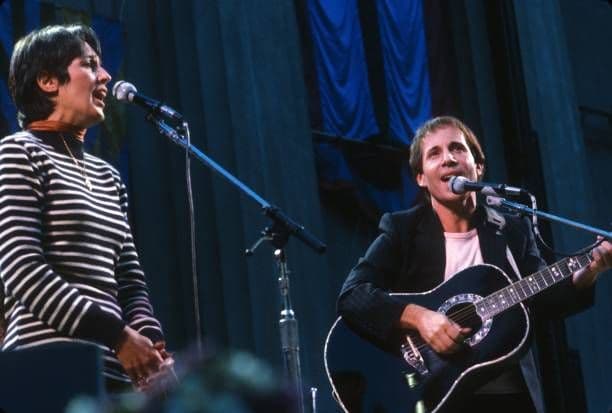
A Gentle Ballad of Endurance and Quiet Dignity, Where Two Voices Carry the Weight of Loneliness and Survival
When “The Boxer” first reached the public in April 1969, it arrived not merely as a song, but as a quiet confession wrapped in poetic resilience. Originally written and recorded by Paul Simon as part of the album “Bridge over Troubled Water” (1970) with Simon & Garfunkel, the song achieved remarkable success, climbing to No. 7 on the Billboard Hot 100 and reaching No. 6 in the UK Singles Chart. Yet, beyond the numbers, its legacy has always rested in its emotional truth—a truth that finds a uniquely tender expression when performed by Joan Baez & Paul Simon together.
The version featuring Joan Baez carries a different kind of gravity. Baez, long associated with the folk revival and the protest spirit of the 1960s, brings a crystalline clarity to the narrative. Her voice does not merely accompany Simon’s—it elevates the song’s quiet sorrow into something almost sacred. Their duet feels less like a performance and more like a shared remembrance, as though two old souls are revisiting a story they both understand all too well.
At its heart, “The Boxer” tells the story of a young man battered by life, searching for meaning in a world that offers little comfort. The lyrics, filled with imagery of New York winters and lonely streets, echo the struggles of disillusionment and perseverance. Simon himself has often suggested that the song is partly autobiographical—a reflection of the criticism and pressure he faced during his career. The famous refrain, “lie-la-lie,” which might seem simple on the surface, becomes in this context a kind of emotional release—wordless, yet deeply expressive, like a sigh carried across years.
The recording of the song is a story in itself. It was famously crafted across multiple locations, including Nashville and New York, with an almost obsessive attention to detail. The striking drum sound—recorded in a church to achieve its echoing resonance—remains one of the most recognizable elements in popular music. This meticulous production underscores the song’s emotional weight, giving it a sense of space and solitude that mirrors the boxer’s journey.
When Joan Baez joins Paul Simon on the song, the narrative subtly shifts. Her presence introduces a sense of compassion, as though the boxer is no longer entirely alone. There is a quiet dialogue between their voices—Simon’s weary introspection balanced by Baez’s luminous steadiness. It is this interplay that gives the duet its enduring appeal, especially for listeners who have lived long enough to recognize the quiet battles described in the song.
Over the decades, “The Boxer” has become more than just a track from a celebrated album. It stands as a meditation on resilience—the kind that does not announce itself loudly, but persists in silence. Its closing lines, where the boxer remains “standing in the clearing,” refusing to yield, resonate with a kind of understated courage that feels timeless.
Listening to Joan Baez & Paul Simon’s interpretation today, one is reminded that some songs do not age—they deepen. The world changes, voices fade, but certain melodies continue to carry the weight of human experience with remarkable grace. “The Boxer” is one of those rare songs: a companion for quiet evenings, a mirror for personal reflection, and above all, a testament to the enduring strength found in simply carrying on.
 Oldies Songs