
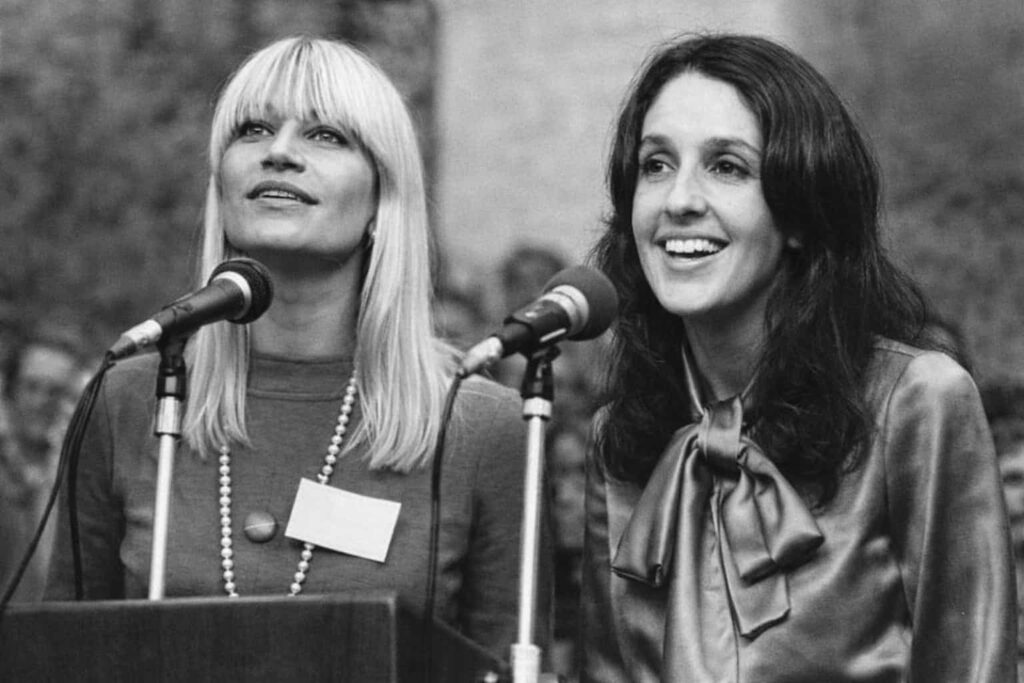
“Lonesome Valley” – A quiet gospel reflection carried by Joan Baez and Mary Travers, where folk memory meets spiritual solitude
There are songs that do not belong to a single decade, nor even to a single generation. “Lonesome Valley”, a traditional American gospel spiritual, is one of those rare pieces of music that seems to exist outside of time itself. When interpreted by two defining voices of the 1960s folk movement—Joan Baez and Mary Travers of Peter, Paul and Mary—it becomes something more than a performance. It feels like a shared remembrance, a passing of something fragile and deeply human from one voice to another.
To be precise and historically grounded, “Lonesome Valley” was never released as a commercial charting single by Joan Baez and Mary Travers. It is not a song associated with Billboard rankings or pop chart competition. Instead, it lives in the quieter corners of folk performance history—recorded and performed in live settings and collaborative folk gatherings where the emphasis was never on commercial success, but on emotional truth and communal storytelling. The song itself is far older than either artist, rooted in early 20th-century American gospel tradition and widely known through recordings by artists such as the Carter Family, who helped popularize it in its early recorded form.
At its core, the lyrics of “Lonesome Valley” carry a simple but unshakable message: no one can walk your path for you. It speaks of solitude not as punishment, but as a condition of human experience. “You got to go there by yourself,” the traditional refrain insists, echoing like a truth that each generation must rediscover in its own way. In the voices of Joan Baez and Mary Travers, this message is softened yet intensified—no longer a stern warning, but a compassionate acknowledgment of life’s inevitable solitude.
What makes this collaboration so emotionally resonant is not technical complexity, but the weight of lived experience behind the voices. By the time these performances were recorded, both singers had already become symbolic figures in the American folk revival—artists who gave voice to civil rights struggles, anti-war sentiment, and the search for moral clarity in turbulent decades. Yet in “Lonesome Valley,” political urgency steps aside, leaving space for something quieter and more reflective. It is almost as if both singers pause, not to protest the world, but to accept its fundamental loneliness with grace.
There is a certain late-afternoon feeling to this song when sung by them—like sunlight fading through an old window, touching familiar objects that suddenly feel unfamiliar. Joan Baez, with her crystalline soprano, often carries a sense of clarity, as if she is observing sorrow from a higher vantage point. Mary Travers, by contrast, brings warmth and groundedness, her voice often feeling like it belongs closer to the earth. Together, they do not compete; they listen to one another. That is what gives “Lonesome Valley” its quiet emotional gravity.
Unlike many folk recordings of the era that were shaped for albums or radio play, this piece feels closer to a shared moment than a product. There is no pursuit of chart placement, no attempt to modernize or reshape its ancient message for commercial appeal. Instead, it stands as a reminder of how folk music often functioned in its purest form: as oral tradition preserved through voice, memory, and presence.
For listeners revisiting it today, especially those who have lived long enough to understand the weight of solitude, “Lonesome Valley” does not feel distant. It feels familiar. It is not merely about hardship—it is about the dignity of facing life’s hardest truths without illusion. And in the pairing of Joan Baez and Mary Travers, that truth is delivered not with despair, but with a calm, almost tender acceptance.
In a world where music is often measured in numbers, rankings, and commercial success, this song resists all of that. It asks for something else entirely: attention, memory, and honesty. And perhaps that is why it continues to linger—not as a hit, but as a reminder of what it means to walk one’s own “Lonesome Valley,” with only one’s own voice, and the echo of others who once sang the same path before us.