
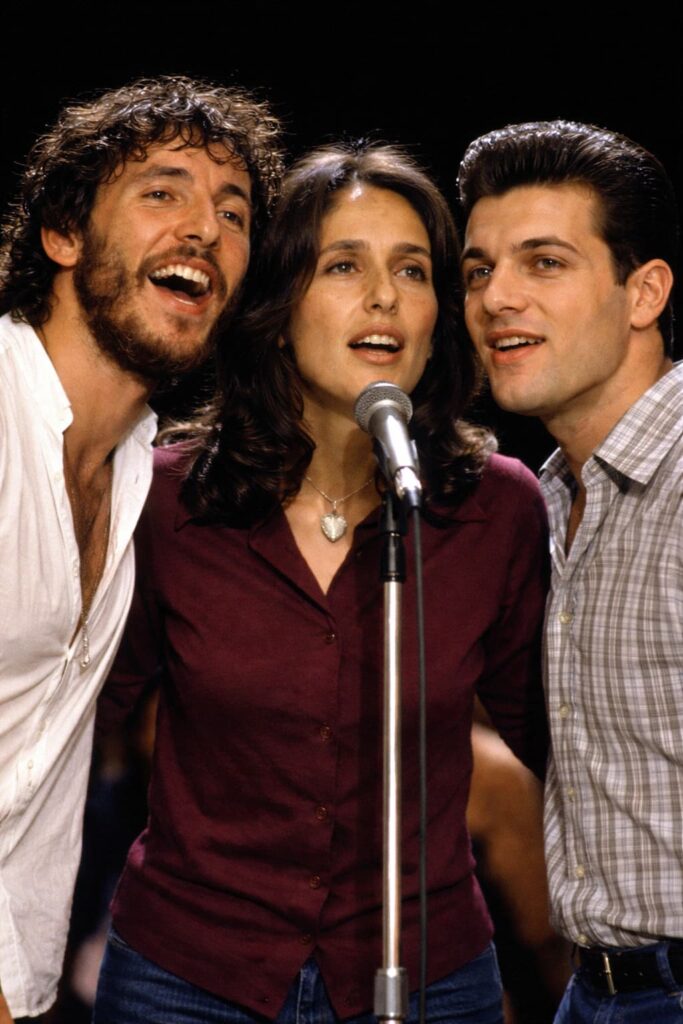
A Birthday Gathering That Echoes Across Generations — Music as Memory, Protest, and Quiet Hope
When the stage lights came up for “Happy Birthday Pete Seeger”, it was far more than a celebratory concert—it was a living archive of American folk music, a moment where voices from different eras gathered to honor a man whose songs had long outlived their time. Held in 2009 at Madison Square Garden, marking the 90th birthday of Pete Seeger, the event became an unforgettable testament to the enduring spirit of protest, unity, and shared humanity. The concert was later released as an album titled “The Clearwater Concert: Celebrating Pete Seeger’s 90th Birthday”, which reached No. 113 on the Billboard 200, a modest chart position perhaps, but one that hardly captures its cultural weight.
What made that night extraordinary was not commercial success, but the gathering itself. Artists like Bruce Springsteen, Joan Baez, and Tommy Sands stood side by side, each bringing their own histories, their own scars, and their own reverence for Seeger. Springsteen, in particular, had long cited Seeger as a guiding light, even dedicating his 2006 album “We Shall Overcome: The Seeger Sessions” to reinterpreting the folk legend’s repertoire. On that birthday stage, his presence felt less like a performance and more like a heartfelt thank-you—one artist acknowledging the roots from which he grew.
The songs performed that evening—“This Land Is Your Land,” “If I Had a Hammer,” “Where Have All the Flowers Gone?”—were not just melodies, but chapters of history. Many of them had once been banned, silenced, or dismissed during turbulent political times, particularly during the era of McCarthyism when Seeger himself was blacklisted. And yet, here they were, sung by thousands, their words rising freely into the rafters. It was a powerful reminder that music, when honest and fearless, cannot be erased.
There is something deeply moving about hearing Joan Baez, whose crystalline voice once carried the sound of civil rights marches, return to these songs decades later. Her performance that night was not about perfection, but about presence—about standing as a witness to time. Similarly, Tommy Sands, known for his gentle but firm advocacy for peace in Northern Ireland, brought a quiet dignity that complemented the evening’s spirit. Each artist, in their own way, became a storyteller, weaving together a tapestry of struggle and hope.
At the center of it all stood Pete Seeger himself—frail in body, but unshaken in spirit. When he joined the others in leading the crowd in song, it felt less like a finale and more like a passing of the torch. His voice, though weathered, still carried the conviction that had defined his life: that music belongs to everyone, and that it can still change the world, one voice at a time.
The meaning behind this “Happy Birthday” was therefore layered and profound. It was not simply about celebrating a life, but about reaffirming a set of values—community, justice, and resilience. For those who had lived through the decades when these songs first emerged, the concert must have felt like opening an old photograph album, each note triggering a memory, each lyric a reflection of a moment once lived.
In the end, the legacy of Pete Seeger is not confined to records or chart positions. It lives on in gatherings like this, where voices come together not for fame, but for something far more enduring. And perhaps that is the quiet miracle of that night: a reminder that while time moves on, some songs—and the truths they carry—never really fade away.
 Oldies Songs