
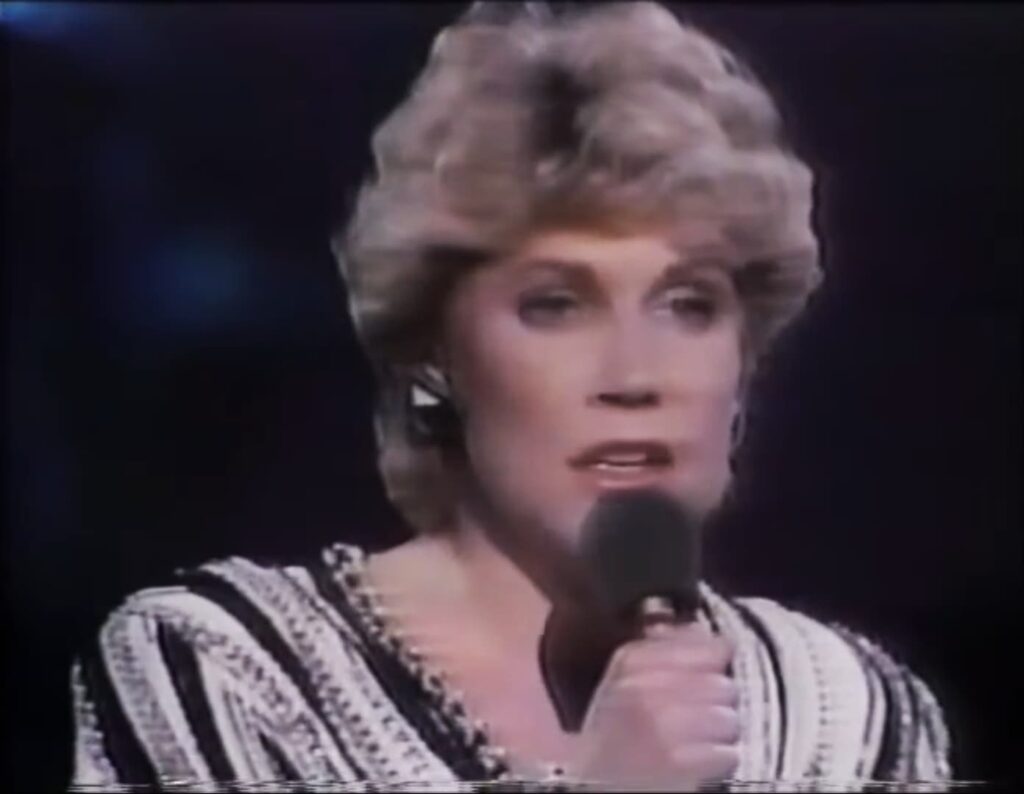
In the Winter of 1984, Anne Murray Walked Into a Snow Covered Television Special and Quietly Sang One of the Gentlest Protest Songs Ever to Become a Major Hit
At first glance, “A Little Good News” sounded almost too soft for its time.
Released during the anxious early 1980s and performed beautifully on Anne Murray’s television special Quebec Winter Carnival, the song carried no political slogans, no dramatic outrage, and no grand declarations. Anne Murray simply stood beneath warm studio lights and sang with calm sincerity about something millions of people were already feeling but rarely saying out loud:
They were exhausted.
Exhausted by fear.
Exhausted by violence.
Exhausted by hearing bad news every single day.
That quiet emotional honesty became the hidden power of “A Little Good News.”
While many listeners remember the song as a gentle adult contemporary country hit, underneath its soft arrangement lived something much deeper. The early 1980s were filled with Cold War anxiety, nuclear fears, economic uncertainty, and relentless television headlines about crime and conflict. Across North America, families sat in living rooms night after night absorbing an endless cycle of negativity through the evening news.
Then Anne Murray arrived with a song asking, almost timidly, if the world could slow down for a moment.
“Nobody robbed a liquor store on the lower part of town…”
Today, the lyric may sound innocent or old fashioned. But in 1983 and 1984, it reflected a very real emotional fatigue spreading quietly through society. People were overwhelmed long before terms like “doomscrolling” or “media burnout” even existed.
That is part of what makes the performance feel strangely modern now.
More than forty years later, “A Little Good News” may resonate even more deeply than it did when it first topped the charts and earned Anne Murray the Grammy Award for Best Female Country Vocal Performance.
The genius of Anne Murray’s interpretation was that she never oversold the message.
Another singer might have turned the song into political drama or emotional spectacle. Anne approached it differently. She sang like a trusted friend sitting beside you after a difficult day. Her voice carried warmth instead of anger, reassurance instead of confrontation.
That quality defined much of her career.
Unlike many major stars of her era, Anne Murray never built herself around rebellion, glamour, or tortured celebrity mythology. Her strength came from sincerity. Audiences trusted her because she sounded emotionally steady in a world that often felt increasingly noisy and unstable.
Watching the Quebec Winter Carnival performance today feels like stepping back into a lost era of television itself. The snow filled imagery, orchestral warmth, cozy staging, and gentle pacing all reflect a time when television specials still tried to comfort audiences instead of overwhelm them.
It feels almost like emotional shelter from another century.
And perhaps that explains why the performance remains so moving decades later.
When Anne sings, “We sure could use a little good news today,” the line lands with extraordinary emotional force not because it is lyrically complex, but because she sounds as though she truly means it. There is no irony in her delivery. No cynicism. Only quiet hope that people might become kinder to one another and that the world might soften, even briefly.
That understated humanity helped make Anne Murray unique within both country and pop music.
She stood at the intersection of country warmth, adult contemporary elegance, and family television culture, creating songs that offered calm rather than chaos. In many ways, “A Little Good News” became the perfect summary of her artistic identity: gentle, sincere, emotionally reassuring, and deeply compassionate.
Looking back now, there is also something bittersweet about realizing how prophetic the song became.
In 1983, Anne Murray was already singing about emotional overload decades before social media accelerated the feeling beyond imagination. What once sounded like a modest request now feels almost like a cultural warning delivered softly enough that people barely noticed.
And maybe that is why the performance still lingers in the heart.
Because Anne Murray proved something many artists forget:
Sometimes gentleness can carry more power than anger ever could.