
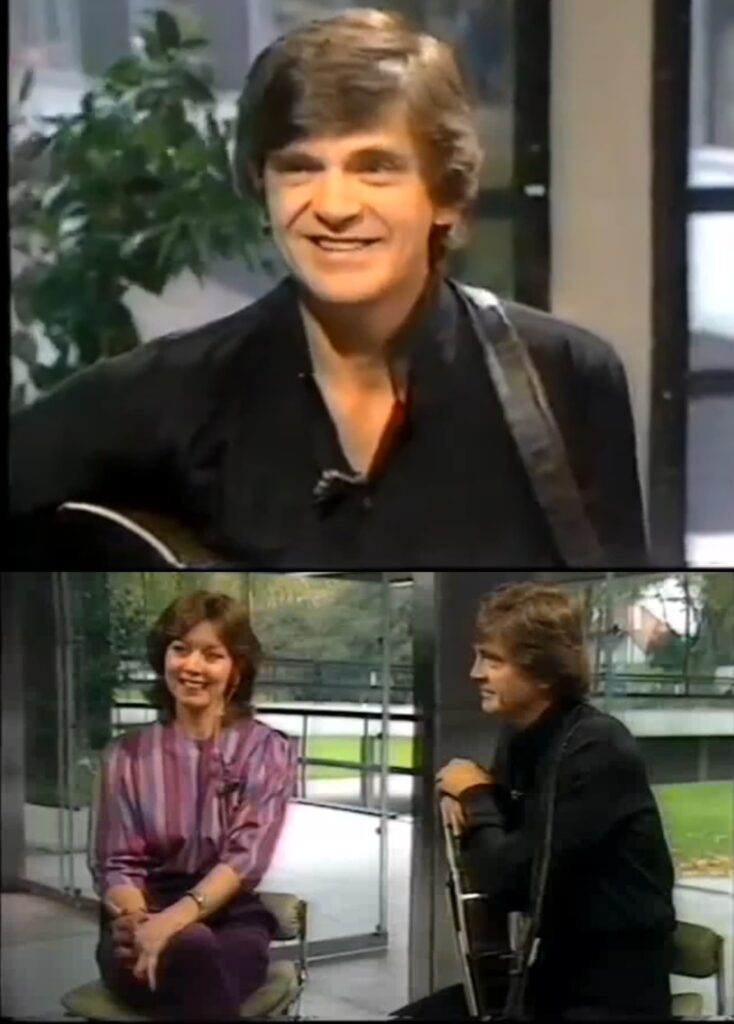
In a Quiet 1982 BBC Interview, Phil Everly Spoke About the End of The Everly Brothers So Casually That It Somehow Made the Story Even More Heartbreaking
By October 1982, rock and roll had already changed several times over.
The age of clean cut harmony duos had given way to arena rock, punk, New Wave, MTV, and synthesizers. Yet sitting calmly on the BBC program Pebble Mill at One, Phil Everly still carried the same soft spoken warmth that once helped make The Everly Brothers one of the most influential acts in popular music history.
What makes the interview so moving today is not dramatic confession or bitterness.
It is how ordinary Phil sounds while talking about extraordinary things.
When the host mentioned that it had been nearly ten years since the breakup of The Everly Brothers, Phil simply replied, “We decided to put away the Everly Brothers and kind of take a couple of years off.”
Put away.
Not destroy. Not collapse. Not feud.
Just “put away,” almost like storing old furniture in an attic.
Anyone familiar with the brothers’ history understood the pain hidden beneath those gentle words. Years of exhaustion, tension, arguments, and emotional distance had slowly torn apart one of the most famous sibling partnerships in music. But Phil spoke about it without anger, sounding instead like a man who had simply become tired.
Then came the line many fans still remember most.
After the breakup, Phil said he “grew tomatoes and got a dog.”
It remains one of the most unexpectedly human moments ever spoken by a rock and roll pioneer. Here was one of the voices that helped shape modern harmony singing, a man who influenced The Beatles, Simon & Garfunkel, and countless folk rock artists, quietly describing life after fame as gardening and ordinary routines.
That contrast gives the interview its emotional power.
Behind the screaming audiences and hit records was someone who never entirely seemed comfortable with celebrity culture in the first place. Unlike many stars of the 1950s and 1960s, Phil Everly carried a shy and reflective presence. During the interview, he smiled politely, laughed softly, and never tried to dominate the room. He sounded less like a legend and more like someone cautiously rebuilding his life.
There was another fascinating layer to the conversation.
Phil explained that he had traveled to England to record new music because “the English are dominating the charts in the United States.” It was a remarkable full circle moment. After all, The Everly Brothers had heavily influenced the British Invasion itself. Without the Everlys’ close harmonies, early recordings by The Beatles and many British vocal groups might have sounded entirely different.
Now, in 1982, Phil was returning to Britain to learn from a younger generation shaped partly by his own legacy.
What also surprised many viewers was his openness toward modern production. Rather than rejecting synthesizers or contemporary sounds, Phil embraced them. Speaking about his single “Louise,” he explained that it included “all the new techniques” while still remaining true to the melodic songwriting he believed in.
The performance that followed captured that balance perfectly.
“Louise” carried glossy early 1980s textures and soft synthesizers, yet underneath it still sounded unmistakably like Phil Everly. The melancholy melody, romantic atmosphere, and delicate phrasing all carried echoes of the emotional sensitivity that once made songs like “All I Have To Do Is Dream” immortal.
Watching the interview today feels strangely bittersweet.
Phil spoke warmly about his teenage son learning guitar and writing songs. He talked about future tours and future plans with quiet optimism. Modern audiences, however, watch knowing how much time has already passed. The Everly Brothers would eventually reunite, grow old, and finally become part of music history themselves.
That knowledge hangs gently over every moment of the interview.
But perhaps the most nostalgic thing about the entire broadcast is its intimacy. The host and artist simply talked. About children, gardening, uncertainty, music, and life after fame. No scandal. No shouting. No desperate self promotion.
Just conversation.
And in that calm afternoon BBC studio, one of the architects of modern popular music sat smiling modestly, sounding less like a surviving rock legend and more like a thoughtful man quietly learning how to begin again.