
A joyful revival of rock ’n’ roll innocence—where a new generation rediscovers the thrill of young love through an old classic
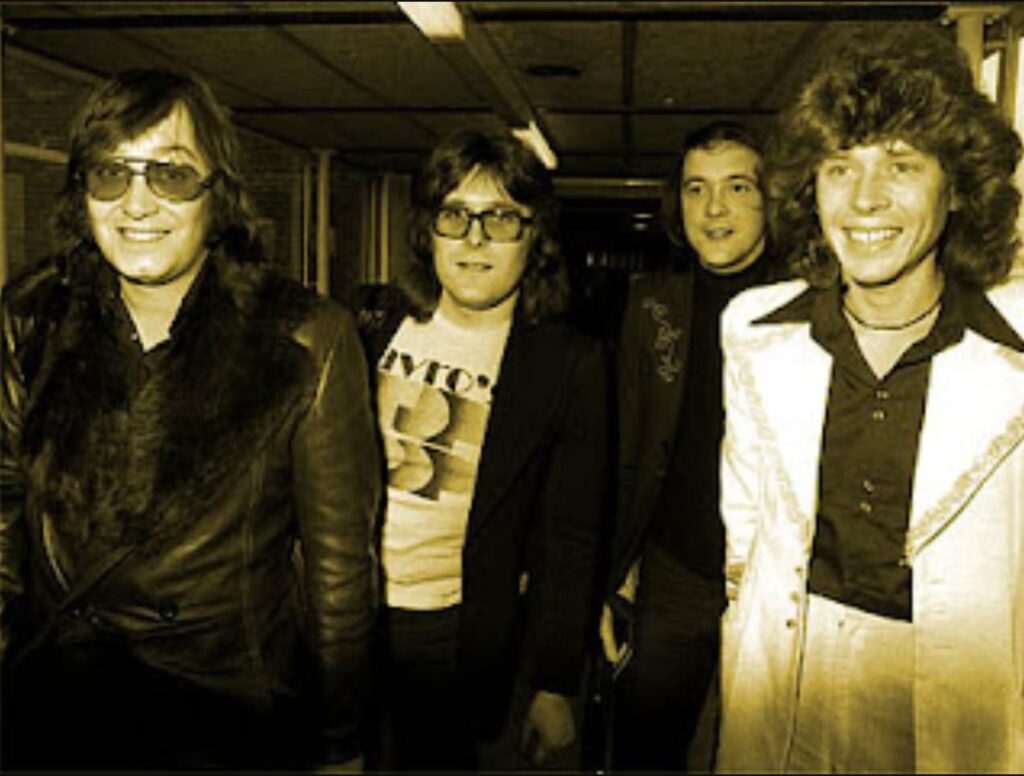
When Oh Boy burst onto the airwaves in 1975, it carried with it more than just a catchy rhythm—it revived a spirit that many thought had faded with time. Performed by Mud, the song reached an impressive No. 1 on the UK Singles Chart, marking one of the band’s most commercially successful moments. Yet behind that chart-topping achievement lies a deeper story—one rooted in nostalgia, tribute, and the enduring power of early rock ’n’ roll.
Originally written and recorded by Buddy Holly in 1957, “Oh Boy” was a quintessential expression of youthful excitement—simple, direct, and irresistibly upbeat. Holly’s version carried the raw innocence of early rock, a sound that defined a generation just discovering the electric possibilities of modern music. Nearly two decades later, Mud chose to reinterpret this classic, not merely as a cover, but as a heartfelt homage.
By the mid-1970s, Mud had already established themselves within the glam rock movement, known for hits like “Tiger Feet” and “Lonely This Christmas.” Yet with “Oh Boy,” they stepped away from glitter and theatrics, embracing instead a stripped-down, retro style that paid clear respect to rock’s formative years. Produced by the hit-making duo Nicky Chinn and Mike Chapman, the track retained its original charm while adding a polished, contemporary sheen suitable for the era.
What makes Mud’s version particularly compelling is its sincerity. Unlike many covers that attempt to reinvent or modernize beyond recognition, this rendition feels like a conversation across time—a bridge between generations. The band understood that the essence of “Oh Boy” lay not in complexity, but in its unfiltered joy. And so they preserved that spirit, allowing listeners to reconnect with a simpler emotional landscape.
Lyrically, the song celebrates the anticipation and exhilaration of love—the kind that feels almost overwhelming in its intensity. “All of my love, all of my kissin’…”—the words themselves are uncomplicated, yet they carry a weight of genuine feeling. In Mud’s hands, these lines resonate with a kind of knowing warmth, as if revisited with the wisdom of years, yet still capable of stirring the same youthful heartbeat.
There is also a quiet poignancy in this revival. By 1975, the world had changed significantly from the days of Buddy Holly. Music had evolved, tastes had shifted, and the innocence of the 1950s often seemed like a distant memory. And yet, in bringing “Oh Boy” back to life, Mud reminded audiences that certain emotions remain timeless. Love, excitement, longing—these do not belong to any one era.
For many listeners, the song became more than just a hit single; it was a doorway back to a different time. A time when music was played on vinyl, when melodies lingered long after the needle lifted, and when a simple song could capture the entirety of a feeling without the need for excess.
In retrospect, “Oh Boy” stands as a testament to the cyclical nature of music. Styles may come and go, but the heart of a great song endures. Mud’s success with the track was not just a commercial victory—it was a cultural moment, a gentle reminder that sometimes, looking back is the best way to move forward.
And perhaps that is why, even today, the opening notes of “Oh Boy” still carry a certain magic. Not because they are new, but because they are familiar—like a memory that never truly fades, waiting patiently to be heard again.