
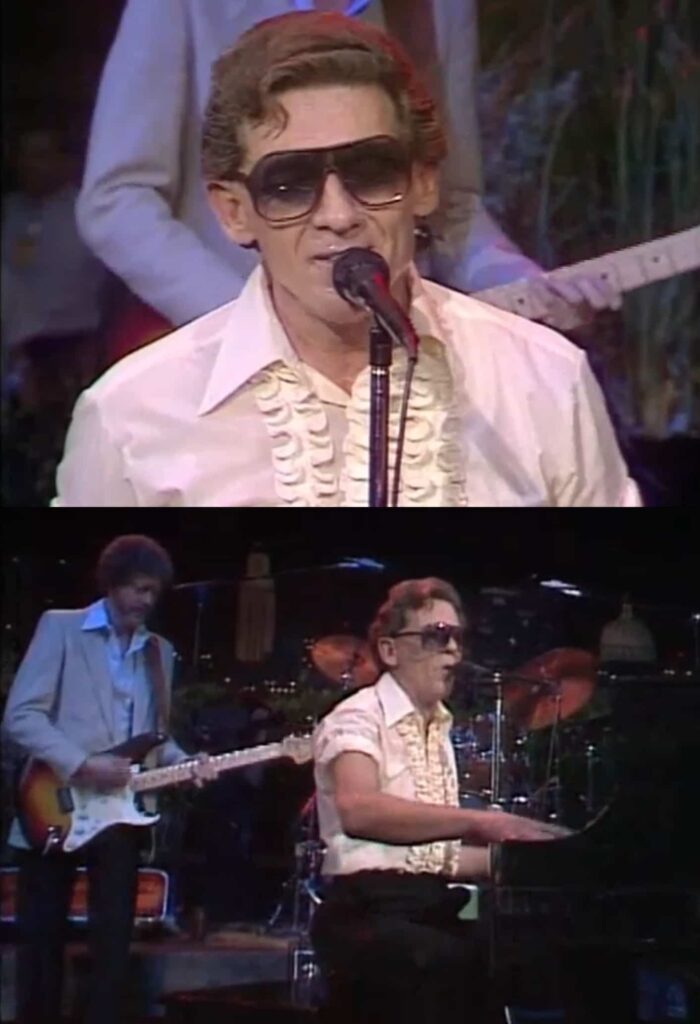
When the Piano Caught Fire Again: How “Whole Lotta Shakin’ Goin’ On” Proved Jerry Lee Lewis Had Lost None of His Fury
On October 17, 1983, during an appearance on Austin City Limits, Jerry Lee Lewis stormed through “Whole Lotta Shakin’ Goin’ On” with the same reckless energy that had shocked audiences decades earlier. By then, Lewis was already a living monument to the birth of rock and roll. Yet the performance made one thing unmistakably clear: age had not tamed him.
From the opening moments, the atmosphere changes completely. Lewis does not ease into the song. He attacks it. The piano pounds forward with relentless rhythm while his voice swings between playful swagger and raw command. The famous call-and-response lines, half sung and half shouted, turn the performance into something larger than music. It feels like controlled chaos.
Originally released in 1957, “Whole Lotta Shakin’ Goin’ On” helped define the rebellious spirit of early rock and roll. By 1983, many artists from that era had softened into nostalgia acts. Lewis refused to do that. On the Austin City Limits stage, he performed the song not as history, but as living instinct.
What makes this rendition remarkable is its looseness. Lewis bends timing, stretches phrases, jokes with the audience, and injects spontaneous humor into nearly every section. Even the spoken asides about “shaking” and “wiggling” carry the unpredictable edge that made him famous. The performance constantly threatens to spill out of control, yet somehow never does.
The audience response mirrors the electricity coming off the stage. Cheers erupt throughout the song, not simply from recognition, but from astonishment that Lewis could still summon such force. There is a sense that everyone in the room understands they are witnessing one of the last true originals operating entirely on instinct.
And then there is the ending. After the final explosion of applause, Lewis pauses to thank the audience, offering blessings and gratitude with surprising sincerity. For a brief moment, the wildness gives way to reflection. The contrast makes the performance even more human.
Looking back, this 1983 appearance stands as more than a revival of a classic hit. It captures the essence of Jerry Lee Lewis himself: volatile, charismatic, deeply rooted in gospel and country traditions, yet forever pushing against restraint.
That is why the performance still resonates. Because beneath the pounding piano and wild laughter lies the sound of an artist refusing to become a memory. Even decades after changing music forever, The Killer still played as though the room might burst into flames if he stopped.