
A Restless Portrait of Loneliness Hidden Behind Neon Lights and Late-Night Bars
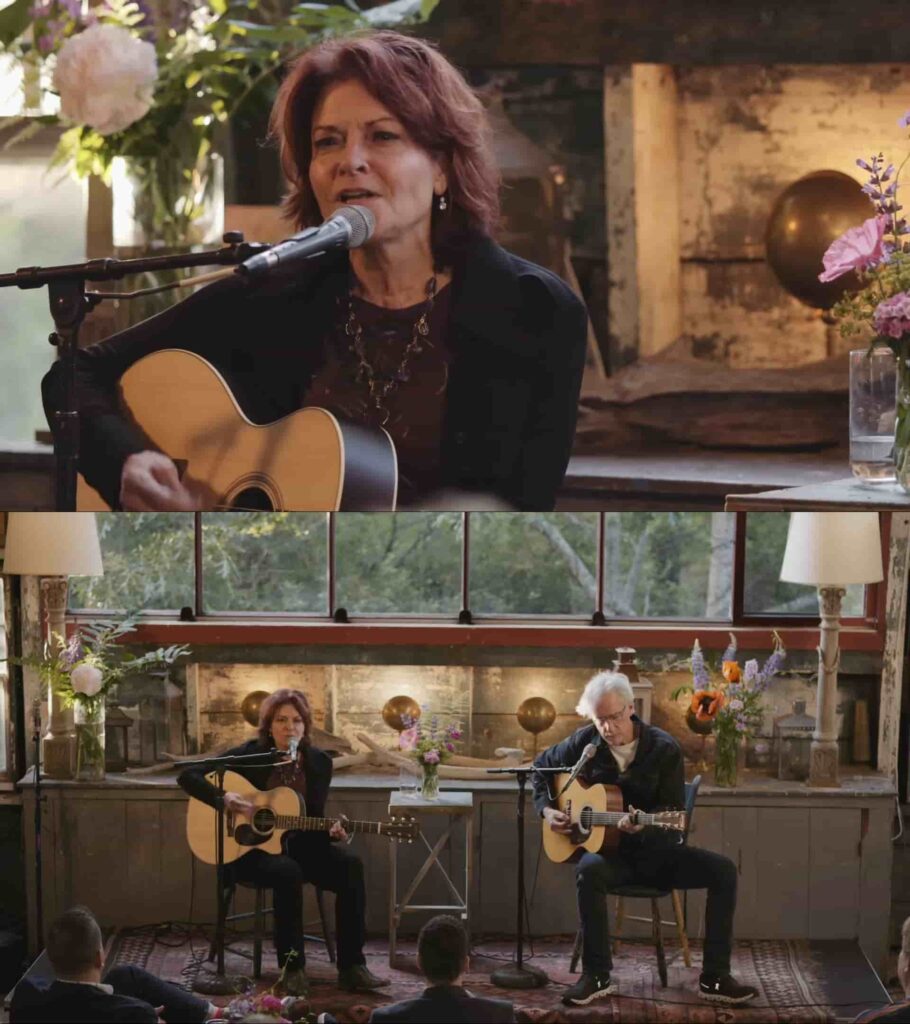
When Rosanne Cash sings “Seven Year Ache,” she does not sound like someone merely performing a country hit. She sounds like a woman standing quietly at the edge of heartbreak, watching another person drift further into emotional exile with every passing night. In this intimate performance accompanied by John Leventhal, the song sheds the polished brightness of its original studio recording and becomes something even more haunting: a weary conversation between memory, regret, and survival.
Originally released in 1981 as the lead single from Rosanne Cash’s landmark album Seven Year Ache, the song became the defining breakthrough of her early career. It reached No. 1 on the Billboard Hot Country Singles chart and crossed over impressively to the pop audience, climbing to No. 22 on the Billboard Hot 100. At a time when country music was cautiously beginning to flirt with broader mainstream sounds, Rosanne Cash managed to create something unusually sophisticated — emotionally literate country music wrapped inside subtle pop textures and restless late-night atmosphere.
But commercial success only tells part of the story.
What made “Seven Year Ache” extraordinary in 1981 was not simply its melody or chart position. It was the emotional ambiguity running through every line. Unlike traditional country heartbreak songs that often divide characters neatly into heroes and villains, Rosanne Cash wrote something far more psychologically honest. The narrator is not innocent. The man she addresses is not entirely cruel. Instead, both seem trapped inside cycles of loneliness, self-destruction, and emotional distance they barely understand themselves.
That complexity was deeply personal to Rosanne Cash. As the daughter of Johnny Cash, she spent much of her early life growing up around music, fame, instability, and constant movement. By the late 1970s and early 1980s, she was determined to establish herself not as “Johnny Cash’s daughter,” but as a serious songwriter with her own artistic voice. “Seven Year Ache” became the song that finally separated her identity from her father’s towering shadow.
The title itself carries layered meaning. Traditionally, the phrase “seven-year itch” refers to restlessness or dissatisfaction in long-term relationships. Rosanne subtly transforms that familiar expression into something sadder and more enduring: an ache rather than an itch. Not temporary temptation, but emotional exhaustion that settles deep into the bones.
The lyrics unfold like scenes from a dimly lit roadside bar sometime after midnight. Men leaning over pool tables. Women watching from corners. Empty boulevards. False bravado hiding private despair. Rosanne Cash paints these details with remarkable precision, but never overexplains them. She trusts silence as much as words.
That restraint becomes even more powerful in this live duet setting with John Leventhal, her longtime musical collaborator and later husband. Leventhal’s guitar work does not dominate the performance; it breathes beside her voice. The spaces between notes matter as much as the notes themselves. Together, they create the feeling of two people sitting awake long after everyone else has gone home, still trying to understand why certain wounds never fully disappear.
There is also something timeless about Rosanne Cash’s vocal delivery. She never approaches heartbreak theatrically. Her voice remains calm, conversational, almost detached at moments — which somehow makes the sadness hit harder. Many singers try to dramatize pain. Rosanne Cash often understates it, allowing listeners to recognize their own private loneliness inside the quiet spaces of the song.
By the early 1980s, country music was changing rapidly. The “Urban Cowboy” era had brought smoother production, crossover ambitions, and polished radio sounds. Yet “Seven Year Ache” avoided becoming disposable pop-country because Rosanne anchored it in emotional realism. The song carried literary intelligence without losing accessibility. It sounded modern without abandoning country storytelling traditions.
Over the decades, the song has aged remarkably well because its emotional landscape remains painfully recognizable. Almost everyone eventually encounters some version of the people inside this song: those who keep disappearing into nightlife, into distractions, into emotional avoidance, hoping movement will somehow outrun memory. But Rosanne Cash understands something difficult and true — loneliness travels with us.
Watching this performance now feels different than hearing the original hit in 1981. Time has added gravity to every lyric. Rosanne no longer sings as a young artist proving herself. She sings as someone who has lived through decades of love, disappointment, reinvention, and endurance. That history quietly lingers behind every line.
And perhaps that is why “Seven Year Ache” continues to resonate so deeply. It is not simply a song about romantic failure. It is about the human tendency to wander emotionally even when we desperately want connection. It understands that some people keep moving not because they are free, but because they are afraid to stop long enough to face themselves.
Few country songs capture that truth with such elegance, intelligence, and melancholy grace.