
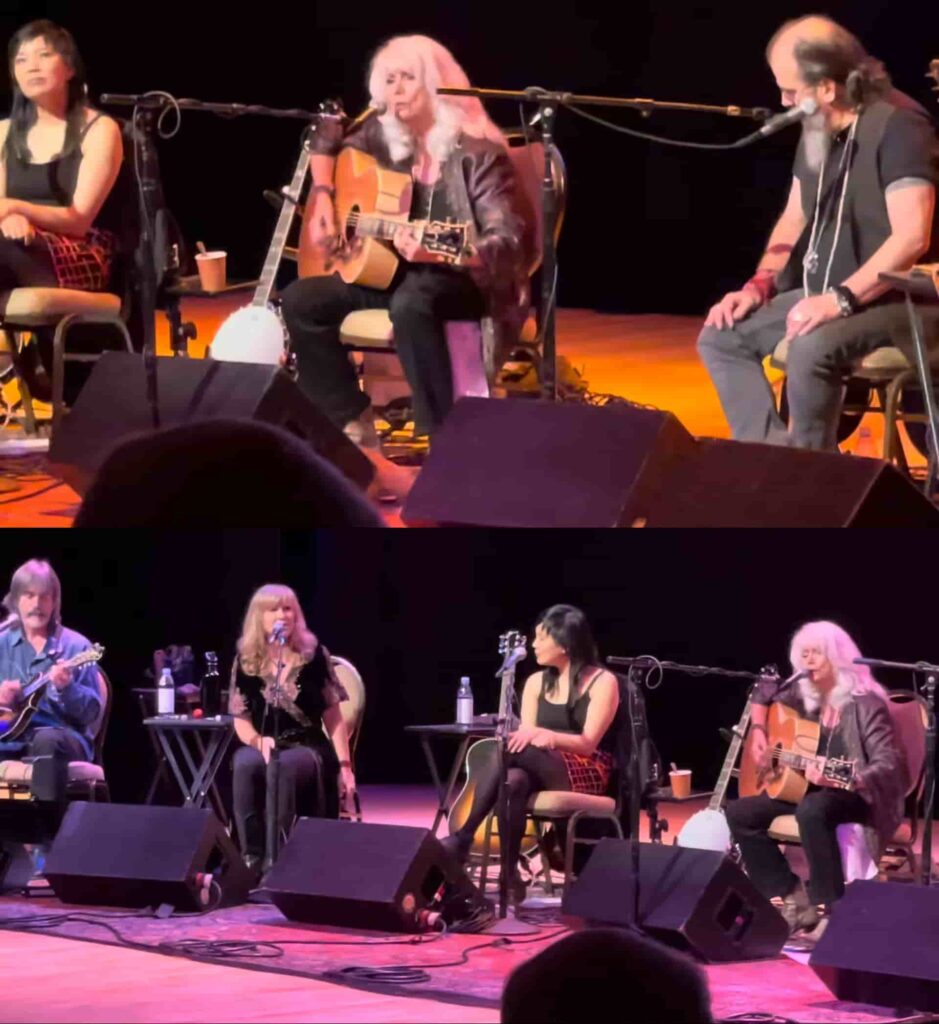
At 74, Emmylou Harris Turned a Simple Bluegrass Hymn Into a Meditation on Memory, Time, and Grace
On October 30, 2021, inside the warm wooden walls of the Scottish Rite Auditorium in Collingswood, New Jersey, Emmylou Harris closed the Lantern concert series not with spectacle, but with something far more enduring: honesty.
Before singing “Green Pastures,” the song she once recorded during the groundbreaking Roses in the Snow era, Harris stood before the audience and laughed at herself. She spoke about what she jokingly called the “over-70 disease,” admitting that forgotten lyrics now felt like misplaced files stored somewhere on her “other hard drive.” The room laughed with her, not at her. It was the kind of humor that only comes from a life fully lived.
Then the music began.
For many listeners, Roses in the Snow remains one of the defining acoustic albums of modern American roots music. Released in 1980, it helped bring bluegrass textures into a wider country audience at a time when polished Nashville production dominated the radio. Harris reminded the audience that Ricky Skaggs had first taught her “Green Pastures,” a song originally associated with The Stanley Brothers. More than four decades later, she returned to it with the same reverence, though now carrying the weight of time in every note.
“I think we’re going to girly it up,” she teased before the performance.
What followed was neither fragile nor nostalgic in the ordinary sense. It felt deeply alive.
Backed by the rich low harmonies of Larry Campbell, Harris delivered the old gospel-bluegrass standard with remarkable tenderness. Her voice no longer soared with the bright sharpness of youth. Instead, it floated with something rarer: experience. Every phrase seemed weathered by years of highways, concerts, losses, reunions, and survival.
The arrangement remained beautifully restrained. Acoustic instruments moved gently beneath her vocal, creating the feeling of an old Appalachian church gathering somewhere beyond time itself. When Harris sang about “green pastures where we shall live and die,” the words no longer sounded symbolic. They felt personal.
That was the extraordinary power of this performance.
Many artists spend their later years trying to recreate who they once were. Emmylou Harris did the opposite. She allowed age to enter the music openly. The forgotten lyrics, the self-aware jokes, the softer edges in her voice, all of it became part of the emotional architecture of the evening.
In that moment, “Green Pastures” stopped being merely a traditional song. It became a reflection on memory itself. On what remains after decades pass. On how music can preserve entire chapters of life long after youth disappears.
The audience inside the Scottish Rite Auditorium seemed to understand this instinctively. There was no rush in the room. No hunger for theatrics. Only quiet attention. The kind reserved for artists whose songs have traveled beside people for years through marriages, funerals, long drives, heartbreaks, and lonely midnights.
As the final harmonies faded into silence, Harris offered something larger than performance. She reminded everyone why roots music survives generation after generation. Not because it stays unchanged, but because it continues aging alongside the people who carry it forward.
And on that October night in New Jersey, “Green Pastures” sounded greener than ever.