
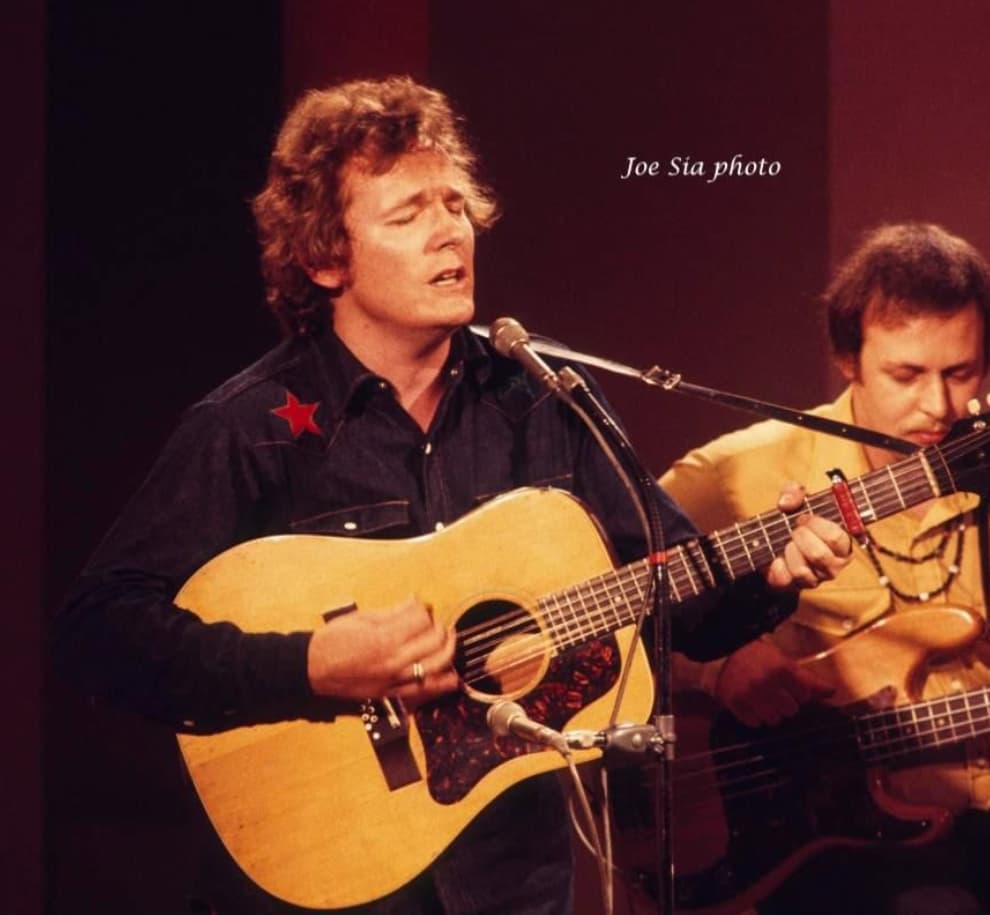
A song about freedom, loneliness, and two drifting souls who could never truly stay in one place — “Me and Bobby McGee” remains one of the most bittersweet reflections on love ever written in American music.
There are songs that become hits… and then there are songs that become part of memory itself. “Me and Bobby McGee” belongs to the second category. Long before it became forever linked with Janis Joplin, the song had already begun its life in the hands of one of country music’s greatest storytellers, Kris Kristofferson. But when Gordon Lightfoot recorded his version in 1970, he brought something uniquely his own to it — a quiet dignity, a weathered tenderness, and the feeling of a man looking back on the road behind him with equal parts gratitude and sorrow.
Released on Lightfoot’s 1970 album Sit Down Young Stranger — later retitled If You Could Read My Mind after the success of that single — “Me and Bobby McGee” became one of the standout interpretations of the era. While Lightfoot’s version did not reach the towering commercial heights of Joplin’s posthumous No. 1 recording, it still performed strongly in Canada and became deeply respected among folk and country audiences for its restrained emotional honesty. In many ways, Lightfoot’s interpretation feels closer to the song’s dusty, wandering roots than the explosive heartbreak heard in Joplin’s version.
The story behind the song itself has become part of music folklore. Kristofferson reportedly wrote “Me and Bobby McGee” after a suggestion from producer Fred Foster, who was inspired by the name of a secretary named Bobbie McKee. What emerged, however, was far more than a clever title. The song became an anthem for drifters, outsiders, and restless spirits — people forever chasing freedom even when they know freedom often comes with loneliness attached to it.
Few lines in popular music have carried as much emotional weight as:
“Freedom’s just another word for nothing left to lose.”
That lyric alone helped elevate the song beyond ordinary country storytelling. It captured the complicated spirit of the late 1960s and early 1970s — a time when many people were questioning stability, tradition, and the meaning of happiness itself. In Lightfoot’s hands, the lyric does not sound rebellious or triumphant. It sounds reflective. Almost tired. Like wisdom earned the hard way somewhere between bus stations, empty highways, and faded motel rooms.
Musically, Lightfoot approached the song with remarkable subtlety. Unlike the raw emotional storm of Janis Joplin’s rendition, his version leans into acoustic warmth and narrative clarity. His calm baritone voice allows the lyrics to breathe naturally, almost as though he is recalling a real chapter from his own life rather than performing a composition. That was always one of Gordon Lightfoot’s greatest strengths as an artist — he never sounded like he was trying to impress anyone. He sounded like someone telling the truth.
And perhaps that is why his recording continues to resonate decades later.
By 1970, Lightfoot was already becoming one of Canada’s defining singer-songwriters, admired for compositions like “Early Morning Rain”, “Ribbon of Darkness”, and later “If You Could Read My Mind.” But “Me and Bobby McGee” revealed how naturally he could inhabit another writer’s song while still making it unmistakably his own. He understood the loneliness hidden beneath the romance of the open road. He understood that many great love stories are remembered not because they lasted, but because they disappeared.
There is also something timeless about the imagery in the song itself: diesel trucks, windshields, cheap diners, highways stretching endlessly toward nowhere in particular. Those details belong to a very specific America, yet the emotions feel universal. Everyone, at some point, remembers a person they once traveled beside — someone who shared a season of life before vanishing into memory.
Over the decades, “Me and Bobby McGee” has been recorded by dozens of artists across country, folk, rock, and pop music. Yet Gordon Lightfoot’s version remains quietly special because it avoids dramatics altogether. Instead, it offers acceptance. The sadness is there, certainly — but so is gratitude. The narrator does not curse the ending. He simply remembers.
That emotional restraint is precisely what gives the performance its lasting power.
Today, revisiting “Me and Bobby McGee” through Gordon Lightfoot’s voice feels like opening an old photograph album found in a dusty attic. The faces may have faded. The roads may no longer exist. But the emotions remain startlingly clear. And somewhere inside that gentle melody lives one of music’s oldest truths:
Sometimes the people who mean the most to us are the ones we were never meant to keep.