
Three Generations of Women, One Enduring Legacy, and the Quiet Power of Songs That Tried to Change the World
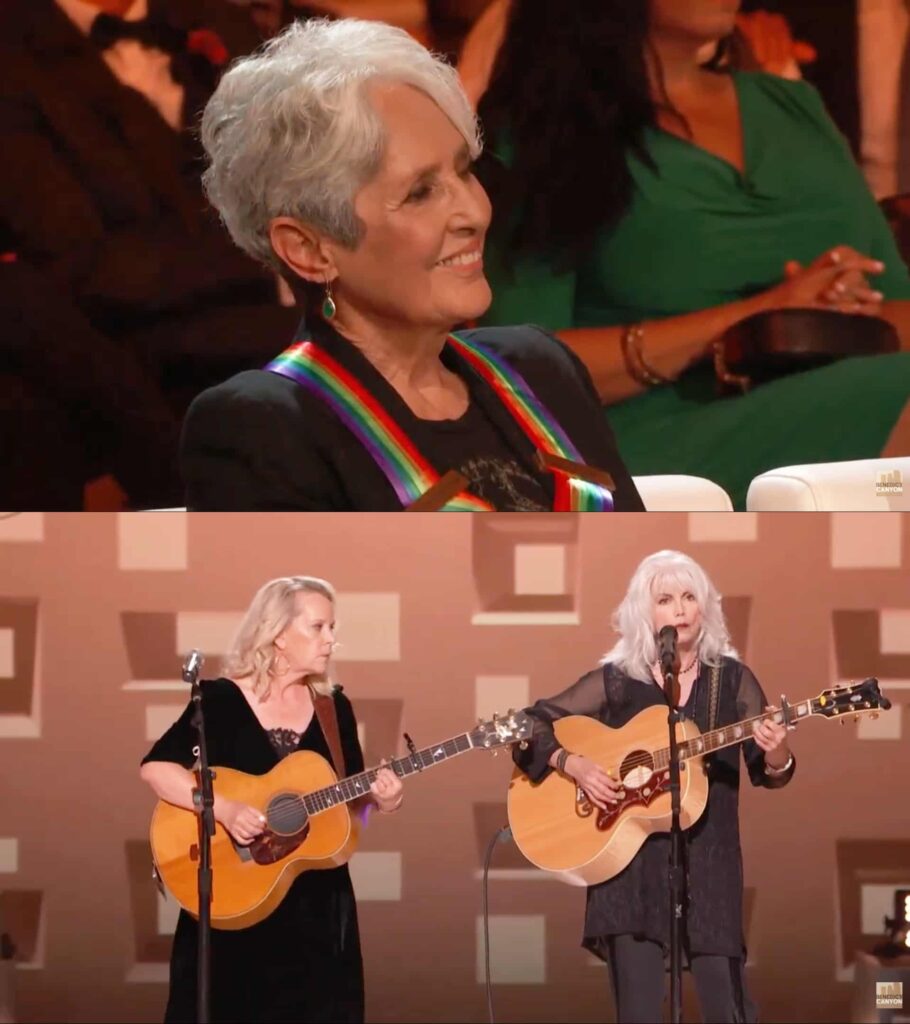
When Mary Chapin Carpenter and Emmylou Harris stepped onto the stage at the Kennedy Center Honors to celebrate Joan Baez, the moment carried a kind of emotional gravity that extended far beyond music. This was not simply a tribute performance arranged for television. It felt like a passing of memory, conscience, and artistic responsibility from one generation of women to another.
By the time Joan Baez received her Kennedy Center Honor in 2021, her place in American cultural history had long been secured. Emerging from the folk revival of the late 1950s and early 1960s, Baez became one of the defining voices of protest music during the Civil Rights Movement and the Vietnam War era. With songs like “Diamonds & Rust,” “We Shall Overcome,” “Farewell Angelina,” and her unforgettable interpretations of Bob Dylan’s early work, she transformed folk music into something larger than entertainment. For millions, Joan Baez represented moral clarity during years of national division and social upheaval.
That history lingers quietly behind every second of this performance.
Both Mary Chapin Carpenter and Emmylou Harris belong to later generations of American songwriting, yet neither would sound exactly the same without the path Joan Baez helped create. Long before female singer-songwriters became commercially celebrated figures, Baez stood on stages armed with little more than an acoustic guitar, an impossibly pure soprano voice, and the courage to publicly align herself with unpopular causes. She marched alongside Martin Luther King Jr., protested war policies, defended human rights internationally, and consistently used her fame not as insulation from the world, but as a way to confront it directly.
That sense of integrity shaped the atmosphere of this tribute.
There is no unnecessary spectacle in the performance. No theatrical overstatement. Instead, Mary Chapin Carpenter and Emmylou Harris approach the moment with visible humility, almost as though they understand they are stepping into sacred musical territory. Their harmonies unfold with remarkable gentleness, allowing emotion to emerge naturally rather than forcing it outward.
And few artists understand harmony quite like Emmylou Harris.
For decades, Harris has possessed one of the most emotionally recognizable voices in American music — ethereal, weathered, luminous, and somehow simultaneously comforting and heartbreaking. Her harmonies rarely overpower songs; they elevate them quietly, like memory drifting through a room. Beside her, Mary Chapin Carpenter brings grounded warmth and reflective intelligence, qualities that have defined her songwriting since the late 1980s.
Together, their voices create something extraordinarily intimate.
What makes the performance especially moving is the absence of ego. Neither artist attempts to reinterpret Joan Baez through modern stylization or dramatic reinvention. Instead, they honor the emotional purity that always defined Baez’s artistry. In doing so, they remind listeners of something contemporary music often forgets: simplicity can carry enormous emotional power when rooted in sincerity.
Watching Joan Baez seated in the audience during the tribute adds another emotional dimension entirely. Age softens the moment without diminishing its significance. This is no longer the fierce young activist facing hostile crowds during the 1960s. This is a woman looking back across decades of struggle, music, political conflict, and cultural transformation — now witnessing younger artists acknowledge the path she carved for them.
There is something deeply touching about that continuity.
Folk music has always depended on preservation through human connection rather than commercial machinery. Songs survive because people continue singing them. Values survive because someone chooses to carry them forward. In this performance, Mary Chapin Carpenter and Emmylou Harris become part of that tradition. They are not merely honoring Joan Baez the celebrity. They are honoring Joan Baez the conscience.
And conscience has always been central to Baez’s legacy.
While many artists of the 1960s eventually distanced themselves from overt political engagement, Joan Baez remained remarkably consistent throughout her life. Whether advocating for civil rights, opposing war, supporting imprisoned dissidents, or speaking about nonviolence, she treated music not as escape from reality, but as participation in it. That seriousness sometimes made her polarizing. It also made her unforgettable.
Musically, the tribute reflects the enduring connection between folk and country traditions. Though often categorized separately by the music industry, both genres share deep roots in storytelling, emotional honesty, and lived experience. Emmylou Harris has spent much of her career blurring those boundaries, while Mary Chapin Carpenter brought literary sophistication and emotional realism into mainstream country songwriting during the 1990s.
Their appearance together here feels almost symbolic: two artists shaped by different corners of Americana uniting to honor the woman who helped make emotionally and socially conscious songwriting artistically respectable in the first place.
Perhaps that is why the performance resonates so strongly even for listeners unfamiliar with the historical details. Beneath the elegance and reverence lies a universal truth about music itself. Songs can outlive movements. Voices can survive generations. And certain artists do more than entertain — they teach people how to feel, how to question, and sometimes even how to hope.
Joan Baez did exactly that.
And in this hauntingly beautiful Kennedy Center tribute, Mary Chapin Carpenter and Emmylou Harris remind the world that the torch she carried still burns quietly in the hands of those willing to sing with honesty, compassion, and courage.