
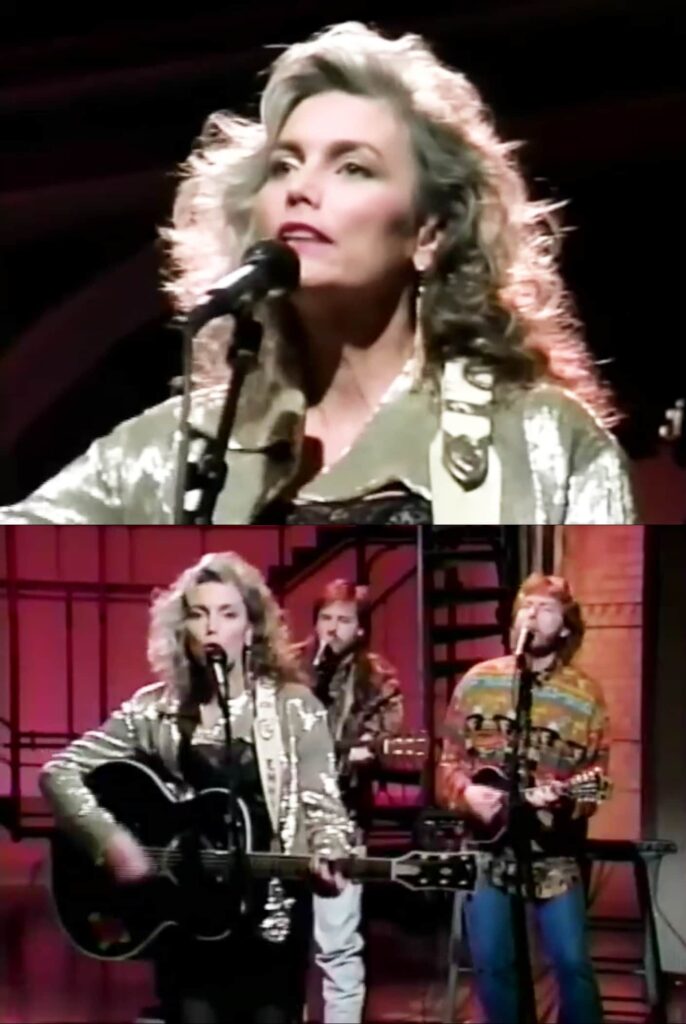
When Emmylou Harris Sang “Lodi,” It No Longer Sounded Like Escape. It Sounded Like Survival.
On January 9, 1992, Emmylou Harris walked onto a late-night television stage and quietly revealed one of the boldest reinventions of her career. Backed by the acoustic firepower of the Nash Ramblers, she performed Lodi, the weary road anthem written by John Fogerty, and transformed it into something deeply personal: a confession from an artist exhausted by the machinery of touring, fame, and repetition.
The original 1969 recording by Creedence Clearwater Revival carried the grit of a stranded musician trapped in small towns and endless highways. But Emmylou’s 1992 version felt older, wiser, and strangely more fragile. Gone was the swamp-rock swagger. In its place came mandolins, acoustic guitars, upright rhythm, and a voice that sounded both crystalline and tired at the same time.
When she sang:
“Looks like I’m stuck in Lodi again…”
it no longer sounded like a catchy chorus. It sounded like someone reflecting on years spent living out of suitcases, dressing rooms, and bus windows.
What made the performance unforgettable was how alive it felt. The Nash Ramblers did not modernize the song or bury it beneath production tricks. They played with the loose confidence of musicians who understood that Americana music survives through atmosphere and feeling, not perfection. Every instrument breathed. Every pause mattered.
Then came the interview afterward, and suddenly the performance became even more revealing.
Speaking candidly with rare honesty, Emmylou explained why she had abandoned the loud electric format that had defined much of her touring career. After fourteen years with her previous band, she admitted she had grown weary of “singing over top of the loud instruments night after night.” Rather than slowly fading into routine, she dismantled everything and rebuilt from scratch around acoustic music.
It was not nostalgia. It was artistic survival.
Even more striking was her admission that she deliberately wanted to introduce “an element of terror” and “the unknown” back into her life as a musician. That single statement explains why so many longtime listeners remain fiercely loyal to Emmylou Harris. While many artists spend later years protecting their legacy, she kept risking hers.
That fear gave the performance its electricity.
By 1992, Emmylou was already regarded as one of the great interpreters in American music. Yet instead of chasing radio trends, she moved backward into roots music, intimacy, and stripped-down storytelling. The result would eventually help revive interest in the historic Ryman Auditorium performances that became central to her next artistic chapter.
There is also something beautifully symbolic about her choosing “Lodi” during this period. The song is about a traveling musician questioning the road beneath him. And there stood Emmylou Harris, years into a legendary career, publicly admitting she was still searching for a new way forward.
Today, the performance feels even more emotional because it captures an artist refusing comfort in real time.
Not many singers willingly walk back into uncertainty after success. But Emmylou Harris always understood something essential about great music:
sometimes the only way to stay alive artistically is to become afraid again.