
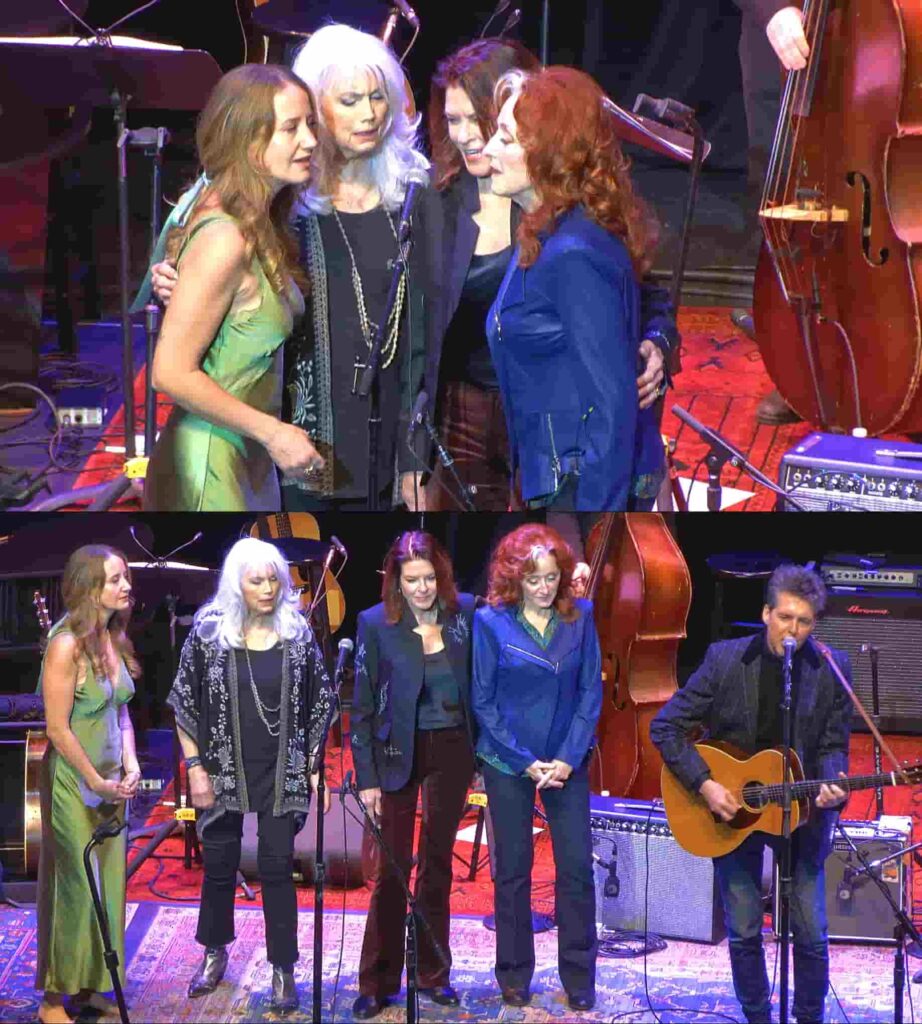
Four Legendary Voices Turned “The Night They Drove Old Dixie Down” Into a Living Conversation Between Generations
At San Francisco’s sold-out Masonic Auditorium in February 2025, Bonnie Raitt, Emmylou Harris, Rosanne Cash, and Margo Price stood shoulder to shoulder and revived one of America’s most haunting songs with dignity, sorrow, and startling emotional power.
Some performances entertain an audience for a night.
Others remind people where they came from.
On February 8, 2025, inside the historic Masonic Auditorium in San Francisco, four generations of American roots music gathered around “The Night They Drove Old Dixie Down,” the immortal song written by Robbie Robertson and forever associated with The Band. By the end of the performance, the theater no longer felt like a concert hall. It felt like a memory shared across decades.
The moment carried unusual weight before a single lyric was sung.
At the center stood Bonnie Raitt and Emmylou Harris, two artists whose voices have accompanied listeners through nearly half a century of American music history. Beside them were Rosanne Cash, daughter of Johnny Cash and one of the finest songwriters of her generation, and Margo Price, whose raw modern country spirit has helped carry traditional songwriting into a new era.
Together, they approached the song carefully, almost reverently.
Originally released by The Band in 1969, “The Night They Drove Old Dixie Down” has always occupied a complicated and emotional place in American music. It is not simply a Civil War ballad. It is a song about collapse, grief, poverty, exhaustion, and ordinary people trapped beneath the machinery of history. Few songs capture the emotional wreckage left behind by conflict with such humanity.
That emotional depth filled the San Francisco stage immediately.
From the opening lines, the performance avoided grand theatrical gestures. Instead, each singer allowed the story itself to breathe. Bonnie Raitt’s weathered blues phrasing grounded the performance with earthy realism, while Emmylou Harris brought the ghostly Appalachian ache that has defined her greatest recordings for decades.
Then came Rosanne Cash, singing with the calm emotional precision that has always separated her from louder performers. Every line sounded lived-in, as though she understood intimately how history travels through families long after headlines disappear.
And beside them stood Margo Price, representing a younger generation that still believes old songs matter because old emotions never disappear.
That combination created something rare.
Rather than competing for attention, the four women listened to one another closely. Their harmonies rose slowly, almost like church music, wrapping around the audience with warmth and sorrow simultaneously. By the time they reached the chorus, the room seemed suspended between past and present.
The performance became especially moving because of the visible passage of time standing onstage itself.
Emmylou Harris, now in her late seventies, sang with a voice transformed by age but deepened by wisdom. Bonnie Raitt carried the calm confidence of someone who no longer needs to prove anything to anyone. Together, they represented a generation of musicians who survived changing trends, collapsing industries, personal heartbreaks, and decades of relentless touring while still protecting the emotional truth inside the music.
Watching them beside Rosanne Cash and Margo Price felt symbolic in the best way. Not a nostalgic farewell, but a passing forward of musical memory.
The audience inside the Masonic Auditorium appeared to understand this instinctively. There was applause, certainly, but also deep attentiveness. People were not simply reacting to famous names. They were listening to a song that has traveled through American life for more than fifty years and still carries emotional relevance.
That is the miracle of great roots music.
It survives because every generation hears its own struggles hidden inside the old stories.
And on that February night in San Francisco, “The Night They Drove Old Dixie Down” sounded less like a history lesson and more like a reminder that loss, resilience, and human dignity never truly grow old.