
Less Than Eighteen Months After Buddy Holly’s Death, His Crickets Joined the Everly Brothers on Stage and Rock and Roll Kept Moving Forward
In 1960, audiences attending The Everly Brothers’ UK tour witnessed something far more significant than a performance of a hit song. On the surface, “Bird Dog” was exactly what fans expected: an energetic rock and roll favorite delivered with the effortless harmony that had made Don and Phil Everly two of the biggest stars in popular music.
But standing behind them was a story that added a deeper emotional dimension to every note.
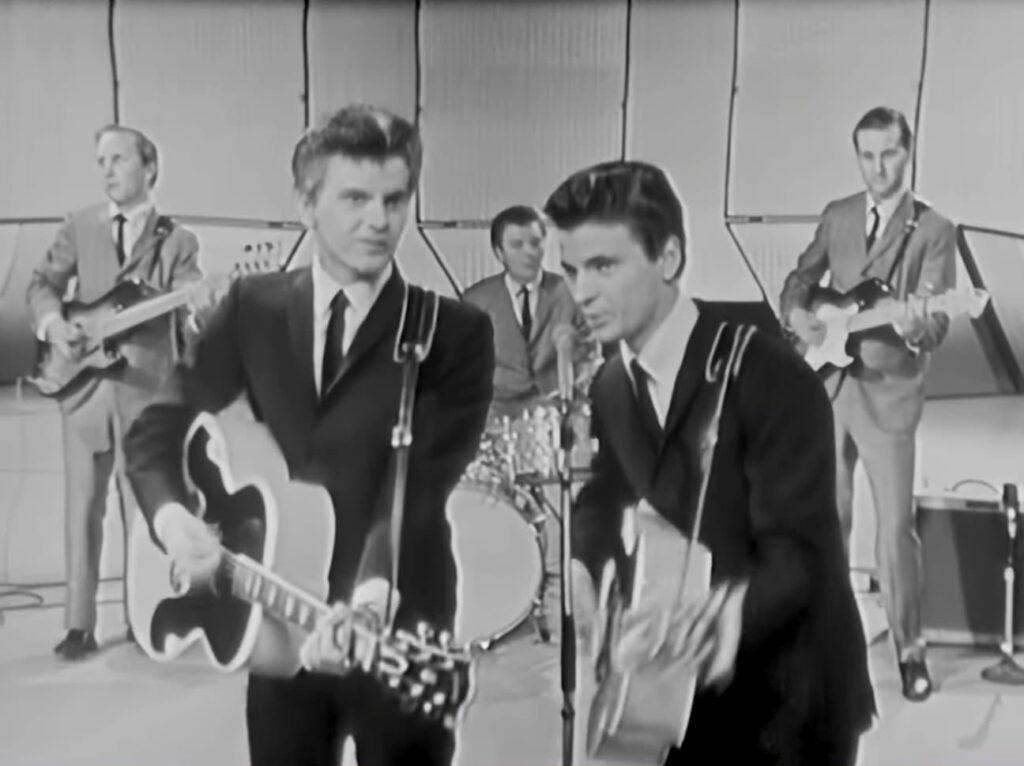
Backing the Everlys that evening were members of Buddy Holly’s Crickets: Joe B. Mauldin on bass, Jerry Allison on drums, and Sonny Curtis on guitar. Less than eighteen months had passed since the devastating plane crash of February 1959 that claimed the life of Buddy Holly, a tragedy that forever altered the course of rock and roll.
For many fans, Holly’s death had felt unimaginable. He was only twenty-two years old, yet he had already become one of the most influential figures in popular music. His recordings, songwriting, and innovative approach to rock and roll helped shape an entire generation of artists, including the Everly Brothers themselves.
The sight of his former bandmates performing again carried enormous meaning.
Rather than disappearing after the loss of their friend and leader, the surviving Crickets chose to continue making music. Their appearance alongside the Everlys became a quiet symbol of perseverance during one of rock’s most difficult chapters.
The performance itself radiates youthful energy.
From the opening moments of “Bird Dog,” Don and Phil sound completely at ease. Their harmonies glide together with the supernatural precision that made them famous. Even today, it remains astonishing how naturally the brothers blended their voices, creating a sound that countless artists would spend decades trying to imitate.
The song’s playful lyrics about a rival trying to steal someone’s sweetheart were never intended to carry deep emotional weight. That was part of its charm. Released in 1958, “Bird Dog” showcased the Everlys’ ability to transform a simple teenage story into an irresistible rock and roll record.
Yet watching this 1960 performance today creates an entirely different experience.
Behind the lighthearted lyrics stands the reality of what had happened just months earlier. The audience hears laughter and youthful confidence, but history adds another layer. The musicians on stage were helping rebuild a musical world still recovering from one of its greatest losses.
What makes the footage so fascinating is how little anyone dwells on tragedy. There are no speeches. No tributes. No dramatic acknowledgments of the past.
Instead, there is music.
And perhaps that is what makes the moment so powerful.
Jerry Allison’s drumming remains sharp and driving. Joe B. Mauldin’s bass provides the steady foundation. Sonny Curtis adds the guitar work that keeps the performance moving forward. Together, they demonstrate the professionalism and resilience that had always defined the Crickets.
For a few minutes, two of the most important acts of early rock and roll share the same stage. The Everly Brothers represent one branch of the genre’s future, while Buddy Holly’s surviving bandmates carry forward the legacy of a friend whose influence would continue growing long after his death.
Today, this performance stands as more than a television appearance from 1960. It is a snapshot of rock and roll at a crossroads. One chapter had ended far too soon, but another was already being written.
As Don and Phil Everly sing the final chorus of “Bird Dog,” and the Crickets drive the song forward behind them, the message becomes clear without a single word being spoken: great music survives. The people who create it may leave too soon, but the songs, the friendships, and the spirit that inspired them continue to echo through every generation that follows.