
WHILE CHRISTMAS SHOPPERS RUSHED PAST, ROY ORBISON SANG FOR THE MAN EVERYONE ELSE FORGOT
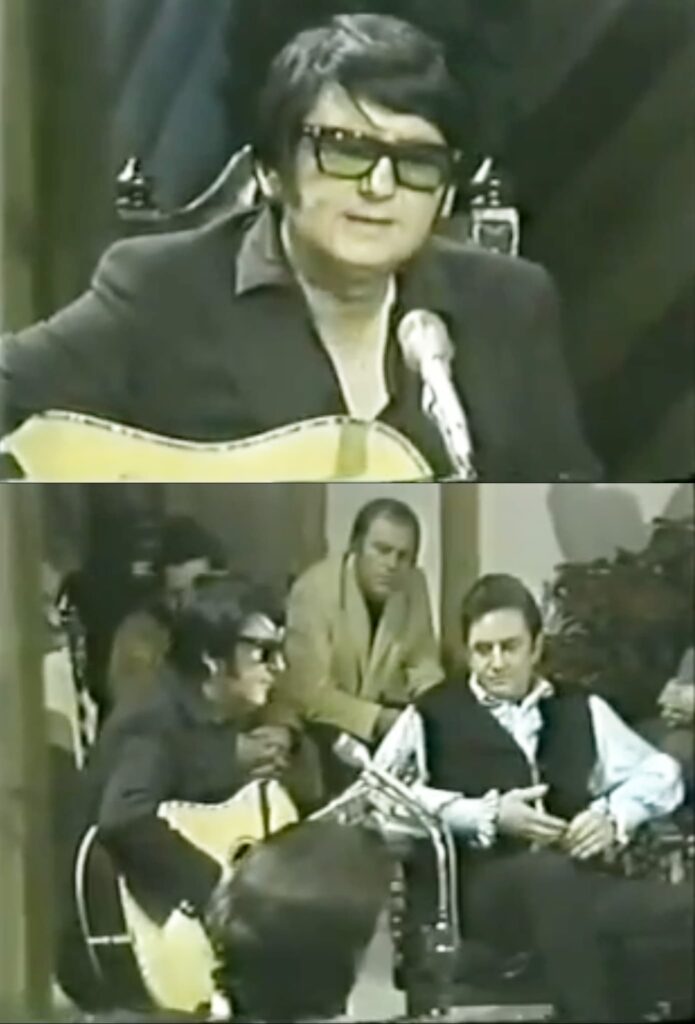
In 1970, during an intimate acoustic appearance alongside Johnny Cash, Roy Orbison delivered a performance of “Pretty Paper” that quietly transformed a Christmas song into one of the most heartbreaking moments in country and popular music history. There were no grand arrangements, no sweeping orchestras, and no dramatic stage effects. Just Orbison’s unmistakable voice, a gentle guitar, and a story about loneliness unfolding beneath the bright lights of the holiday season.
The simplicity made it devastating.
As the performance began, Johnny Cash sat nearby listening closely while Orbison softly introduced the opening lines:
“Pretty paper, pretty ribbons of blue…”
At first glance, the lyrics sound warm and familiar, filled with images of bustling Christmas streets, wrapped presents, ribbons, and handwritten love notes. But beneath that festive imagery lies something much darker. Written by Willie Nelson and later immortalized by Roy Orbison in 1963, “Pretty Paper” tells the story of a disabled street vendor ignored by hurried holiday shoppers as life rushes past him.
Orbison understood that sadness deeply.
Unlike many Christmas songs built around joy and celebration, “Pretty Paper” lives inside contradiction. The streets are alive with color and excitement, yet one lonely figure remains invisible in the middle of it all. That tension became painfully clear in this stripped-down 1970 performance.
“Crowded streets, busy feet, hustle by him…”
Orbison sang the line with extraordinary restraint. He did not exaggerate the sorrow. He barely raised his voice at all. Yet somehow the quietness made the pain feel even larger. His delivery carried the weight of someone observing humanity from a distance, watching people move too quickly to notice suffering directly beside them.
By the time he reached:
“Hoping that you won’t pass him by…”
the room had become completely still.
There has always been something uniquely haunting about Roy Orbison’s voice. Even at its most beautiful, it carried loneliness inside it. His singing could sound both powerful and fragile at the same time, as though every note emerged from somewhere deeply wounded. During “Pretty Paper,” that quality elevated the song beyond seasonal nostalgia into something timeless and profoundly human.
The presence of Johnny Cash added another emotional layer to the performance. Cash spent much of his career singing for prisoners, outsiders, workers, addicts, and forgotten people standing at the edges of society. Sitting beside Orbison, he appeared to recognize immediately the quiet dignity inside the song. Two men known for entirely different musical styles suddenly seemed united by the same understanding: that music matters most when it remembers the people the world overlooks.
The acoustic arrangement exposed every emotional detail.
Without orchestration to soften the mood, listeners could hear the ache inside Orbison’s phrasing. Every pause lingered. Every line seemed suspended in cold winter air. When he sang about laughter ringing in the distance while “in the midst of the laughter, he cried,” the contrast felt almost unbearable.
That single image explains why “Pretty Paper” has endured for generations.
The song is not really about Christmas decorations or holiday shopping. It is about invisibility. About the quiet tragedy of people passing one another every day without truly seeing each other. The ribbons, pencils, and packages become symbols of distraction, while loneliness sits unnoticed only a few feet away.
In modern times, the performance feels even more relevant.
Every holiday season still arrives wrapped in bright advertisements, crowded stores, and cheerful music playing through shopping centers. Yet beneath all that celebration remain countless people carrying grief, isolation, poverty, or silent heartbreak. Orbison’s performance reminds listeners that compassion often matters more than celebration itself.
What made the 1970 rendition unforgettable was its honesty.
Roy Orbison never treated “Pretty Paper” as novelty or sentimentality. He sang it like a witness describing something real. The sadness in his voice sounded lived-in, almost personal, as though he understood exactly what it meant to feel invisible while the rest of the world kept moving.
And perhaps that is why the performance still lingers decades later.
Because beneath the holiday imagery and gentle melody lies a question that never grows old:
Who among us is still waiting to be noticed before the season passes by?