
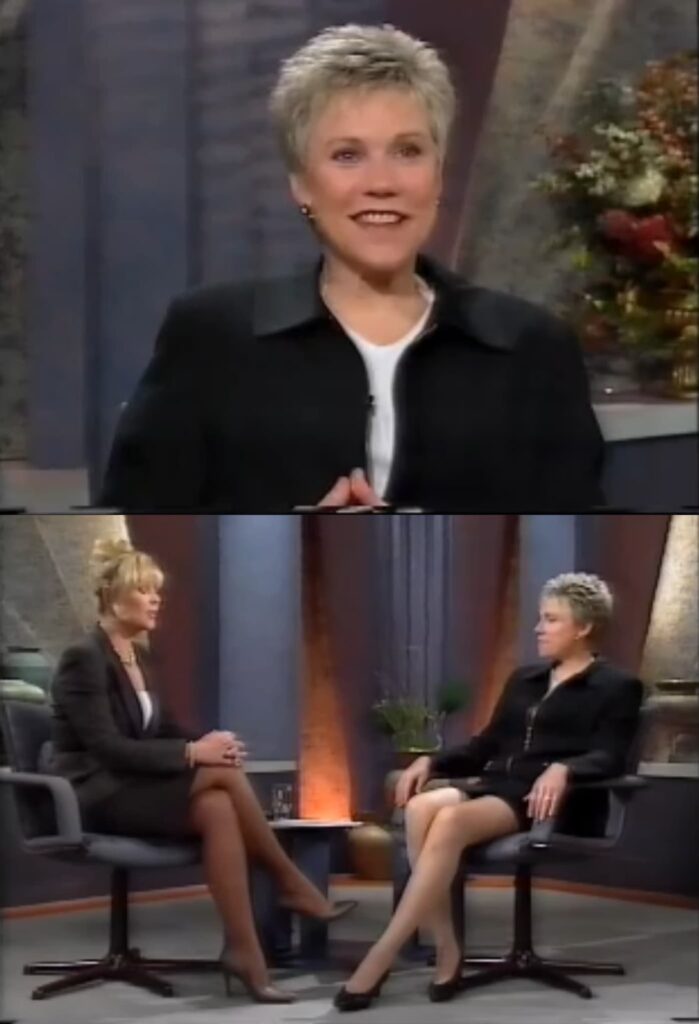
WHEN ANNE MURRAY SPOKE ABOUT MUSIC, SHE SPOKE LIKE SOMEONE WHO STILL BELIEVED SONGS COULD SAVE PEOPLE
In April 1997, during a warm and deeply revealing Australian television appearance, Anne Murray reminded audiences why her voice had endured long after trends, fashions, and radio formulas had faded away.
By the spring of 1997, Anne Murray was no longer simply a successful singer. She had become something rarer: a trusted voice woven into the emotional memory of several generations. Appearing on the Australian program Midday with Kerrie-Anne during her national tour, Murray arrived not with the polished distance of a superstar, but with the calm sincerity of someone who still viewed music as a human connection rather than an industry product.
At the time, she was promoting her thirtieth studio album, Anne Murray (1996), an understated but elegant record that reflected both maturity and quiet confidence. One of the featured songs was “What Would It Take,” written by fellow Canadian icon Bryan Adams, who also played guitar and sang backing vocals on the recording. The single did not become one of Murray’s major international chart hits, but in Canada it represented another important moment in a career that had already stretched across nearly three decades.
And that was precisely what made the interview so compelling.
Anne Murray was not speaking as a nostalgic artist trying to relive past glories. She spoke as someone thoughtfully observing how music itself had changed.
When host Kerrie-Anne Kennerley mentioned “You Needed Me,” Anne immediately called it “probably the best song I’ve ever recorded.” That statement carried weight. Released in 1978 from the album Let’s Keep It That Way, the song became Murray’s signature crossover triumph, reaching No. 1 on the Billboard Hot 100 in the United States and earning her a Grammy Award for Best Female Pop Vocal Performance in 1980. More importantly, the song endured. By 1997, nearly twenty years later, audiences still reacted to it not as an old hit, but as a living memory.
You could hear genuine astonishment in Anne’s voice when she reflected on the passing years. “Feels like yesterday,” Kerrie-Anne remarked. Anne replied with a laugh tinged with disbelief: “Imagine how I feel.”
That small exchange revealed something essential about artists from Murray’s era. They measured time not through headlines, but through songs attached to people’s lives. And throughout the interview, Anne repeatedly returned to the emotional responsibility she felt toward listeners.
One of the most moving moments came when she discussed letters from fans. She spoke about people recovering from tragedies, including car accidents, who told her that her music had helped carry them through painful periods of life. Anne admitted that the music business could sometimes feel “frivolous,” a remarkably humble confession from someone who had already sold millions of records worldwide. Yet those personal stories justified the work for her. They gave meaning to the years spent touring, recording, and standing beneath stage lights night after night.
Then came the story that seemed to stop the studio emotionally still.
Anne recalled hearing from a widow in Salt Lake City who had lost her husband. At a party, the woman met a widower who had recently lost his wife. The two danced together to “Could I Have This Dance,” Anne Murray’s beloved 1980 hit from the soundtrack of Urban Cowboy. The song reached No. 3 on the Billboard Country chart and became one of the defining slow dances of its era. But Anne’s story transformed it from a hit record into something deeply human.
The couple eventually married. Together, they brought twelve children into one blended family. At their wedding ceremony, those children sang “Could I Have This Dance.”
It is difficult to imagine a more beautiful illustration of what Anne Murray represented to listeners. Her songs were never built around vocal acrobatics or fashionable production tricks. They survived because they entered ordinary lives quietly and stayed there for decades.
That philosophy became even clearer later in the interview when Anne discussed contemporary singers such as Celine Dion and Mariah Carey. She openly admired their extraordinary vocal ability, especially Mariah’s astonishing range, yet gently questioned whether modern pop singing had begun sacrificing melody and lyrical clarity for technical performance.
“I’d love to hear the lyric,” she explained. “And I love to hear the melody as well.”
That sentence may summarize Anne Murray’s entire artistic philosophy better than any career retrospective ever written.
Unlike many performers of the 1990s, Anne came from an era where interpretation mattered more than display. She never sang to overwhelm the audience. She sang to reach them. Her phrasing was conversational, warm, and emotionally transparent. Whether performing “Snowbird,” which launched her internationally in 1970 after reaching No. 8 on the Billboard Hot 100, or later classics like “Danny’s Song” and “Shadows in the Moonlight,” Murray built her career on emotional credibility rather than spectacle.
The interview also captured her quiet pride in Canadian music history. When Anne began her career, internationally recognized Canadian artists were still relatively few: Gordon Lightfoot, Joni Mitchell, Neil Young, and Murray herself formed part of a small pioneering generation. By 1997, however, Canadian artists such as Shania Twain, Alanis Morissette, and Celine Dion were dominating global charts. Anne spoke about this evolution with the satisfaction of someone who understood she had helped open the door.
And perhaps that is what makes this 1997 appearance feel so touching today.
Anne Murray did not behave like a legend demanding reverence. She sounded like a thoughtful woman still surprised that songs recorded years earlier continued traveling through strangers’ lives. She spoke about music with gratitude, curiosity, and humility. Even after thirty albums, international fame, Grammy Awards, and decades of success, she still seemed most moved by the idea that somewhere, two lonely people once found each other while dancing to one of her songs.
Not every great artist changes culture through reinvention or rebellion. Some change it simply by offering comfort so honestly that people carry those songs with them forever.
Anne Murray was one of those artists.