
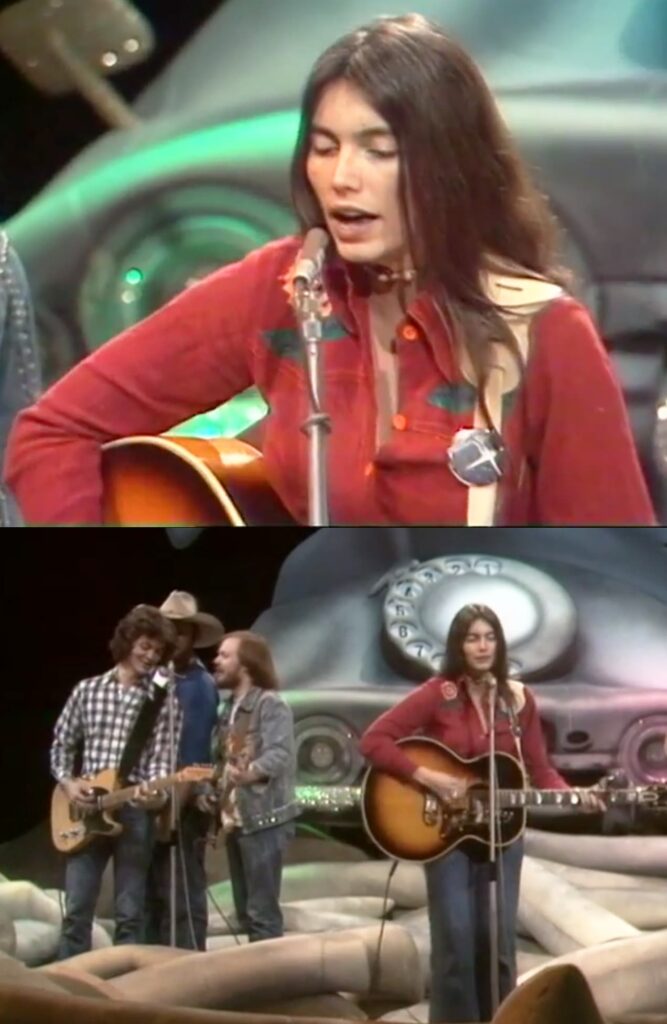
A Country Angel Singing About a Night of Trouble: The 1976 Performance That Revealed a Different Side of Emmylou Harris
In 1976, Emmylou Harris stood at one of the most important crossroads of her career. The success of Elite Hotel, her second major-label album, had transformed her from a respected singer associated with Gram Parsons into a rising star in her own right. Yet among the polished ballads and heartfelt country songs that helped define that era, one performance continues to surprise audiences nearly fifty years later: “Feelin’ Single, Seein’ Double (I Really Had A Ball Last Night).”
At first glance, the performance appears to be little more than a lively two-minute country romp. The tempo is brisk, the melody cheerful, and Harris delivers every line with a smile that makes the song feel effortless. But beneath that bright surface lies a fascinating contradiction that still captures the imagination of country music fans today.
Written by Wayne Kemp, the song had already earned a reputation as a humorous drinking tune. Its narrator wakes up after a reckless night, facing the consequences of poor decisions and an angry partner waiting at home. In the hands of male singers, the song was a classic honky-tonk tale. When Harris recorded and performed it, however, the perspective took on an entirely different meaning.
Here was a woman whose public image was built around grace, elegance, and one of the purest voices in country music. With her flowing blonde hair and gentle stage presence, Harris often appeared almost angelic. Yet in this song she cheerfully sings about feeling single, seeing double, getting into trouble, and desperately searching for an alibi after a night she clearly has no intention of regretting.
That contrast became one of the most compelling aspects of the performance. The voice sounds heavenly. The story is anything but.
Listeners often laugh at the song’s witty lyrics, but country music has always excelled at hiding heartbreak behind humor. Beneath the jokes and clever one-liners is a story about a relationship that is slowly falling apart. The narrator returns home to anger, disappointment, and consequences she cannot avoid. The laughter masks a deeper sadness, a songwriting tradition that stretches back through decades of classic country music.
The performance also highlights the remarkable chemistry between Harris and The Hot Band, one of the finest groups in country-rock during the 1970s. The driving rhythm, crisp guitar work, and shimmering steel guitar create a sound that feels rooted in traditional honky-tonk while embracing the California country-rock movement that was reshaping American music at the time. Every musician seems perfectly locked into the groove, giving the song an energy that still feels fresh decades later.
For many viewers revisiting the footage today, another layer of nostalgia emerges. This is Emmylou Harris during one of the most celebrated periods of her career. The success of Elite Hotel had brought her first Grammy Award and a number-one country album. Her voice possessed a youthful clarity that seemed almost effortless, while her confidence as a performer was growing with every appearance.
Perhaps that is why the performance remains so memorable. It captures a moment before Harris became a towering legend of American roots music. She was already exceptional, but she was still in the process of becoming an icon.
Nearly half a century later, “Feelin’ Single, Seein’ Double” continues to invite discussion. Is it a carefree country comedy, or is it a surprisingly sad story hiding behind laughter? Is the performance memorable because of Harris’s beauty and charm, or because of the daring character she brings to life?
The answer may be both. And that delicate balance between light and shadow is exactly what has kept this 1976 performance alive in the hearts of country music fans for generations.