
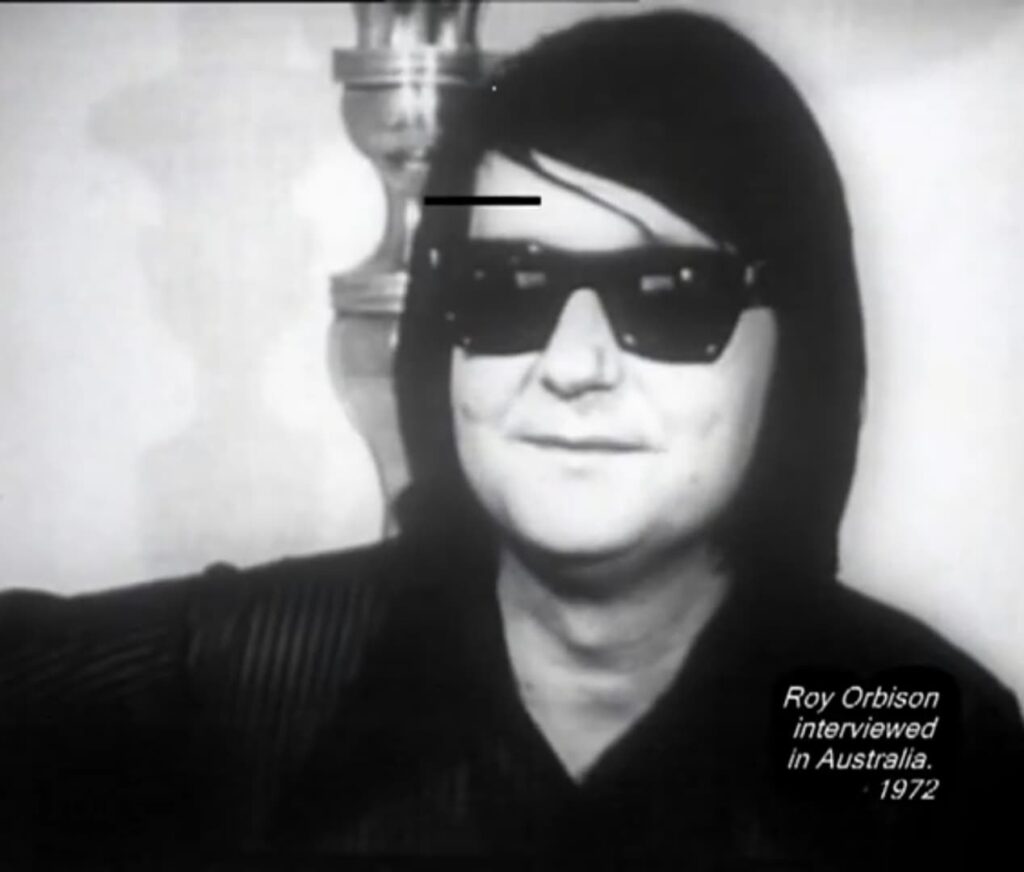
“THE MONEY GOES TO THE ACCOUNTANT” — ROY ORBISON’S QUIET VIEW OF FAME IN 1972
By October 1972, Roy Orbison had already become something larger than a recording artist. To audiences across the world, the “Big O” was a mysterious figure in black, standing motionless beneath the spotlight while delivering some of the most emotionally devastating songs ever recorded. Hits like “Only the Lonely,” “Crying,” and “Oh, Pretty Woman” had transformed him into one of the defining voices of modern music. Yet in this remarkable Australian television interview for Hit Scene, Orbison spoke about success with a humility so disarming that it almost feels foreign today.
Sitting calmly with interviewer Dick Williams during his seventh visit to Australia, Roy Orbison sounded less like an international superstar and more like a thoughtful craftsman trying to explain why the work still mattered to him after all the fame.
When asked about his endless stream of gold records, Orbison offered one of the most revealing insights of his career. He compared music awards not to wealth, but to Olympic medals or blue ribbons won at a county fair. To him, they were proof that he had “made his mark.” The money, he shrugged, went to the accountant. The charts were “just a piece of paper.” But the awards meant something personal. They were tangible evidence that the songs had truly reached people.
That perspective explains much about why Orbison endured while so many others faded with the changing trends of the late 1960s and early 1970s.
Unlike artists desperately chasing youth culture, Roy Orbison never tried to reinvent himself as fashionable. Even when asked about the growing wave of sex and drug themes dominating contemporary music, he answered with quiet restraint. “That’s not my style,” he simply said. There was no outrage in his voice, no moral grandstanding. Just certainty about who he was and what kind of music he wanted to create.
And perhaps the most surprising moment of the interview comes when the conversation turns toward tragedy.
By 1972, Orbison had already suffered unimaginable heartbreak. He had lost his wife Claudette in a motorcycle accident in 1966, then tragically lost two of his sons in a house fire two years later. Those losses permanently shaped public perception of him. Fans often imagined Orbison as a permanently sorrowful figure, endlessly channeling grief into songs like “Crying” and “It’s Over.”
But Orbison quietly dismantled that myth.
He admitted that although many of his songs came from personal experience, he could only truly write when he was “in a good mood” or “self-content.” It is one of the great contradictions in popular music history: the man who sang loneliness more convincingly than anyone else actually needed emotional peace before he could create.
That revelation changes how one hears his music.
The heartbreak in Roy Orbison’s songs was never theatrical misery poured out in real time. It was reflection. Observation. Memory shaped into melody after the emotional storms had already settled. His voice carried pain because he understood it deeply, not because he was trapped inside it every moment of his life.
Watching this interview now, there is something deeply moving about Orbison’s calm intelligence. He speaks thoughtfully about exhausting world tours, about writing songs while waiting in airports, about collaborating naturally with fellow songwriters Bill Dees and Joe Melson. Fame had not hardened him. If anything, it had made him more measured, more philosophical.
At one point he says he has become “older and wiser.” It sounds like a simple remark, but coming from Roy Orbison, it carries unusual weight. Few artists had endured more personal darkness while continuing to create music filled with such tenderness and dignity.
That may ultimately be Orbison’s greatest legacy.
He never treated sadness as spectacle. He never turned heartbreak into self-pity. Instead, he transformed human vulnerability into something timeless. And even at the height of global fame, with millions of records sold and audiences waiting around the world, he still spoke like a man more interested in leaving behind meaningful songs than counting the money they earned.