
A Lonely Airport, A Restless Soul, and the Song That Quietly Changed Folk Music Forever
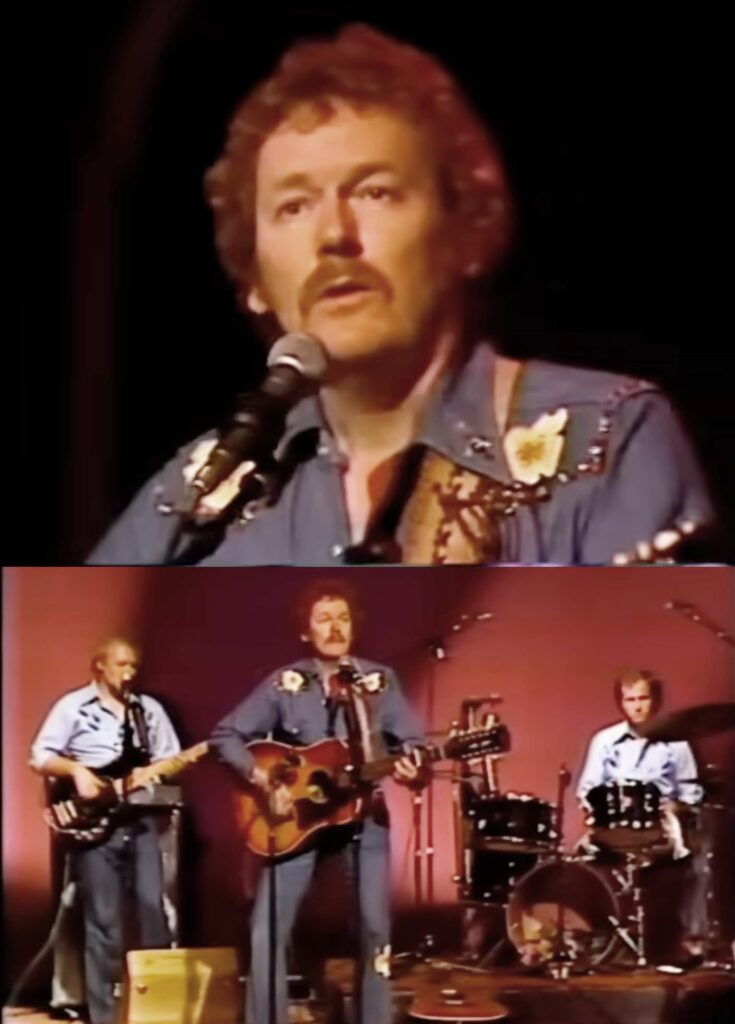
When Gordon Lightfoot introduced “Early Morning Rain” during his 1979 live performance in Chicago, there was a humble honesty in the way he spoke about it. He called it his “first real good song,” the one that helped lift him “up the ladder” after Peter, Paul and Mary recorded it and turned it into a major hit. There was no arrogance in his voice, no attempt to mythologize himself. Just gratitude, memory, and the quiet recognition that one song had changed everything.
And what a song it was.
Written in the early 1960s and officially released on Lightfoot’s 1966 debut album Lightfoot!, “Early Morning Rain” would go on to become one of the most influential folk songs of its era. Though Lightfoot’s own recording did not dominate pop charts in the way some later hits would, the song achieved legendary status through the remarkable number of artists who recorded it. Peter, Paul and Mary brought it into the American mainstream in 1966, helping establish Lightfoot internationally as a songwriter of extraordinary depth. Soon afterward, artists such as Elvis Presley, Johnny Cash, Ian & Sylvia, Jerry Lee Lewis, and even Bob Dylan would perform or praise the song.
By the end of the twentieth century, “Early Morning Rain” had become more than a folk standard. It had become part of the emotional vocabulary of modern songwriting.
The origins of the song remain deeply tied to Lightfoot’s early struggles in Toronto. Before fame arrived, he often spent time near the old Toronto airport, watching planes depart while he himself remained financially stranded on the ground. Those images stayed with him: exhausted travelers, roaring engines, rain-soaked runways, and the aching sensation of wanting to escape one life for another. Out of those observations came one of the most vivid opening verses in folk music history:
“In the early morning rain…”
Immediately, listeners are placed inside loneliness.
The narrator stands near the airport with “a dollar in my hand” and “an aching in my heart,” watching a Boeing 707 prepare for departure while he remains trapped below. It is one of the simplest lyrical setups imaginable, yet Lightfoot transforms it into something universal. The airplane becomes symbolic of freedom itself. Movement. Opportunity. Reinvention. Meanwhile, the man left behind represents everyone who has ever felt stuck in life while the world keeps moving without them.
What made Gordon Lightfoot such an exceptional songwriter was his ability to write emotionally profound material without theatrical excess. He never forced sentimentality. His language remained direct, grounded, almost conversational. Yet beneath that simplicity lived enormous emotional complexity.
During the 1979 Chicago performance, that quality became especially powerful. By then, Lightfoot was already an international star following massive successes like “If You Could Read My Mind,” “Sundown,” “Carefree Highway,” and “The Wreck of the Edmund Fitzgerald.” But when he returned to “Early Morning Rain,” he sounded almost transported back to the beginning of his career. The performance carried the reflective warmth of a man revisiting the song that first opened the door to his future.
His voice in 1979 possessed a remarkable maturity. The youthful sharpness of the 1960s had softened into something richer and more weathered. Every lyric sounded lived through rather than merely performed. And unlike many live performers who attempt to reinvent old material dramatically, Lightfoot trusted the song completely. He understood that “Early Morning Rain” did not require embellishment. Its power already existed inside the imagery, the pacing, and the emotional truth.
One of the most haunting moments arrives in the line:
“You can’t jump a jet plane like you can a freight train.”
It is such a plainspoken sentence, almost casual at first glance. Yet it captures an entire emotional reality. The modern world has become too fast, too distant, too mechanical. The old romantic freedom associated with trains and wandering has disappeared into cold aviation technology. The narrator cannot simply chase escape anymore. He can only stand below and watch others leave.
That subtle sadness runs through much of Lightfoot’s greatest work. His songs often explore distance, memory, separation, and emotional solitude. Even at their warmest, there is usually a quiet loneliness somewhere beneath the surface.
Musically, “Early Morning Rain” also represented an important evolution in folk songwriting during the 1960s. While many contemporary folk songs leaned heavily into political commentary or protest themes, Lightfoot focused instead on interior emotional landscapes. His work helped bridge traditional folk storytelling with the more introspective singer-songwriter movement that would later flourish through artists like James Taylor, Jackson Browne, and Joni Mitchell.
In many ways, Lightfoot’s influence remains underappreciated outside devoted music circles. Yet among songwriters themselves, his reputation has always been enormous. Bob Dylan once famously said he could listen to a Gordon Lightfoot song “for hours.” That admiration came from craftsmanship. Lightfoot understood economy, atmosphere, and emotional precision better than almost anyone of his generation.
Watching the 1979 Chicago performance today feels like opening a window into another era of music entirely. There are no distractions. No spectacle. Just a songwriter, a guitar, and a room listening carefully to words that mattered.
And perhaps that is why “Early Morning Rain” still resonates so deeply decades later. The world has changed. Airports are different. Airplanes are routine now. Yet the feeling inside the song remains timeless. The longing to leave. The ache of being left behind. The dream that somewhere beyond the clouds, life might finally become lighter.
Very few songs capture loneliness with such grace.
And very few songwriters ever did it better than Gordon Lightfoot.
 Oldies Songs