
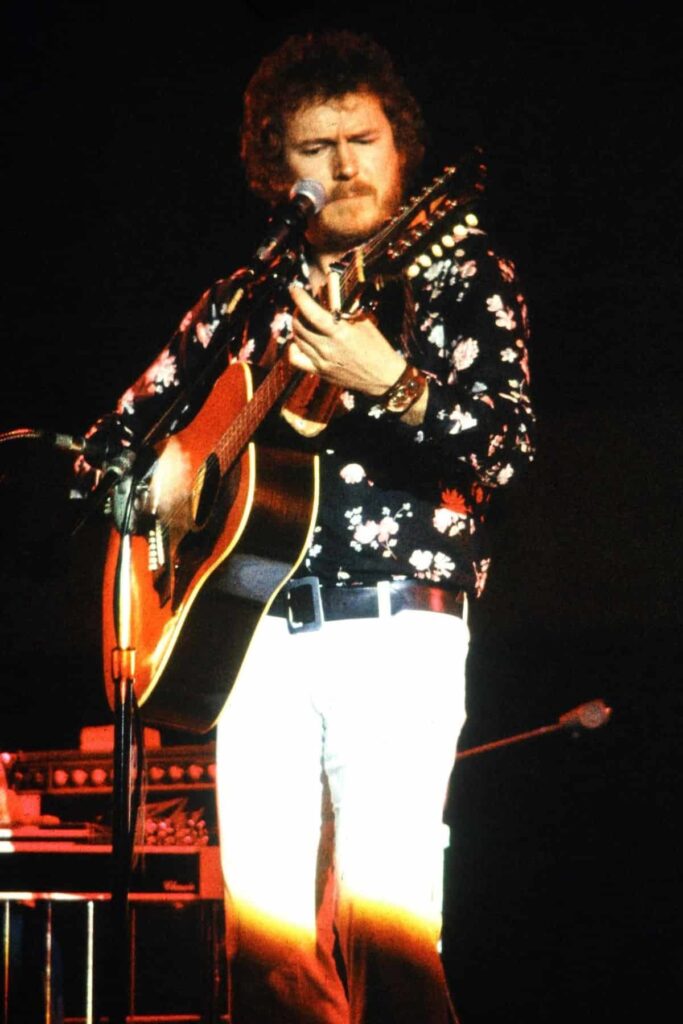
A Night When Gordon Lightfoot Turned Memory Into Music at Massey Hall
There are concerts that entertain us for an evening… and there are concerts that seem to preserve an entire lifetime inside a few songs. Gordon Lightfoot Live at Massey Hall 1975 belongs to the second kind — a performance where every lyric sounded lived-in, every silence carried history, and every note felt like it came from a man quietly reflecting on the roads behind him.
By 1975, Gordon Lightfoot was no longer simply a respected Canadian folk singer. He had become one of the most trusted storytellers in popular music. His songs had already crossed borders and generations, carried by voices that sounded weathered, honest, and unmistakably human. That same year, he stood at the peak of his commercial and artistic powers. His album Cold on the Shoulder reached No. 10 on the Canadian charts, while the single “Rainy Day People” climbed to No. 26 on the Billboard Hot 100 and became another signature piece in his catalog. Only a year earlier, “Sundown” had reached No. 1 in the United States — a rare achievement for a folk-rooted songwriter whose strength came not from spectacle, but from emotional truth.
And yet, what makes the 1975 Massey Hall performance unforgettable is not chart success alone. It is the atmosphere surrounding it. Massey Hall in Toronto was not just another venue for Lightfoot. It was sacred ground. The hall had long been associated with artistic authenticity — the kind of place where audiences came to listen, not merely react. When Lightfoot walked onto that stage, there was no need for elaborate production or theatrical tricks. His presence alone carried the room.
Listening to this concert today feels almost like opening an old family photo album. The songs move with patience. They breathe. There is no rush to impress. In an era when rock music was becoming louder and more extravagant, Lightfoot remained devoted to restraint. That restraint became his power.
What audiences heard that night was more than a collection of hits. They heard the emotional geography of a generation. Songs like “If You Could Read My Mind,” “Sundown,” “Carefree Highway,” and “Rainy Day People” had already become deeply personal to listeners across North America. These were not songs about fantasy or escape. They were songs about distance, regret, changing seasons, failed relationships, loneliness on the road, and the quiet dignity of surviving heartbreak.
Perhaps that is why Lightfoot’s music ages differently from many of his contemporaries. His work does not depend on trends. It depends on recognition — that painful moment when a listener realizes a song understands them better than most people ever could.
One of the most remarkable qualities of the Live at Massey Hall 1975 performance is Lightfoot’s calm authority. He never oversings. He never dramatizes emotion. Instead, he trusts the writing itself. That trust gave his performances an intimacy rarely found in arena-era music. Even in a large hall, he sounded like someone sitting beside you late at night, speaking carefully about things too important to say loudly.
Behind many of these songs was a complicated personal life. “If You Could Read My Mind,” arguably his masterpiece, had been written years earlier during the collapse of his marriage. Rather than turning bitterness into spectacle, Lightfoot transformed private pain into poetic reflection. The song reached No. 1 in Canada and No. 5 on the Billboard Hot 100 in 1970, establishing him internationally as a songwriter capable of turning emotional confusion into timeless art.
By the time of the 1975 concert, audiences already carried emotional histories with these songs. They did not simply hear melodies; they remembered where they had been when they first heard them. That shared memory filled the room as much as the music itself.
There is also something profoundly Canadian about the performance — though its emotional reach is universal. Lightfoot sang about highways, lakes, changing weather, empty towns, and wandering spirits with a realism that felt deeply rooted in northern landscapes. Yet listeners everywhere recognized the deeper themes underneath: the fear of growing older, the ache of lost love, the search for peace in a restless world.
His band deserves recognition as well. The musicians surrounding Lightfoot during this era were exceptionally disciplined, never overwhelming the songs. The arrangements were elegant and understated, allowing the storytelling to remain at the center. That balance became one of the defining characteristics of Lightfoot’s greatest live performances.
Looking back now, Gordon Lightfoot Live at Massey Hall 1975 feels larger than a concert recording. It feels like documentation of a disappearing kind of artistry — a time when sincerity mattered more than image, when songwriting could still carry literary depth without losing mainstream appeal.
Many performers can fill a stage. Very few can fill silence with meaning.
That was Gordon Lightfoot’s gift.
And on that night at Massey Hall, surrounded by songs already becoming memories, he reminded listeners that music does not always need to shout to endure. Sometimes the quietest voices stay with us the longest.