
A Rock And Roll Love Song Reborn In Black And White, Carried By A Voice That Time Could Never Dim
When Roy Orbison stepped onto the stage during Black & White Night, there was already a sense that audiences were witnessing something larger than an ordinary concert. The room was filled with legendary musicians, old friends, and deep admiration for one of the most distinctive voices ever recorded. Then came “Claudette,” and suddenly the years seemed to disappear.
Originally written by Orbison in the late 1950s for his wife Claudette Frady, the song became an early hit for The Everly Brothers in 1958 before Orbison later recorded his own version. Unlike many rock and roll love songs of its era, “Claudette” carried genuine affection behind its playful rhythm. It was personal. The song was named directly after the woman Roy loved, and listeners could always feel that sincerity inside the lyrics.
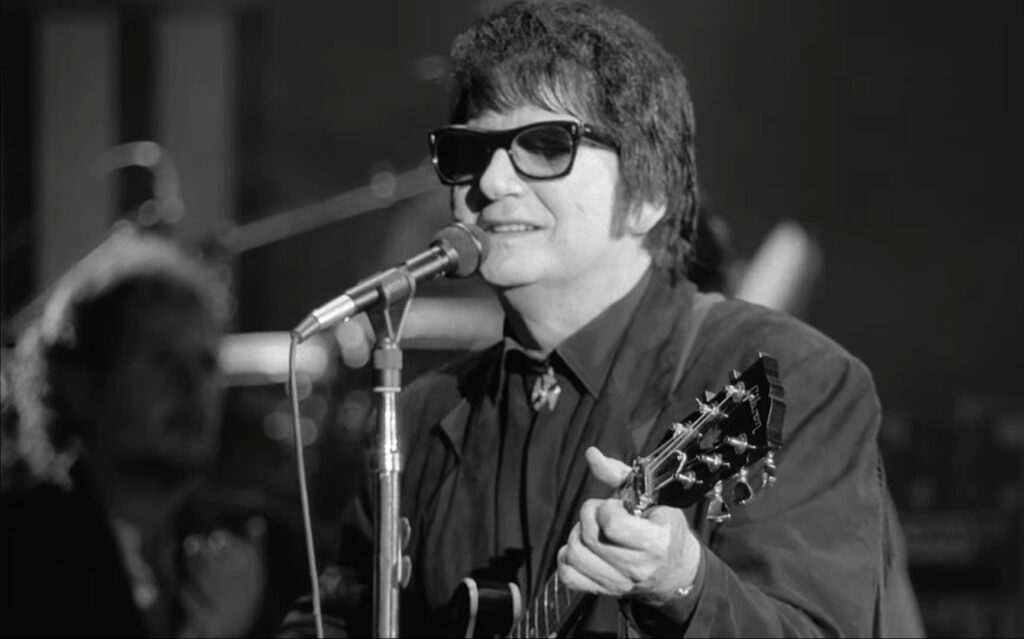
During the legendary Black & White Night concert, filmed in 1987 at the Cocoanut Grove in Los Angeles, Orbison revisited the song surrounded by an extraordinary band that included artists such as Bruce Springsteen, Elvis Costello, Tom Waits, Jackson Browne, and k.d. lang. Yet despite the star-studded stage, all attention naturally drifted back toward Orbison himself.
Dressed in black, standing nearly motionless behind dark sunglasses, he did not need dramatic movement to command the room. His voice did everything.
The performance of “Claudette” carried a youthful spark that surprised many viewers. By the late 1980s, Orbison had already endured immense personal tragedy and years away from mainstream commercial success. But on that stage, he sounded revitalized. The rich vibrato, emotional control, and soaring phrasing remained unmistakable.
What made the moment especially touching was the contrast between Orbison’s calm presence and the joyful energy of the song itself. While many artists from the early rock era struggled to reconnect with younger audiences, Orbison never needed reinvention. His music simply endured. Songs like “Only the Lonely,” “Crying,” “Oh, Pretty Woman,” and “In Dreams” had already secured his place in history long before this concert took place.
Still, Black & White Night felt different. It was not merely a comeback performance. It was recognition. Recognition from fellow musicians who understood how influential Orbison truly was.
As “Claudette” unfolded, the atmosphere became wonderfully alive. The rhythm bounced effortlessly while the band played with visible excitement, almost like fans enjoying the rare privilege of standing beside one of their heroes. Orbison responded with subtle smiles and quiet confidence, letting the song’s melody carry the emotional weight.
Watching the performance today feels bittersweet for another reason. Only weeks after the concert’s release and renewed success, Roy Orbison would pass away in December 1988 at the age of 52. That reality gives every song from Black & White Night an added layer of emotion. Viewers are not simply watching a great concert. They are watching an artist rediscover his moment in front of the world one final time.
And perhaps that is why “Claudette” still shines so brightly in this performance.
It reminds listeners of the joy Orbison carried beneath the sadness often associated with his music. The excitement of young love. The simplicity of naming a song after someone who changed your life. The timeless magic of rock and roll performed with complete sincerity.
Under the soft black-and-white lights, Roy Orbison did not look like a fading legend from another era.