
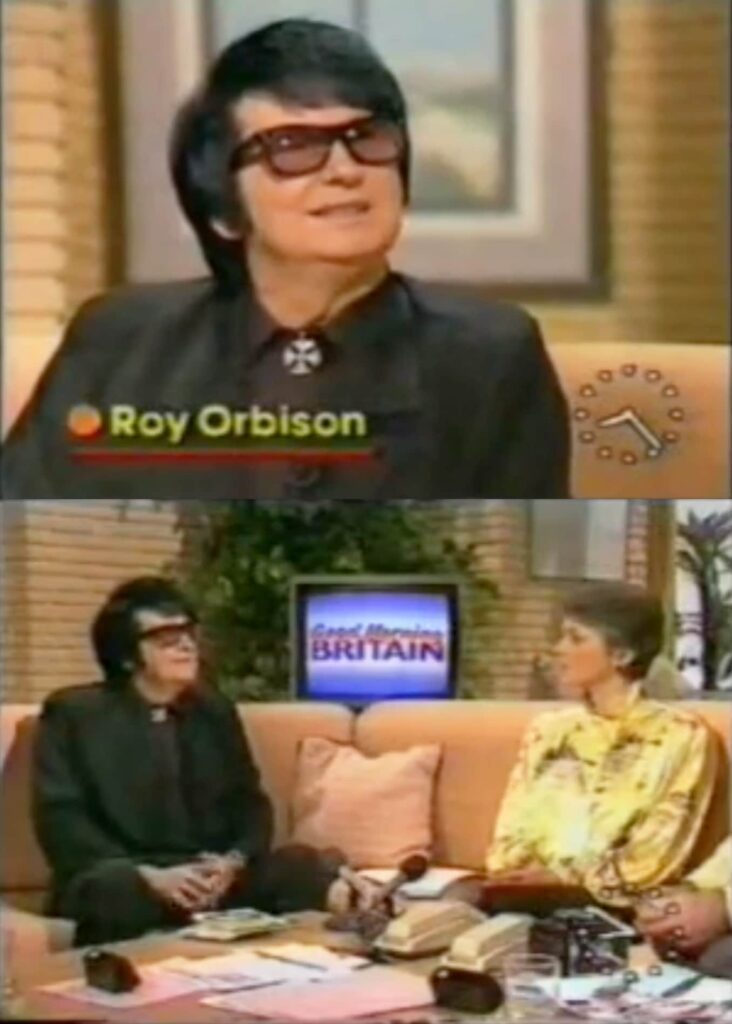
ROY ORBISON’S DARK GLASSES WERE AN ACCIDENT… BUT THE LONELINESS IN HIS VOICE WAS REAL
By December 1987, Roy Orbison was living through one of the most remarkable comebacks in popular music history. Younger artists like Bruce Springsteen, Bono, Elvis Costello, and Tom Waits were openly treating him not merely as an influence, but as something close to sacred. Yet when Orbison appeared on Good Morning Britain, there was nothing grand or self-important about him. Sitting calmly in dark glasses and black clothing that had already become part of rock-and-roll mythology, Roy spoke less like a legend and more like a thoughtful man still quietly amazed that people cared about his songs after all those years.
And perhaps that humility is what makes the interview so moving now.
The conversation begins with praise that would overwhelm most artists. Elvis Presley had once called Roy “the greatest singer in the world.” Springsteen openly admitted he wanted to sing like him. By 1987, Orbison’s songs were finding new life again through films like Blue Velvet, which reintroduced “In Dreams” to an entirely new generation.
But Roy never carries himself like a man obsessed with legacy.
Instead, he tells stories.
Some of the most fascinating moments involve the accidental creation of his famous image. For decades, fans assumed the dark glasses symbolized mystery, sadness, or emotional distance. In reality, Orbison reveals that the look was born from simple embarrassment. Before a 1963 performance in Alabama, he accidentally left his regular prescription glasses on an airplane and had no choice but to perform wearing sunglasses. Soon afterward, he traveled to England with The Beatles, photographers captured the image, and suddenly the myth of Roy Orbison was born.
There is something wonderfully human about that story.
One of the most recognizable images in music history created not through marketing strategy, but through circumstance.
The same accidental honesty runs throughout the interview.
When discussing his all-black wardrobe, Roy does not offer some elaborate artistic explanation. Instead, he remembers wanting a black cowboy shirt as a child while playing cowboys and Indians. Once he finally had enough money as an adult, he bought one. That is Roy Orbison in a nutshell. Behind the operatic voice and tragic grandeur was still a boy from West Texas who loved music, stories, and simple dreams.
And what a voice it was.
Perhaps the most revealing line in the entire interview comes when Roy says he “fell in love” with his own voice at six or seven years old. Not in an arrogant way. More like wonder. He speaks about listening to himself sing and being fascinated by the sound. That innocent amazement never fully left him. Even after thirty years in the business, Orbison still talks about music with the enthusiasm of someone discovering it for the first time.
That sincerity separated him from many of his contemporaries.
While rock music often rewarded swagger, rebellion, or cool detachment, Roy Orbison remained emotionally exposed. His greatest recordings like “Crying,” “Only the Lonely,” “In Dreams,” and “Running Scared” were built around vulnerability rather than bravado. He sang about heartbreak not as performance, but as emotional survival.
The interview also captures Roy standing beautifully between generations.
He speaks warmly about Johnny Cash helping him reach Sun Records, even joking about how Sam Phillips slammed the phone down when Orbison first called claiming Cash had sent him. Yet at the same time, Roy is clearly energized by the younger artists now surrounding him. He excitedly discusses new collaborations involving Bono, Bruce Springsteen, Elvis Costello, Jackson Browne, and T Bone Burnett. There is no bitterness about changing musical eras. Only gratitude that he still has a place inside them.
Looking back today, the interview carries an almost painful sweetness because we know what Roy himself could not fully know yet.
Within a year, the world would witness the extraordinary triumph of the Traveling Wilburys and the release of Mystery Girl, one of the strongest albums of his career. And then suddenly, in December 1988, he would be gone.