
A Piano, A Wild Smile, And The Moment Rock And Roll Exploded Into Pure Chaos And Joy
In 1957, television audiences watching Jamboree were not prepared for what they were about to witness.
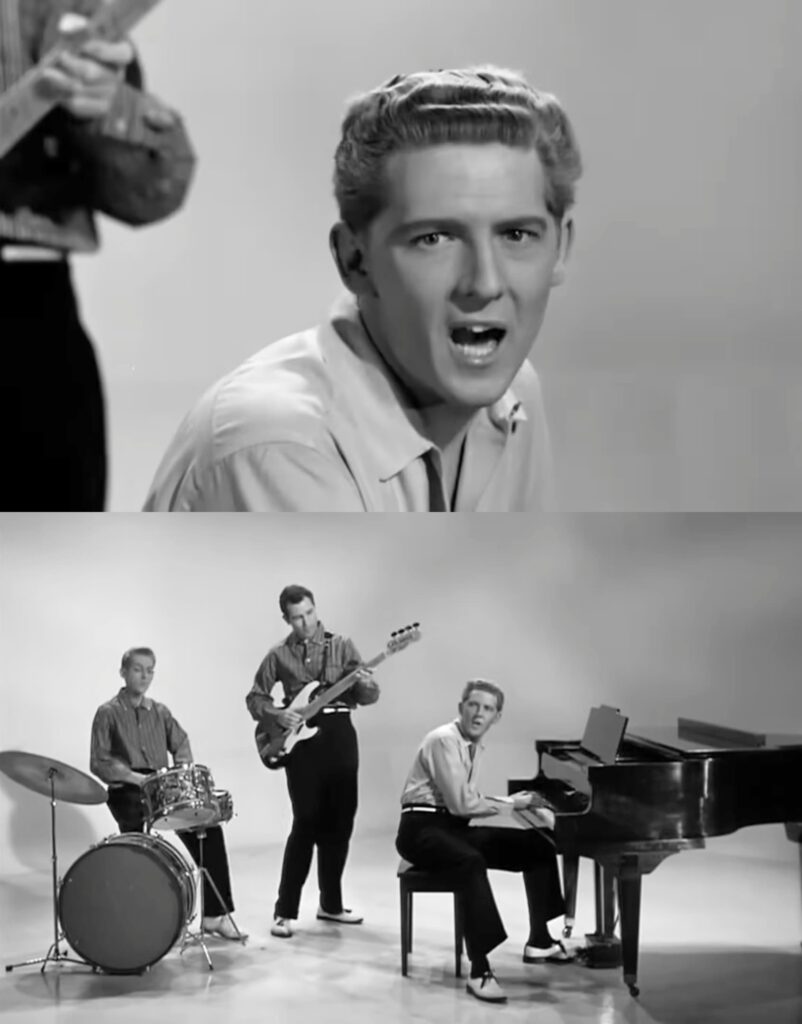
A young man from Louisiana sat behind a piano, his hair slicked back, his foot pounding the floor, his hands attacking the keys with reckless energy. Then came the opening words of “Great Balls of Fire,” and suddenly rock and roll no longer sounded polite, controlled, or safe.
It sounded dangerous.
That young man was Jerry Lee Lewis, and within minutes he turned a television performance into one of the defining moments of early rock history.
From the first line, “You shake my nerves and you rattle my brain,” Lewis attacked the song with explosive force. He did not sing like a carefully trained vocalist. He sounded possessed by excitement itself. His voice cracked, shouted, laughed, and roared through the lyrics while his piano playing rolled forward like a runaway train.
At a time when many television performances still carried traces of the polished big band era, Jerry Lee Lewis looked and sounded completely untamed. His body moved constantly. His feet stomped. His piano almost seemed too small to contain him. Watching the performance even now feels like watching someone trying to outrun electricity.
Released in 1957, “Great Balls of Fire” quickly became one of the biggest rock and roll hits of the decade. Written by Otis Blackwell and Jack Hammer, the song blended rhythm and blues, country, gospel intensity, and youthful rebellion into something unforgettable. But it was Lewis himself who transformed it into legend.
Nicknamed “The Killer,” Jerry Lee Lewis brought an intensity few performers could match. Unlike singers who stood calmly before microphones, Lewis treated the stage like a battlefield between control and chaos. His piano style drew heavily from Southern boogie woogie, gospel music, and country rhythm, creating a sound that felt both joyful and slightly dangerous.
That danger frightened many adults in the 1950s.
To younger audiences, however, it felt liberating.
Watching the Jamboree performance today still carries astonishing energy because Lewis never appeared to be performing mechanically. Every second feels spontaneous, as though the music could completely spin out of control at any moment. And perhaps that unpredictability was exactly the point.
The lyrics themselves captured the restless spirit of early rock and roll perfectly. Nervous excitement. Physical attraction. Reckless emotion. The song did not hide its passion behind subtle poetry. It exploded openly with youthful urgency. When Lewis shouted “Goodness gracious, great balls of fire!” it sounded less like a lyric and more like a man overwhelmed by his own emotions.
What also made the performance remarkable was the sheer confidence radiating from Lewis at such a young age. He played the piano not as accompaniment, but as the center of the storm. Every pounding chord pushed the song forward harder and faster.
Decades later, the performance still feels alive because it captured a turning point in popular music. Rock and roll was no longer simply dance music. It had become attitude, rebellion, personality, and raw emotional release.
And few embodied that transformation more completely than Jerry Lee Lewis.
Watching him at the piano in 1957 is like witnessing a fire at the exact moment it begins spreading beyond control. Loud, thrilling, unpredictable, and impossible to ignore.