
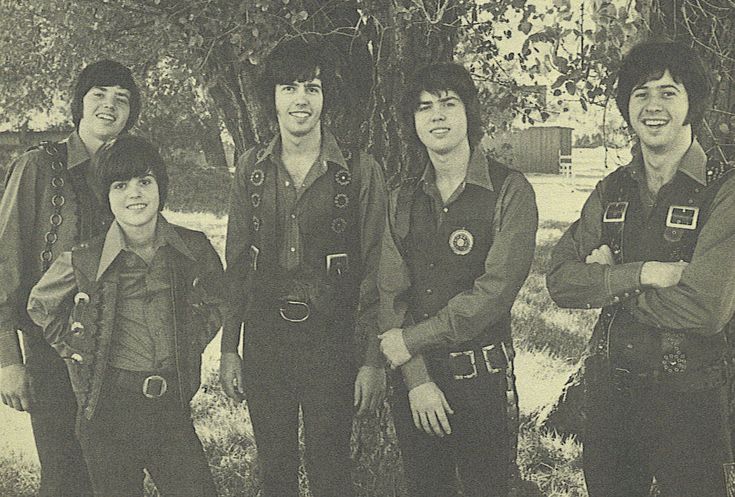
A Playful Melody from a Simpler America — How “Be My Little Baby Bumble Bee” Captured the Innocence of Early Family Entertainment
Long before polished pop productions and arena-sized performances became the identity of The Osmonds, there was a time when the brothers were simply four young boys harmonizing with remarkable warmth, carrying echoes of barbershop tradition and old American novelty songs into living rooms across the country. “Be My Little Baby Bumble Bee” belongs to that forgotten but deeply charming chapter of their story — a recording that now feels less like a commercial single and more like a faded photograph from another age.
Originally rooted in an old vaudeville-era novelty tune from the early 20th century, “Be My Little Baby Bumble Bee” was never intended to be a grand artistic statement. It was playful, lighthearted, and innocent by design. Yet when The Osmond Brothers performed it during their early television years, particularly through their appearances on The Andy Williams Show, the song took on a different emotional weight. It became part of the wholesome image America embraced during the late 1950s and early 1960s — a period when family entertainment still revolved around harmony, politeness, and the comforting illusion that life could remain uncomplicated forever.
Unlike later Osmond hits such as “One Bad Apple” or “Love Me for a Reason,” this song never became a major charting pop smash. It did not storm the Billboard Hot 100, nor was it crafted for the growing rock-and-roll revolution that was reshaping youth culture at the time. Instead, its importance lies somewhere more subtle. It represents the bridge between traditional American entertainment and the modern pop era that the Osmonds would eventually conquer in the 1970s.
What makes the recording so touching today is not necessarily the song itself, but the atmosphere surrounding it. Listening now, one can almost hear the innocence in the brothers’ voices — especially before fame transformed them into international teen idols. There is an unmistakable sincerity in those early performances. Nothing sounds calculated. Nothing feels manufactured. The harmonies are cheerful but fragile, like memories preserved inside an old black-and-white television broadcast.
The story behind the song is also deeply connected to the origins of the Osmond family itself. Raised in Ogden, Utah, the brothers began singing primarily to help support two of their older brothers, Virl and Tom Osmond, both of whom were hearing impaired. Music, in many ways, became both survival and unity for the family. Before record contracts, before sold-out tours, there were local performances, church influences, and endless rehearsals shaped by discipline and faith. Songs like “Be My Little Baby Bumble Bee” emerged from that environment — simple melodies chosen not for artistic prestige, but because they brought smiles to audiences and showcased the boys’ natural harmony.
There is something profoundly nostalgic about revisiting novelty songs from that era. Modern listeners sometimes dismiss them as childish, yet they overlook what these recordings represented emotionally. During postwar America, songs like this offered comfort. Families gathered around television sets together. Children learned harmonies from siblings rather than algorithms. Entertainment was not yet driven entirely by rebellion or spectacle. In that context, The Osmond Brothers became symbols of optimism — clean-cut, respectful, and musically gifted.
And perhaps that is why this little song still lingers in memory decades later.
Not because it changed music history.
Not because it topped charts.
But because it preserved a feeling.
A feeling of early innocence before the world became louder.
As the years passed, The Osmonds evolved dramatically. By the early 1970s, they were competing directly with the biggest pop acts in the world. Their music became more sophisticated, their image more modern, and their fanbase exploded internationally. Yet hidden beneath all that success was the same family foundation heard in songs like “Be My Little Baby Bumble Bee.” The tight harmonies, the familial chemistry, the instinctive warmth — it all began there.
For longtime admirers of classic entertainment history, revisiting this recording can feel unexpectedly emotional. It reminds listeners of an era when music often carried an unspoken gentleness. There were no cynical lyrics, no dramatic production tricks, just melody, harmony, and human closeness.
Today, hearing “Be My Little Baby Bumble Bee” is almost like opening a small musical time capsule. One suddenly remembers how different popular entertainment once felt — slower, softer, and perhaps more sincere in its simplicity.
And in that simplicity, the young Osmond Brothers left behind something far more enduring than a chart position.
They left behind a memory of innocence itself.