
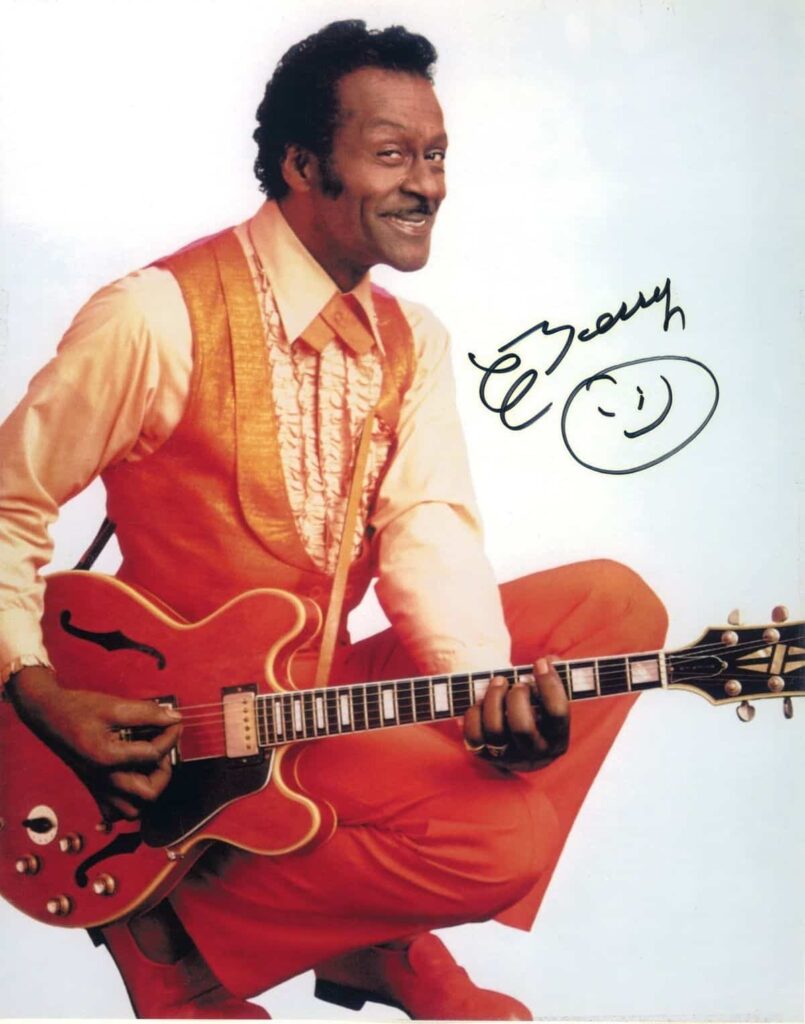
A Joyful Celebration of Love, Fate, and Everyday Life Wrapped Inside One of Rock ’n’ Roll’s Most Enduring Stories
When Chuck Berry released “You Never Can Tell” in 1964, few could have predicted that this witty little story-song — filled with coffee percolators, teenage dreams, and a modest apartment decorated with second-hand charm — would become one of the most beloved narrative recordings in the history of early rock music. Yet decades later, the song still sounds alive, still dances with warmth and optimism, and still carries the unmistakable voice of a man who understood ordinary people better than most songwriters ever could.
Originally issued on the album St. Louis to Liverpool, the song became a major comeback hit for Chuck Berry, reaching No. 14 on the Billboard Hot 100 in 1964 and climbing even higher on the R&B chart. At a time when the British Invasion was dominating American radio — with bands like The Beatles and The Rolling Stones reshaping popular music — Berry managed to remind audiences that the roots of rock ’n’ roll still belonged to him. In many ways, “You Never Can Tell” sounded almost old-fashioned beside the louder, rougher sounds arriving from England, but that became part of its magic. It did not chase trends. It simply told a human story.
The genius of the song lies in its simplicity. “You Never Can Tell” follows a young married couple beginning life together with very little money but endless hope. Berry paints their world with astonishing detail: a two-room apartment, a hi-fi set, TV dinners, and records spinning late into the night. These were not glamorous images. They were deeply familiar ones. Millions of listeners recognized themselves in those lines because Berry understood that happiness often grows in small places.
What makes the song especially remarkable is the contrast between its cheerful tone and the circumstances under which it was written. Chuck Berry composed much of the song while serving time in prison. That fact changes the emotional weight of the recording entirely. From confinement and isolation came a song bursting with freedom, optimism, and belief in the future. Berry did not write about sorrow or bitterness. Instead, he imagined young people building a life together step by step, dance by dance, dream by dream. There is something profoundly moving about that.
Musically, the record carries one of the most recognizable piano introductions in rock history, performed by pianist Johnnie Johnson, whose playing became an essential part of Berry’s classic sound. The rolling New Orleans-style piano gives the song its buoyant heartbeat, while Berry’s vocal delivery remains relaxed, conversational, and full of sly humor. He sings less like a distant star and more like someone sitting across the room, telling a story remembered fondly after many years.
The title phrase — “you never can tell” — becomes more meaningful with each verse. It suggests that life unfolds in unexpected ways. Young couples struggle, dreams survive, fortunes change, and love quietly endures. Berry understood uncertainty not as something frightening, but as part of life’s strange beauty. That message helped the song remain timeless long after its original release.
For many listeners, however, the song experienced a second life in 1994 when director Quentin Tarantino used it memorably in the film Pulp Fiction during the famous dance scene between John Travolta and Uma Thurman. Suddenly, a whole new generation discovered the recording. Yet even in that stylish cinematic moment, the song retained its original innocence and warmth. It still sounded like a celebration of ordinary joy.
There is also something deeply American about “You Never Can Tell.” Beneath its playful surface, it captures a postwar generation trying to build stability after uncertain times. Buying furniture, listening to records together, dancing in the living room — these details now feel almost sacred in hindsight. Berry transformed everyday domestic life into poetry without ever sounding sentimental.
Unlike many rock songs driven by heartbreak or rebellion, this one celebrates commitment and partnership. The young couple in the song does not become rich or famous. Their triumph is much quieter than that. They simply build a life together. And somehow, that modest dream feels even more emotional today than it did in the 1960s.
Over the years, countless artists have covered the song, but no version captures the easy confidence and storytelling brilliance of Chuck Berry’s original recording. His ability to combine humor, rhythm, observation, and emotional truth into under three minutes remains almost unmatched in popular music history.
Listening to “You Never Can Tell” now feels like opening an old photo album filled with fading snapshots of diners, jukeboxes, vinyl records, and Saturday night dances. The world it describes may seem distant, but the feelings inside it never disappeared. Love, uncertainty, hope, and resilience still move through the song exactly as they did the first time the needle touched the record.
And perhaps that is why it continues to endure. Long after musical fashions changed and generations passed, Chuck Berry left behind a reminder that life’s greatest stories are often the smallest ones — the kind built quietly between two people dancing in a tiny apartment while the records keep spinning late into the night.
 Oldies Songs