
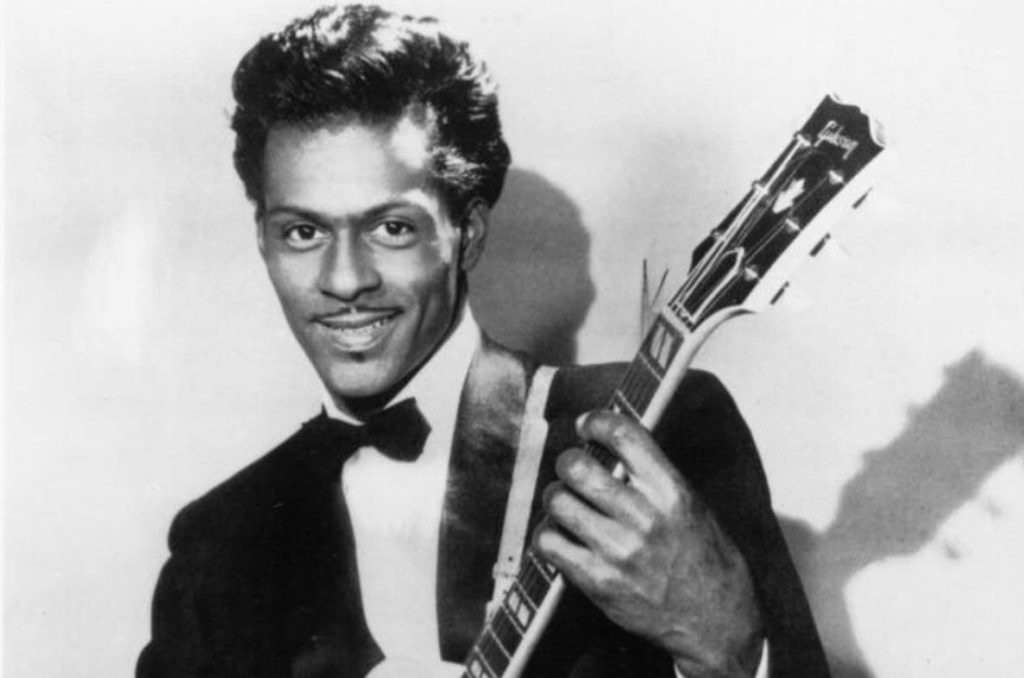
A Song About Dreaming Beyond Poverty, Carried by the Sound That Changed Popular Music Forever
When Chuck Berry released “Johnny B. Goode” in March 1958, the world did not simply receive another rock and roll hit. It received a myth. A musical portrait of ambition, talent, and escape — told through the story of a poor country boy whose guitar could carry him far beyond the limits of his surroundings. Nearly seven decades later, the opening guitar riff still feels alive, urgent, and youthful, as though it refuses to grow old no matter how much time passes.
Released as a single on Chess Records, “Johnny B. Goode” climbed to No. 2 on the Billboard R&B chart and reached No. 8 on the Billboard Top 100 chart in the United States in 1958. At a time when rock and roll was still viewed by many adults as noisy rebellion rather than legitimate art, the song crossed racial, generational, and cultural lines with astonishing ease. It became one of the defining recordings of the entire rock era and later earned a place in the Grammy Hall of Fame. Even more remarkably, it was chosen in 1977 for the Voyager Golden Record, the collection of music and sounds placed aboard NASA’s Voyager spacecraft as a message to possible extraterrestrial life. Imagine that for a moment: if another civilization somewhere in the universe were to ask what youthful hope sounded like on Earth, they might first hear the guitar of Chuck Berry.
Part of the song’s emotional power comes from how deeply personal it truly was. Though Berry never openly presented the song as autobiography, Johnny B. Goode clearly reflected pieces of his own life. Berry was born into modest circumstances in St. Louis, Missouri, and he understood very well what it meant to dream of something larger while growing up in a world that offered limited opportunities. The original lyric reportedly described the boy as “colored,” but Berry changed it to “country” before release, likely to ensure broader radio acceptance in segregated America. That small lyrical adjustment says much about the realities Black musicians faced in the 1950s — artists whose music transformed the culture while they themselves still battled discrimination behind the scenes.
Musically, the song was revolutionary in its simplicity and energy. The famous opening guitar introduction became one of the most copied phrases in rock history. Without “Johnny B. Goode,” it becomes difficult to imagine the styles later developed by artists like The Beatles, The Rolling Stones, Bruce Springsteen, or AC/DC. The song essentially created the blueprint for rock guitar heroism long before stadium rock even existed. Berry’s playing carried both rhythm and lead simultaneously, driving the song forward like a train racing down unfamiliar tracks at night.
Yet beneath its excitement lies something surprisingly tender. At its heart, “Johnny B. Goode” is really about hope — specifically the hope that talent can overcome hardship. The line about Johnny’s mother believing that “someday your name will be in lights” still carries emotional weight because it speaks to a universal longing. Every generation understands the quiet dignity of parents believing in a child’s future, even when circumstances seem impossible. That emotional thread is one reason the song continues to resonate long after the fashions and slang of the 1950s disappeared.
There is also an innocence in the song that feels increasingly rare today. Johnny does not seek fame for vanity or excess. He simply plays because music lives inside him. Berry presents talent almost as destiny — something natural and unstoppable. The countryside setting, the railroad tracks, the humble shack made of “earth and wood” all give the song an almost folk-like quality beneath the rock and roll surface. It is American storytelling in musical form.
Over the decades, countless artists recorded their own versions of “Johnny B. Goode.” Elvis Presley performed it live with explosive energy, while Jimi Hendrix transformed it into a blazing psychedelic showcase. Even younger audiences who never explored 1950s rock often discovered the song through the 1985 film Back to the Future, where the unforgettable performance scene introduced Berry’s music to a completely new generation.
Listening to Chuck Berry today can feel like opening an old family photo album — not because the music sounds outdated, but because it captures a younger version of the modern world. In those sharp guitar notes and rolling rhythms, one can still hear the excitement of a time when rock and roll was new enough to feel dangerous, hopeful, and limitless all at once.
And perhaps that is why “Johnny B. Goode” never fades. It reminds listeners of a version of youth that believed music itself could change a life. For three minutes, it tells us that somewhere out there, a boy with a cheap guitar and a difficult beginning might still be playing beside the railroad tracks, dreaming of a future brighter than anyone around him can yet imagine.
 Oldies Songs