
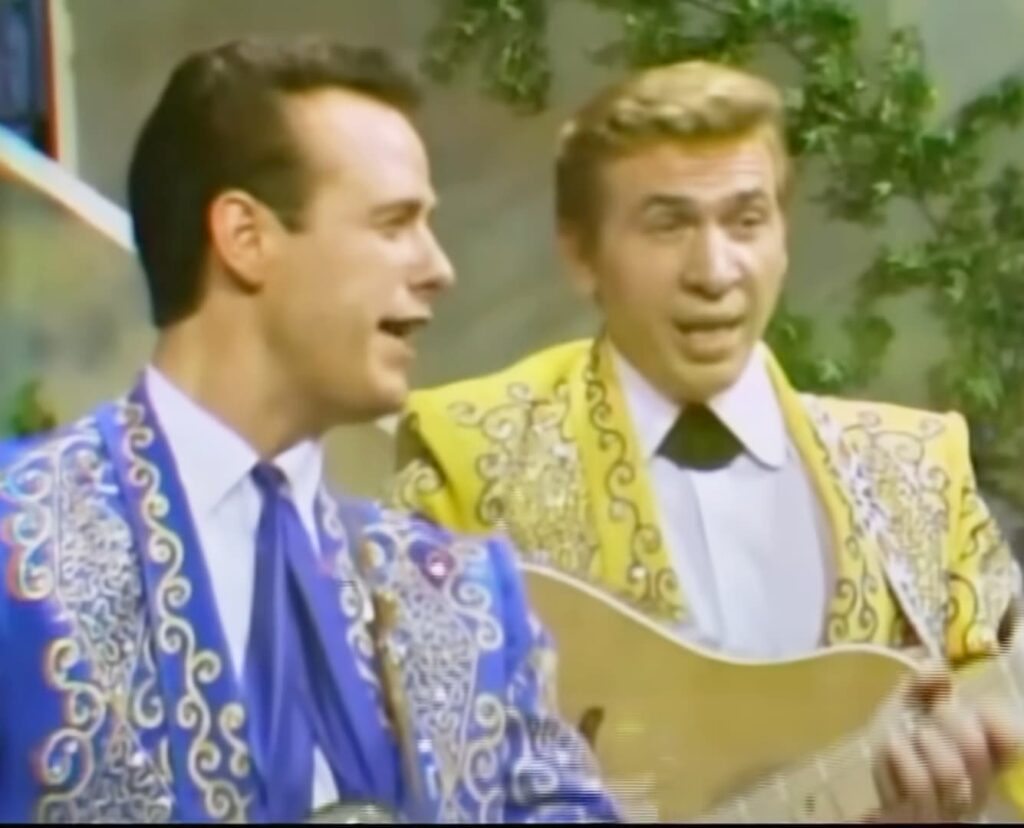
When Buck Owens Grabbed the Tiger’s Tail: A 1966 Television Performance That Captured the Bakersfield Revolution at Its Peak
On March 15, 1966, Buck Owens and His Buckaroos stepped onto the stage of Ranch Show to perform “I’ve Got A Tiger By The Tail.” To television viewers at the time, it was simply another appearance by one of country music’s hottest stars. Looking back nearly six decades later, the performance feels like something much larger: a rare glimpse into the exact moment when the Bakersfield Sound stood at the height of its power.
What makes this footage so fascinating is that Buck Owens was not yet a legend reflecting on past glory.
He was the present tense of country music.
By 1966, “I’ve Got A Tiger By The Tail”, originally released on the 1965 album of the same name, had become one of the defining records of Owens’ career. The song helped carry the Bakersfield Sound far beyond California, proving that country music could be sharp, energetic, and rebellious without abandoning its roots.
At a time when Nashville producers were increasingly embracing lush orchestration and polished arrangements, Owens offered something entirely different.
A Telecaster guitar.
A driving rhythm section.
A steel guitar that cut through the air.
And songs that sounded like they belonged to working people rather than recording executives.
The result changed country music forever.
Yet one of the most remarkable aspects of “I’ve Got A Tiger By The Tail” is how often listeners misunderstand it.
The melody is cheerful. The performance is upbeat. Audiences clap along and smile.
But beneath the catchy rhythm lies one of the cleverest metaphors in country music history.
The narrator believes he is in control of a romance, only to discover the opposite is true. Like someone foolish enough to grab a tiger by the tail, he suddenly realizes he is trapped in a situation far more powerful than himself.
He cannot hold on.
He cannot let go.
That combination of humor and emotional truth helped transform the song into a classic.
Watching the performance today, however, many fans find their attention drifting toward another figure standing beside Buck Owens.
That figure is Don Rich.
In 1966, audiences came to see Buck Owens. Modern viewers often return to these videos because they want to watch Don Rich.
Rich was far more than a guitarist. His harmony vocals, fiddle playing, and brilliant Telecaster work became essential ingredients of the Bakersfield Sound. Many historians argue that the partnership between Owens and Rich ranks among the most important collaborations in country music history.
Their chemistry was almost effortless.
One glance between them on stage reveals years of musical trust and friendship.
What gives the performance an added emotional weight today is knowing what nobody in that studio could have known in 1966.
Eight years later, in 1974, Don Rich would die in a motorcycle accident at just 32 years old.
His loss devastated Owens personally and professionally. Buck later admitted that nothing in his career ever felt quite the same afterward.
That knowledge transforms this joyful television appearance into something unexpectedly poignant.
The smiles remain genuine.
The music remains exhilarating.
But modern audiences watch with the awareness that they are witnessing a golden era that would not last forever.
The performance also serves as one of the clearest visual documents of the Bakersfield Sound itself. Every defining characteristic is present: the bright Telecaster attack, the prominent steel guitar, the powerful rhythm section, and the complete absence of the orchestral polish dominating much of Nashville at the time.
This was not simply a hit song.
It was a musical declaration of independence.
Perhaps the most striking thing about Buck Owens in this clip is his confidence. He does not rely on dramatic gestures or elaborate stagecraft. He stands comfortably, sings the song, and trusts the music to do the work.
And it does.
Because by 1966, Buck Owens understood something many performers spend a lifetime trying to learn: when the song is great enough, it becomes the show.
Today, “I’ve Got A Tiger By The Tail” remains more than one of Buck Owens’ biggest hits. It stands as the record that helped define an entire movement, a moment when Bakersfield challenged Nashville, and a precious snapshot of Buck Owens and Don Rich creating country music magic together at the absolute peak of their powers.