
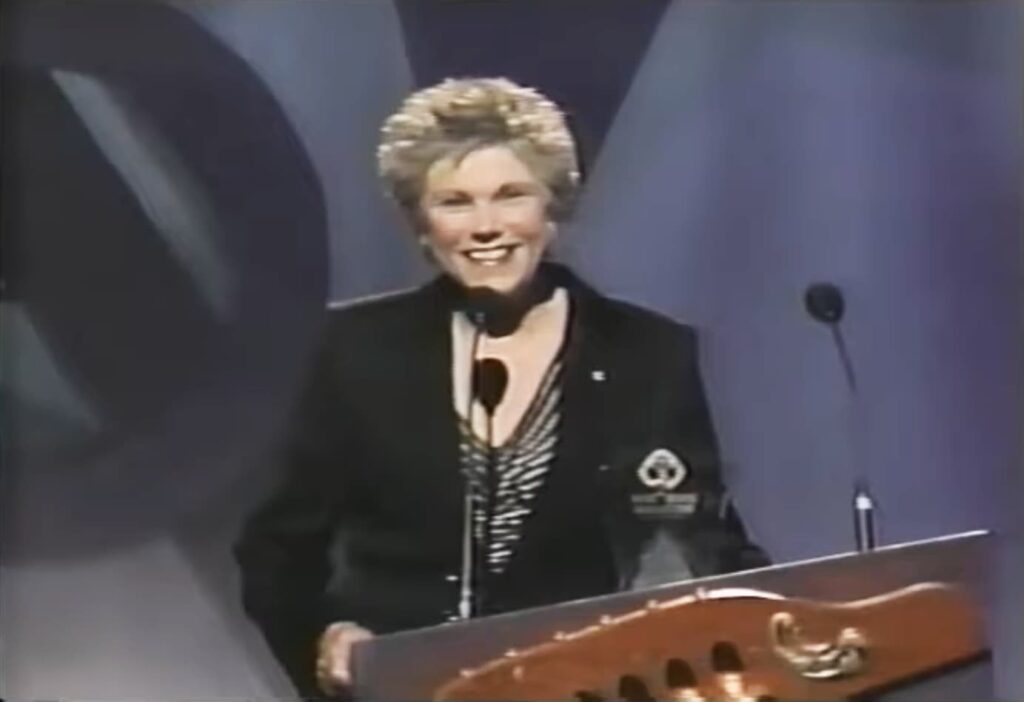
Anne Murray’s Hall of Fame Night Was Not About Awards. It Was About Gratitude, Humility, and a Journey That Changed Canadian Music Forever.
In September 2002, the Canadian country music community gathered to celebrate one of its most beloved voices. Yet for many watching Anne Murray step onto the stage to be inducted into the Canadian Country Music Hall of Fame, the overwhelming feeling was not surprise. It was gratitude.
In truth, many felt the honor had been overdue.
By the time she received the induction, Murray had already spent more than three decades shaping the sound of Canadian popular music. She had sold more than 40 million records worldwide, earned Grammy Awards, Juno Awards, platinum albums, and countless industry honors. Long before the international success of artists such as Shania Twain and Celine Dion, Anne Murray had proven that a performer from a small Canadian town could capture the hearts of audiences around the world.
The evening’s tribute traced that remarkable journey from Springhill, Nova Scotia, where Murray grew up as the only daughter among five brothers, to the world’s most prestigious concert halls. Viewers were reminded of the pivotal year of 1969, when “Snowbird” introduced her to a global audience and made her the first solo Canadian female artist to earn a gold record in the United States.
Today, that achievement may seem almost routine. At the time, it was groundbreaking.
Yet one of the most fascinating moments of the evening came not from the tribute itself, but from Murray’s acceptance speech. Standing before her peers, she revealed a little-known detail about her early musical ambitions.
As a teenager, she had not dreamed of becoming a country star.
Instead, she studied and performed Italian arias, German classical works, and French art songs. Her path seemed destined for the world of classical music. Few could have imagined that the young woman singing those sophisticated pieces would one day become one of the defining voices in country music history.
That revelation added another layer to an already remarkable story. Murray did not follow a predictable route to success. Her career became proof that talent, authenticity, and perseverance often matter more than fitting neatly into expectations.
Still, the moment many remember most fondly arrived shortly after she took the podium.
Following an introduction that celebrated decades of achievements, Murray smiled and delivered a line that immediately filled the room with laughter.
She admitted that she had expected to be retired by then, spending her days on a golf course somewhere. Instead, she joked, she had met manager Bruce Allen, who believed she should keep singing until she was ninety.
The remark perfectly captured the quality that had endeared her to audiences for so long. Despite extraordinary accomplishments, she never appeared interested in portraying herself as a legend.
That humility continued throughout her speech. Rather than focusing on awards or record sales, Murray thanked the people who had helped make her career possible: radio stations, songwriters, producers, record executives, band members, crew, friends, family, and fans. Success, she suggested, was never the work of one person alone.
The evening also included a touching moment when Murray offered her best wishes to fellow Canadian icon Gordon Lightfoot, who was recovering from health issues at the time. Looking back after Lightfoot’s passing in 2023, those words carry an added emotional weight.
What makes this Hall of Fame induction so memorable today is not the list of accomplishments. It is the contrast between how the industry viewed Anne Murray and how she viewed herself.
To the presenters, she was a national treasure, a pioneer, and a trailblazer.
To Anne Murray, she remained the same woman from Springhill who had simply been fortunate enough to spend her life singing songs she loved.
That rare combination of greatness and humility may be the true reason her legacy continues to endure. The Hall of Fame ceremony did not transform Anne Murray into a legend.
It simply gave Canadian music an opportunity to stand, applaud, and say thank you.