
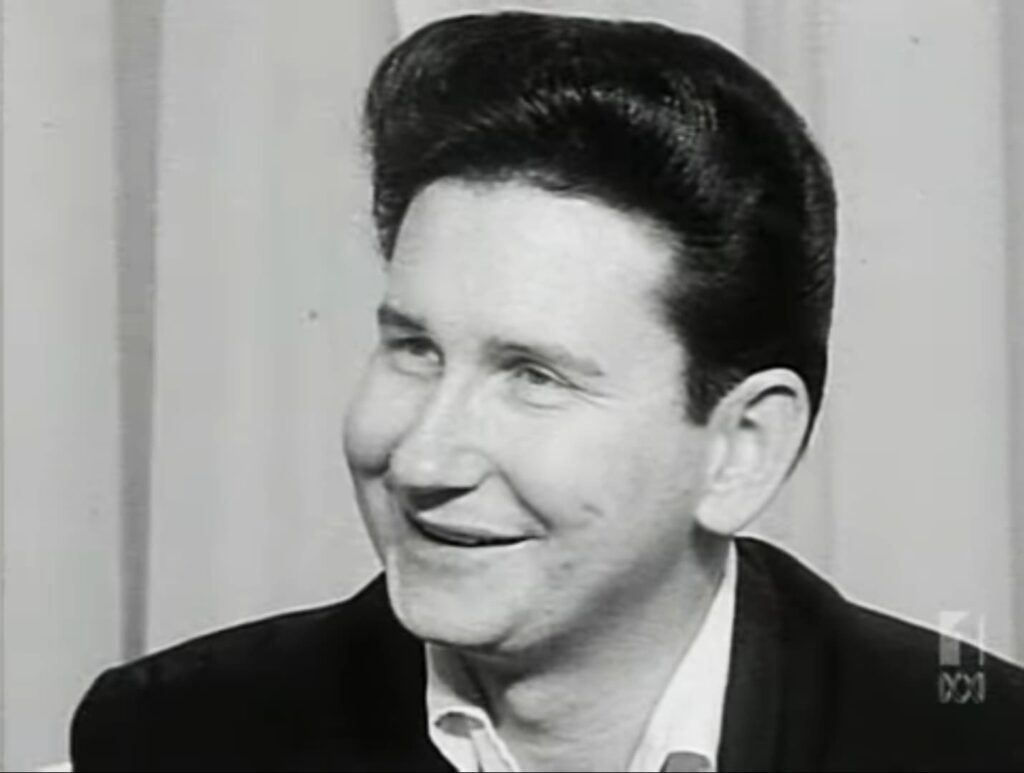
Most Fans Remember the Dark Glasses. This Rare 1965 Interview Reveals the Young Man Behind the Legend.
On January 1, 1965, Roy Orbison sat down for a television interview in Australia. More than sixty years later, the conversation remains fascinating for one simple reason.
He wasn’t wearing the dark sunglasses.
Today, it is almost impossible to separate Orbison from the image that became his trademark. The black glasses, the dark clothing, the mysterious stage presence, and that unforgettable voice have become part of popular music history. Yet in this rare television appearance, viewers see something entirely different.
A 28-year-old superstar at the height of his powers.
His eyes are visible. He smiles easily. He answers questions with a relaxed confidence that feels surprisingly ordinary for someone who had already become one of the biggest recording artists in the world.
By early 1965, Orbison’s career was soaring. In just a few years, he had transformed himself from a Texas singer-songwriter into an international phenomenon through classics such as “Only the Lonely,” “Running Scared,” “Crying,” “In Dreams,” and “Oh, Pretty Woman.”
The interviewer naturally wanted to know where Orbison saw himself among the giants of the music business.
His answer revealed much about his character.
Rather than ranking himself against other stars, Orbison explained that he focused on his own career and whether it was progressing well. Even after being told he had topped polls as the world’s number one male vocalist and male music personality, he seemed almost uncomfortable discussing his achievements.
That humility appears throughout the interview.
When asked about rivals, Orbison acknowledged the enormous popularity of The Beatles, while noting that a group operated in a different category from a solo performer. When speaking about individual artists, he mentioned Elvis Presley and Little Richard as the primary benchmarks of success.
For modern viewers, it is a fascinating snapshot of a unique moment in music history.
The British Invasion was reshaping popular music. The Beatles were conquering the world. Elvis remained a cultural giant. Yet Roy Orbison was standing comfortably among them, creating some of the most enduring recordings of the era.
Another memorable moment comes when the conversation turns unexpectedly personal.
Asked about his jet-black hair, Orbison laughs and reveals that the color is not entirely natural. He explains that his real hair color is closer to Elvis Presley’s when Presley was not using a rinse. It is the kind of ordinary, behind-the-scenes detail that fans rarely heard from major stars during that era.
The discussion of money is equally revealing.
Orbison estimates that he has sold roughly 18 million records and confirms that he has already earned his first million dollars. Yet even then, he immediately softens the statement with a joke, saying the money exists mostly on paper because nobody has actually handed it to him yet.
It is classic Roy Orbison.
Successful beyond imagination, but never boastful.
Watching this interview today carries an added emotional weight. Modern viewers know things that Orbison could not possibly have known in January 1965. He was standing at one of the happiest and most successful moments of his career. The tragedies that would later touch his personal life were still in the future. The challenges that changing musical trends would bring had not yet fully arrived.
What remains on screen is a young artist filled with optimism, enjoying extraordinary success while remaining remarkably grounded.
Perhaps that is what makes this interview so special.
Not the statistics.
Not the record sales.
Not even the rare sight of Roy Orbison without his famous sunglasses.
It is the opportunity to meet the man behind the legend for a few brief minutes and discover that beneath one of the greatest voices in popular music was a humble young Texan who never seemed entirely convinced that he was a superstar.